Box Jump
The first-choice entry to plyometrics — the box jump teaches fast force production and coordinated landing, a cornerstone of jump training. Face the box, dip quickly, explode up, land softly with both feet on the box. Step down rather than jumping down to protect the Achilles.
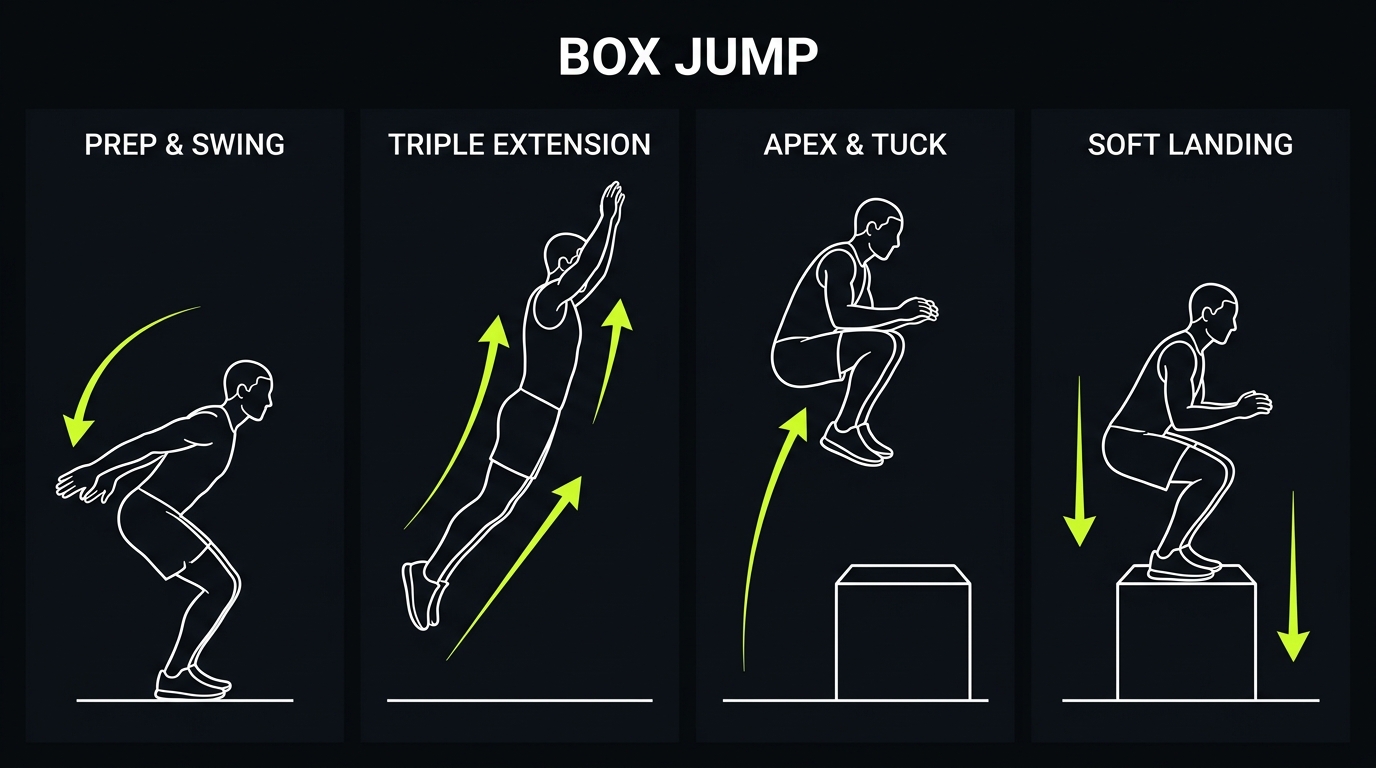
Coaching cues
- 1.Countermovement is shallower than a squat — about 1/4 squat
- 2.Swing the arms hard for extra momentum
- 3.Quieter landings are better landings
- 4.Start low (30-45cm) and progress gradually
- 5.Rest 2-3 min between sets
Detailed training method
Related calculators
Related exercises
Depth Drop
The preparatory exercise for depth jumps — the depth drop teaches safe, efficient absorption of landing impact (eccentric strength), laying the safety foundation for explosive rebounds
Single-Leg Landing Control
The safety prerequisite for every single-leg jump — step off a low box or hop forward, land on one leg, and stick the landing for 2 seconds
Shallow Depth Jump
A transition between depth drops and depth jumps — step off a low box, absorb the landing, then quickly rebound from a shallow squat, training the absorb-to-redrive transition
Related articles
How Long Until You See Results From Jump Training?
A realistic vertical jump improvement timeline: what changes at 2, 4, 8 and 12 weeks, and why starting level, training quality and recovery decide the pace.
How Many Jump Training Sessions Per Week Do You Actually Need?
Training frequency by experience level, safe plyometric contact volume, and the warning signs that tell you to cut back.
How to Split Strength and Plyometric Training
Combined strength and plyometric training beats either alone. Here are the phase ratios, same-day ordering rules and common mistakes.
What Is Plyometrics? A Safe Starting Guide
The stretch-shortening cycle explained, fast vs slow SSC, the NSCA entry criteria and low-intensity progressions for beginners.
How to Count and Control Plyometric Contacts
Foot contacts are the real volume unit for plyometrics. Learn weekly volume by level, session math and the monitoring rules that keep jumps fast.
CMJ vs Squat Jump: The Simplest Jump Bottleneck Test
The difference between your countermovement jump and squat jump reveals whether strength or elastic use is your limiting factor.
How Deep Should the Countermovement Be in a CMJ?
Deeper is not better. Research points to a natural, fluid dip around 90–100° of knee flexion — and speed matters more than depth.
Why Am I Not Improving at Jumping? The 5 Real Causes
Trained for months with no jump gains? The five most common causes of a vertical jump plateau — programming, load management, technique, recovery and measurement — and a simple test to find which one is yours.
How Fast Do You Lose Your Jump? The Detraining Timeline
One week off barely costs anything. Eight weeks off costs a lot — but muscle memory brings it back faster than you think.
Can You Do Plyometrics Every Day? (No — Here's Why)
The nervous system needs 48–72 hours to recover from high-intensity stretch-shortening work. Here is how to schedule it correctly.
How to Track Jump Progress Scientifically
One standard test, fixed conditions, weekly frequency and the smallest worthwhile change — the protocol that turns jump data into decisions.
Does Jump Training Stunt Growth or Make You Shorter?
No scientific evidence shows strength or plyometric training stunts height. The international consensus says youth training is safe and beneficial.
Will Jump Training Make Your Calves and Thighs Bulky?
Jump training's parameters favor neural adaptation and power, not size. Here is why the bulk fear is mostly unfounded.
How to Maintain Your Jump During the Season
In-season training is about the minimum effective dose: keep intensity, cut volume, monitor weekly and never chase PRs.
How to Know Whether to Add Weight or Volume
Progressive overload is the engine — but one variable at a time. Here is the double progression rule for strength and the contact rule for plyometrics.
Nervous on Test Day? How to Perform Under Pressure
Test anxiety is physiological over-activation — and it responds to simulation, routines, breath control and reframing.
Strength Deficit vs Velocity Deficit: Which One Is Limiting Your Jump?
Two athletes can jump the same height for opposite reasons. Learn to tell a strength deficit from a velocity deficit, and train the right bottleneck.
BounceLab vs My Jump, Vert Shock and JumpKit: How to Choose
A practical comparison of assessment-first training with BounceLab, measurement apps like My Jump, fixed programs like Vert Shock, and jump-testing hardware like JumpKit.