How Deep Should the Countermovement Be in a CMJ?
Deeper is not better. Research points to a natural, fluid dip around 90–100° of knee flexion — and speed matters more than depth.
Athletes obsess over countermovement depth as if deeper automatically meant higher. The research says the opposite: there is an optimal range, and your self-selected depth is usually close to it.
Depth matters less than speed and fluidity: a fast, natural dip around 90–100° outperforms both shallow and exaggerated sinking.
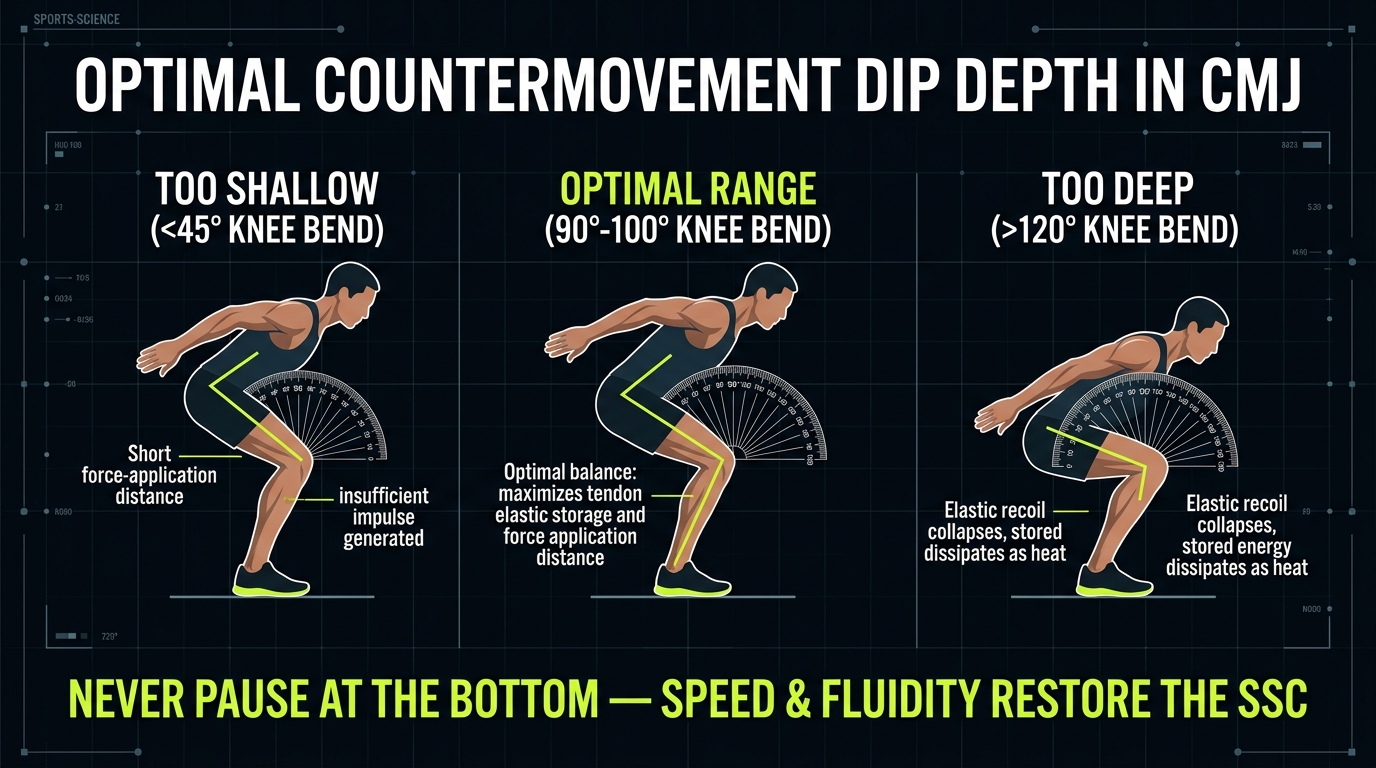
The optimal range
Most athletes naturally dip to around 90–100° of knee flexion — and research suggests this is near-optimal. A fast, fluid dip in that range maximizes elastic storage without sacrificing force application.
Too shallow vs too deep
Both ends of the range cost you height, for different reasons:
- Too shallow (under ~45°): shorter force application means less impulse.
- Too deep (over ~120°): elastic energy storage efficiency drops and some energy dissipates as heat.
How to check yours
Film yourself from the side. Look for two things: an unnatural pause at the bottom, and excessive sinking. If neither is present, stop micromanaging the depth and train the jump.
The mechanics of depth
A deeper dip lengthens force application, which increases impulse — but beyond roughly 120° of knee flexion, elastic energy storage efficiency drops and more energy dissipates as heat. A shallow dip under ~45° shortens force application and loses impulse.
The optimum is where those two curves balance, which is why most athletes naturally select something close to 90–100°.
The pause problem
A pause at the bottom converts a CMJ into a squat jump: the stretch-shortening cycle is interrupted and the elastic contribution disappears. Athletes develop pauses under fatigue or when they overthink depth.
If video shows a pause, cue 'rebound immediately' rather than changing depth — speed is the variable that restores the SSC.
How to fix yours
A two-week correction protocol:
- Film a side view of three CMJ attempts.
- Check for a pause at the bottom and depth outside the 45–120° band.
- If paused → cue 'rebound immediately'; keep depth unchanged.
- If too deep or shallow → cue 'quicker, shorter dip' and re-film.
- Re-test height after two weeks and keep what worked.
Key takeaways
- A natural dip around 90–100° is near-optimal for most athletes.
- Too shallow costs impulse; too deep costs elastic efficiency.
- A pause at the bottom turns the CMJ into an SJ — keep the transition fast.
- Speed of the dip beats depth in the research.
- Film yourself: a pause at the bottom is the most common fixable fault.
Related calculators
References
- Bobbert et al. (1996) Med Sci Sports Exerc
- Van Hooren & Zolotarjova (2017) Sports Med
- PubMed: The difference between CMJ and SJ — mechanisms review (2017)
Keep reading
TECHNIQUE
Arm Swing in the Vertical Jump: How Much Does It Matter?
The arm swing contributes 10–15% of jump height. Here is how it works mechanically and how to time it correctly.
TECHNIQUE
Approach Jump Technique: The Three Cues That Matter
Penultimate step, block step and takeoff — the three phases that turn horizontal speed into vertical height, with the common approach-jump mistakes that kill distance and how to fix them.
TECHNIQUE
Single-Leg vs Double-Leg Jumps: Which Should You Train?
Two-leg jumps build symmetric force; one-leg jumps build horizontal-to-vertical conversion. Most athletes need both.