TRAINING GUIDE
How to Measure Your Vertical Jump: Testing & Assessment Guide
The clean test protocol for CMJ and SJ, the F-V profile, reactive strength, supporting metrics and the smallest worthwhile change.
Testing is how training stops being a guess. The right measurements tell you whether strength, speed or elasticity is the bottleneck — and whether your program is actually working.
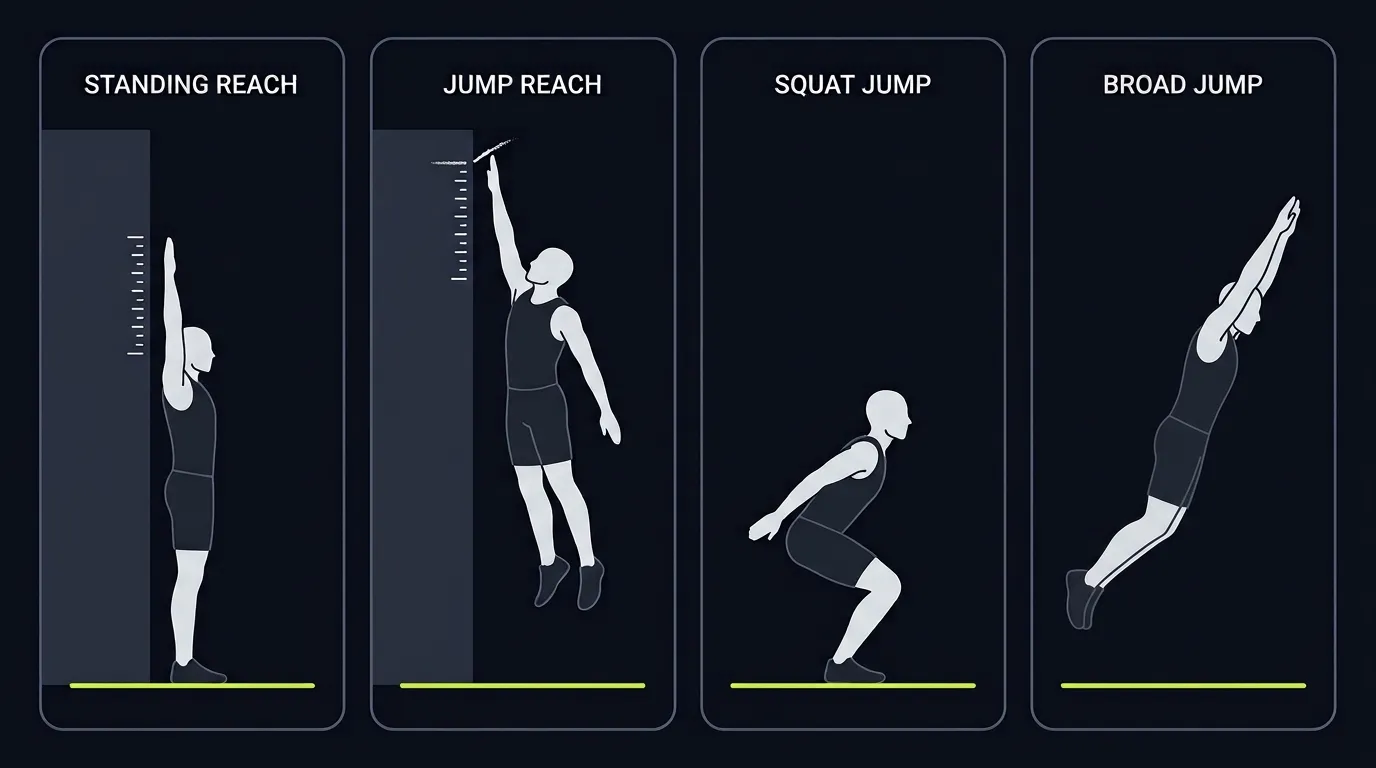
Why testing beats guessing
A plateau can mean a weak program, a measurement artifact or a recovery problem. A standardized test separates those explanations in minutes.
CMJ vs SJ
The squat jump measures pure concentric strength from a static half-squat. The countermovement jump adds the SSC contribution. A normal gap is 10–20% of CMJ: a larger gap means train strength, a smaller gap means train plyometrics.
A clean test protocol
Make every comparison valid:
- Same day, time, shoes, surface and warm-up.
- Best of three attempts with 2–3 minutes rest.
- Same arm rule for both jumps (hands on hips or free swing).
- Judge trends over weeks, not single days.
The F-V profile
Once your squat is at least 1.5x bodyweight, an F-V profile estimates max force (F₀), max velocity (V₀), the balance (Sfv) and peak power (Pmax). A deviation over 40% from optimal responds to targeted strength or speed work by 15–30%.
Note: BounceLab's in-app assessment uses a simplified strength-adjusted jump index (CMJ vs an expected value based on relative squat). A true F-V profile requires SJ testing under multiple loads.
Tracking with the smallest worthwhile change
For trained athletes, only changes beyond roughly 1–2 cm (2–5% of CMJ) are real. A consistent shift across 4–6 weeks beats a single impressive test.
Supporting metrics
Add a monthly squat 1RM, 10 m/30 m sprints and the Reactive Strength Index (jump height ÷ contact time in depth jumps). Together they explain whether a jump change is strength-driven, speed-driven or elastic-driven.
How often to test
Weekly for your anchor CMJ, monthly for the profile and strength metrics, and once per 8–12 week cycle for the F-V profile. More frequent testing of slowly changing variables only adds noise.
Key takeaways
- CMJ−SJ gap is the cheapest bottleneck diagnostic.
- Fix the protocol before you trust the number.
- Only changes beyond 1–2 cm are real.
- F-V profile needs a 1.5x squat first.
- Weekly anchor test + monthly strength/profile metrics.
References
- Van Hooren & Zolotarjova (2017) Sports Med
- Hopkins (2000) Sports Med
- Claudino et al. (2017) Sports Med
- Jiménez-Reyes et al. (2017) Scand J Med Sci Sports
Related articles
CMJ vs Squat Jump: The Simplest Jump Bottleneck Test
The difference between your countermovement jump and squat jump reveals whether strength or elastic use is your limiting factor.
The Force-Velocity Profile: What It Is and Whether You Need It
The F-V profile tells you whether strength or speed is your bottleneck — and when you are not ready for it yet.
How to Track Jump Progress Scientifically
One standard test, fixed conditions, weekly frequency and the smallest worthwhile change — the protocol that turns jump data into decisions.
Which Training Gives the Most Jump Per Hour?
The ROI ranking: foundational strength first, then power conversion, depth jumps, technique — and supplements last.
Key exercises
Box Jump
The first-choice entry to plyometrics — the box jump teaches fast force production and coordinated landing, a cornerstone of jump training
Depth Jump
The gold-standard jump exercise — the depth jump maximizes SSC (stretch-shortening cycle) use, directly raising reactive strength and jump height
Standing Broad Jump
The most natural horizontal power test — it directly reflects lower-body drive and correlates highly with vertical jump height