Depth Jump
The gold-standard jump exercise — the depth jump maximizes SSC (stretch-shortening cycle) use, directly raising reactive strength and jump height. Step (don't jump) off a box, and the instant you land, jump up as high as possible with the shortest contact time. Shorter contact + higher rebound = greater jump potential.
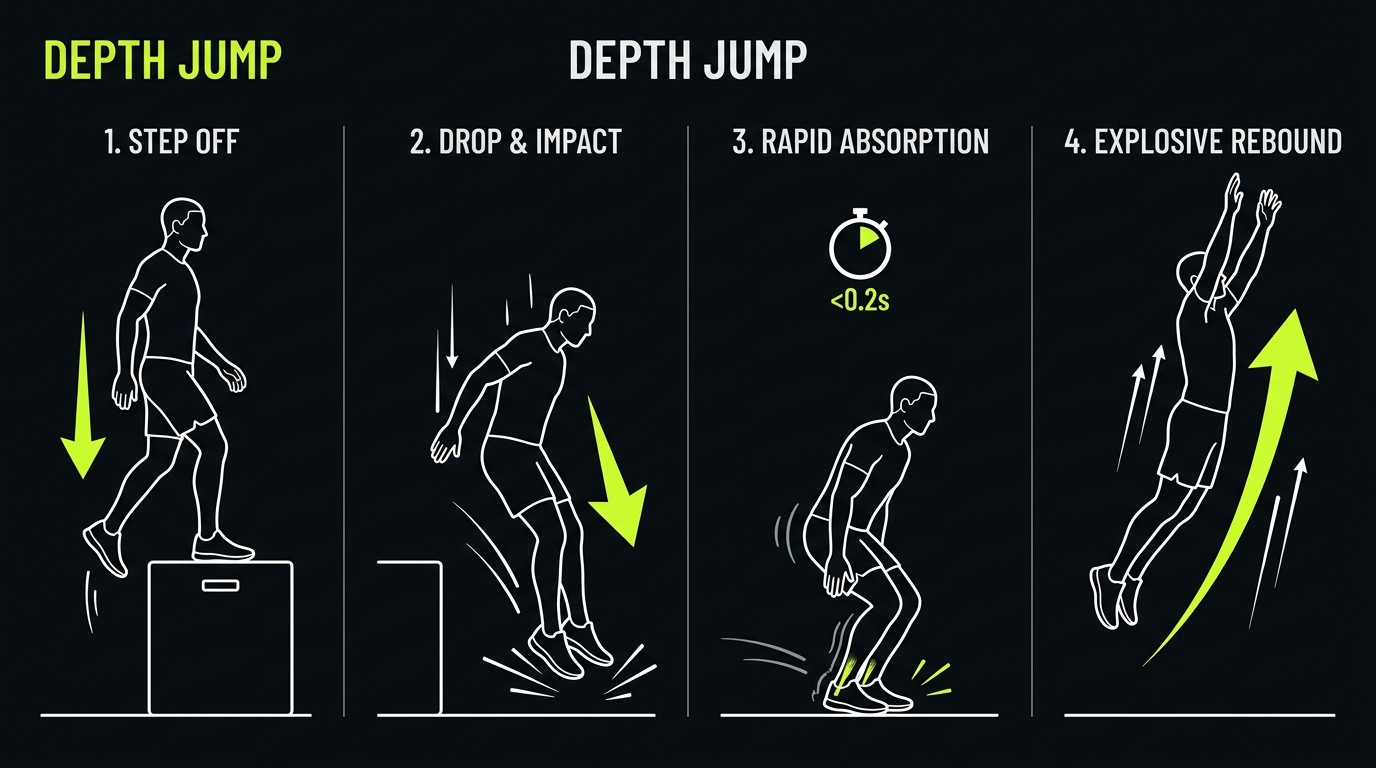
Coaching cues
- 1.Step off the box — don't jump — to avoid pre-activation
- 2.Rebound the instant you land — imagine the floor is a hot plate
- 3.Ground contact 150-250ms is excellent; 250-350ms acceptable — prioritize RSI quality
- 4.Landing posture identical to takeoff posture
- 5.Find your individual optimal drop height via RSI testing (typical 20-40cm) — don't just add height weekly
- 6.Rest 3-5 min between sets
Detailed training method
Caution with Achilles/patellar history; needs 3+ months of systematic strength base; use a cushioned landing surface
Related calculators
Related exercises
Box Jump
The first-choice entry to plyometrics — the box jump teaches fast force production and coordinated landing, a cornerstone of jump training
Depth Drop
The preparatory exercise for depth jumps — the depth drop teaches safe, efficient absorption of landing impact (eccentric strength), laying the safety foundation for explosive rebounds
Single-Leg Landing Control
The safety prerequisite for every single-leg jump — step off a low box or hop forward, land on one leg, and stick the landing for 2 seconds
Related articles
Depth Jump Technique: The Complete Guide
Box height, step-off vs jump-off, contact time, rebound direction and the common errors that turn depth jumps from a power tool into a injury risk.
How to Count and Control Plyometric Contacts
Foot contacts are the real volume unit for plyometrics. Learn weekly volume by level, session math and the monitoring rules that keep jumps fast.
Why Am I Not Improving at Jumping? The 5 Real Causes
Trained for months with no jump gains? The five most common causes of a vertical jump plateau — programming, load management, technique, recovery and measurement — and a simple test to find which one is yours.
Rest Intervals for Jump Training: The Complete Guide
Rest length changes what a set actually trains. Here are the exact intervals for strength, power, hypertrophy and rehab work.
Can You Do Plyometrics Every Day? (No — Here's Why)
The nervous system needs 48–72 hours to recover from high-intensity stretch-shortening work. Here is how to schedule it correctly.
How to Track Jump Progress Scientifically
One standard test, fixed conditions, weekly frequency and the smallest worthwhile change — the protocol that turns jump data into decisions.
Which Training Gives the Most Jump Per Hour?
The ROI ranking: foundational strength first, then power conversion, depth jumps, technique — and supplements last.
Is Jump Height Genetic? (Can It Be Trained?)
Genetics explain roughly 40–80% of jump variance depending on the population — which means training and environment explain the rest.
How to Design a Full Jump-Training Macrocycle
The 12–16 week structure: base adaptation, max strength, power conversion, then peak and test. With RPE and volume targets for each phase.
How to Know Whether to Add Weight or Volume
Progressive overload is the engine — but one variable at a time. Here is the double progression rule for strength and the contact rule for plyometrics.