How to Design a Full Jump-Training Macrocycle
The 12–16 week structure: base adaptation, max strength, power conversion, then peak and test. With RPE and volume targets for each phase.
A macrocycle gives jumping a direction: tolerance first, strength second, power third, peak last. Here is the 12–16 week template used in the BounceLab knowledge base.
A macrocycle is a decision framework, not a fixed calendar: each mesocycle answers one question — can I tolerate it, can I get stronger, can I convert it, can I peak it?
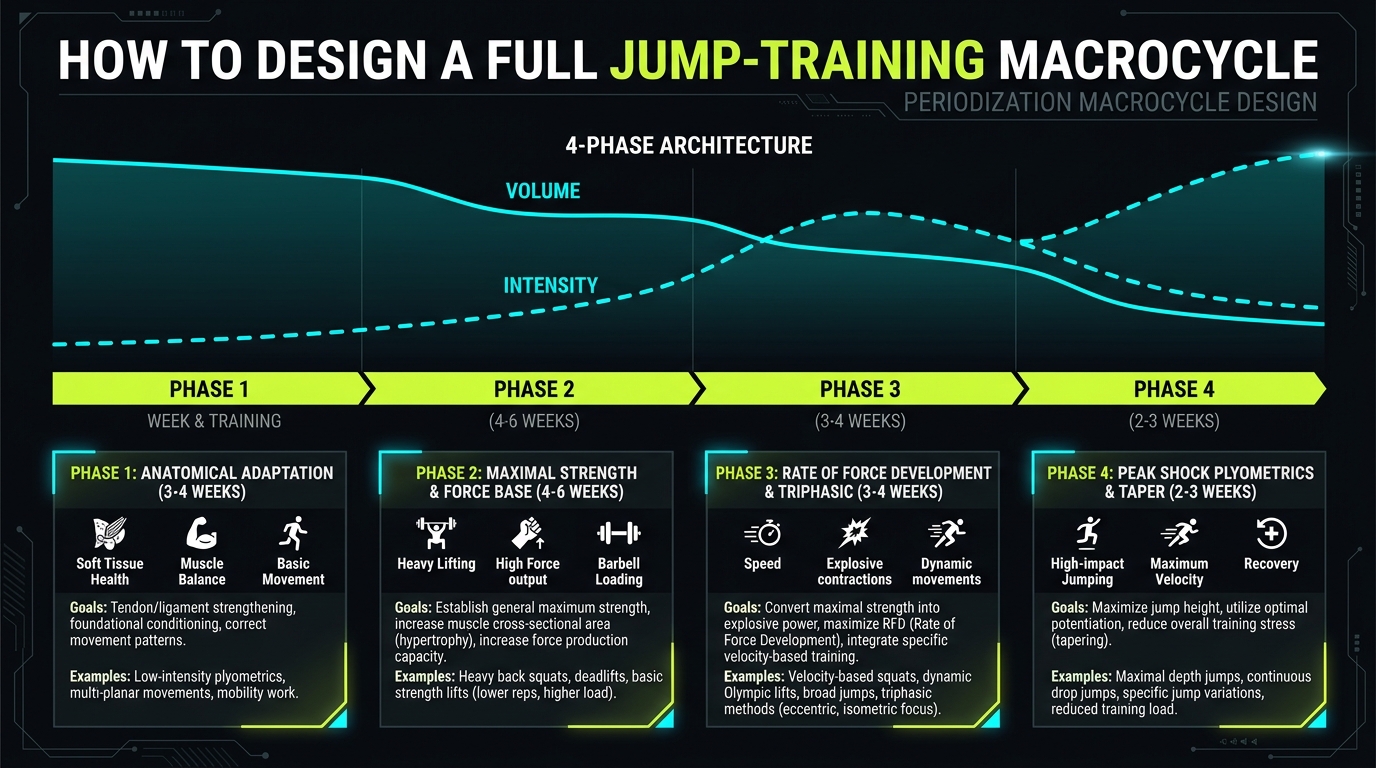
The four mesocycles
The classic structure:
- Weeks 1–4 (base adaptation / GPP): build tolerance and movement patterns with goblet squats, bodyweight single-leg work, low-intensity plyometrics and core. RPE 6–7.
- Weeks 5–8 (max strength / SPP1): raise lower-body 1RMs with full squats, deadlifts, Bulgarian split squats and weighted hip thrusts; plyometrics stay low-volume. RPE 8–9, low reps.
- Weeks 9–12 (power conversion / SPP2): turn strength into power with quarter squats, loaded jumps, depth jumps, hurdle hops, high box jumps and sprints; strength is maintenance only. RPE 7–8.
- Weeks 13–14 (peak/testing): high-intensity low-volume plyometrics, technique work and lots of rest; volume drops to 50–60%.
Close the loop
Weeks 15–16 are a deload and active recovery phase, then re-test and start the next cycle. The macrocycle only works if the test results feed the next block's emphasis.
Why four phases, in this order
Tolerance comes first because you cannot load what you cannot recover from. Strength comes before power because conversion needs a reserve to convert. Power comes before the peak because competition demands the expression, not the base. This is the ordering logic of periodization theory, not a tradition.
Choosing exercises per phase
Each phase has a signature exercise menu:
- GPP (weeks 1–4): goblet squats, bodyweight single-leg work, low-intensity plyometrics, core.
- SPP1 (weeks 5–8): full squats, deadlifts, Bulgarian split squats, weighted hip thrusts.
- SPP2 (weeks 9–12): quarter squats, loaded jumps, depth jumps, hurdle hops, sprints.
- Peak (weeks 13–14): low-volume high-intensity plyometrics and technique work.
Re-testing and adjusting the next cycle
After the deload, re-test CMJ, squat 1RM and approach reach with the same protocol used at the start. The next block's emphasis — strength, conversion or technique — should come from the deficits those numbers show, not from repeating the previous template.
Key takeaways
- Base → strength → power → peak, in that order.
- RPE 6–7 early, 8–9 in the strength phase, 7–8 in conversion.
- Test after the deload — that is when PRs show up.
- Each mesocycle answers one question — do not mix their goals.
- The next cycle starts with the data from the last one.
Related calculators
References
- Bompa & Buzzichelli (2019) Periodization (6th ed.)
- Verkhoshansky & Siff (2009) Supertraining, Ch. 7
- NSCA Essentials of Strength Training and Conditioning (4th ed.), Ch. 21
- PubMed: Periodization and vertical jump performance
Keep reading
PERIODIZATION
How to Do a Deload Week (Without Losing Progress)
The three ways to deload, how often, and why performance often peaks the week after a deload — not during the hardest training.
PERIODIZATION
How to Maintain Your Jump During the Season
In-season training is about the minimum effective dose: keep intensity, cut volume, monitor weekly and never chase PRs.
PERIODIZATION
How to Know Whether to Add Weight or Volume
Progressive overload is the engine — but one variable at a time. Here is the double progression rule for strength and the contact rule for plyometrics.
Related exercises
Barbell Back Squat
The king of strength training and an irreplaceable foundation movement for jump training
Power Clean
Pull the bar explosively from the floor to the front shoulders (caught in a quarter squat)
Depth Jump
The gold-standard jump exercise — the depth jump maximizes SSC (stretch-shortening cycle) use, directly raising reactive strength and jump height