How to Know Whether to Add Weight or Volume
Progressive overload is the engine — but one variable at a time. Here is the double progression rule for strength and the contact rule for plyometrics.
Progressive overload is what makes training work — but adding weight and volume at the same time is how programs fall apart. The rule is one variable at a time.
Progressive overload is only useful when it is dosed: one variable at a time, with a rule for when to push and when to back off.
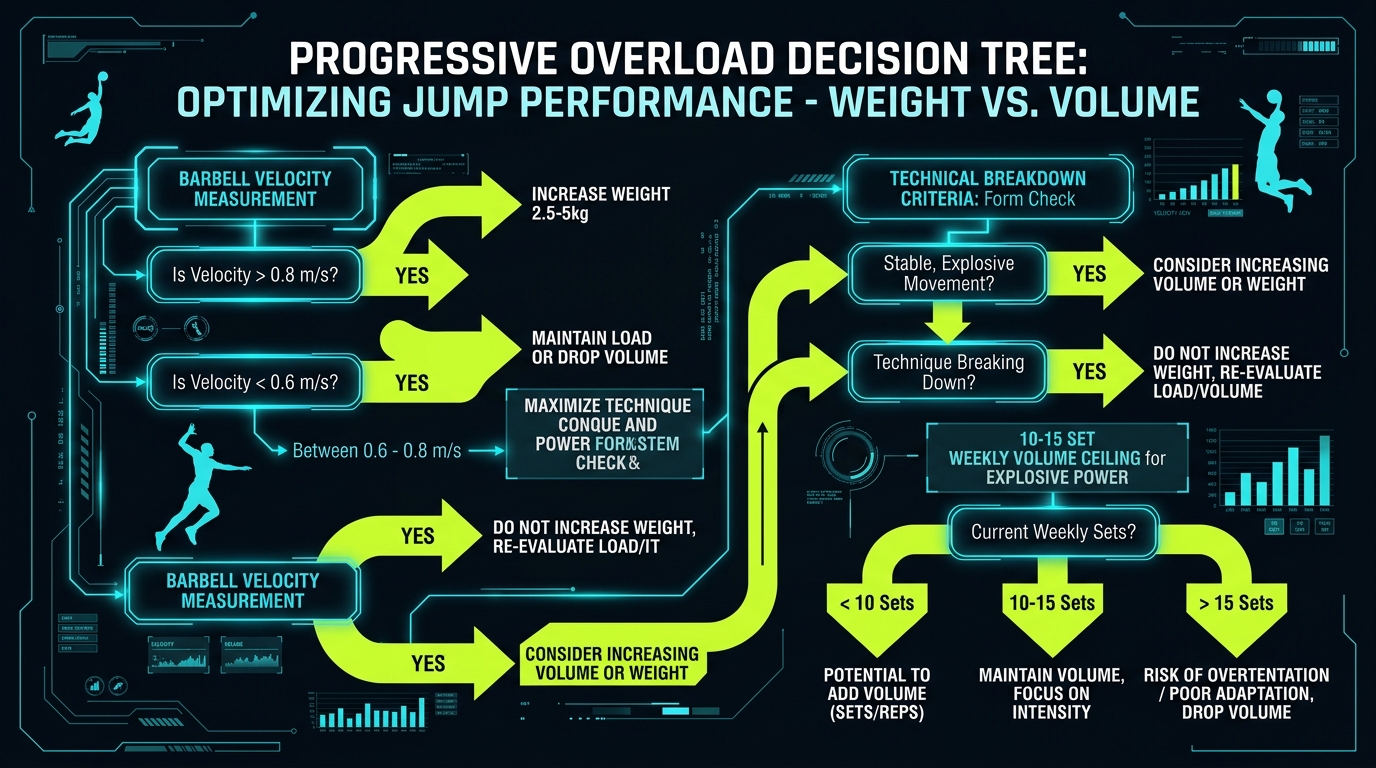
Strength: add weight first
When you complete the target sets and reps with 1–2 reps in reserve, add 2.5–5% next week for lower-body lifts. Use double progression: add reps first (3×5 → 3×6 → 3×7), then jump back to low reps with more weight. If technique degrades, refine form instead of adding load.
Plyometrics: height and quality first
Add height or distance before adding sets, and increase weekly contacts by no more than 10%. If jump height drops more than 5% or landings get loud, prioritize recovery — not more volume.
The failure rule
Never change volume and intensity at the same time. If you fail the target twice in a row, deload. A training log is the best guide — decide with data, not feelings.
The double progression in detail
For strength, add reps first: 3×5 becomes 3×6, then 3×7. Only then add 2.5–5% of load and reset the reps down. This keeps technique intact while guaranteeing progressive overload.
If technique breaks before the rep target is reached, the weight is too heavy for the movement — refine form before adding anything.
The plyometric progression
For plyometrics, add height or distance before adding sets, and increase weekly contacts by no more than 10%. The gates are performance and technique: if jump height drops more than 5% or landings get loud, recover before adding volume.
Rules for deciding with data
A compact decision list for every session:
- Completed target with 1–2 reps in reserve → add next week.
- Failed the target twice in a row → deload.
- Technique degraded → refine form before adding load.
- CMJ dropped more than 5% → prioritize recovery, not volume.
Key takeaways
- Strength: reps first, weight second, one variable at a time.
- Plyometrics: height first, contacts second, +10% per week max.
- Two consecutive failures means deload.
- Add reps before weight; add height before contacts.
- Two failed sessions in a row is a deload signal, not a grind signal.
Related calculators
References
- NSCA Essentials of Strength Training and Conditioning (4th ed.), Ch. 15
- Bompa & Buzzichelli (2019) Periodization, Ch. 5
- PubMed: Progressive overload in resistance training
Keep reading
PERIODIZATION
How to Design a Full Jump-Training Macrocycle
The 12–16 week structure: base adaptation, max strength, power conversion, then peak and test. With RPE and volume targets for each phase.
PERIODIZATION
How to Do a Deload Week (Without Losing Progress)
The three ways to deload, how often, and why performance often peaks the week after a deload — not during the hardest training.
PERIODIZATION
How to Maintain Your Jump During the Season
In-season training is about the minimum effective dose: keep intensity, cut volume, monitor weekly and never chase PRs.
Related exercises
Barbell Back Squat
The king of strength training and an irreplaceable foundation movement for jump training
Depth Jump
The gold-standard jump exercise — the depth jump maximizes SSC (stretch-shortening cycle) use, directly raising reactive strength and jump height
Box Jump
The first-choice entry to plyometrics — the box jump teaches fast force production and coordinated landing, a cornerstone of jump training