Barbell Back Squat
The king of strength training and an irreplaceable foundation movement for jump training. Building lower-body extension strength directly raises ground reaction force and transfers best to CMJ. Place the bar on the upper traps (high bar) or rear delts (low bar), squat down until the thighs are at least parallel, then drive up. High bar biases quads; low bar biases the posterior chain.
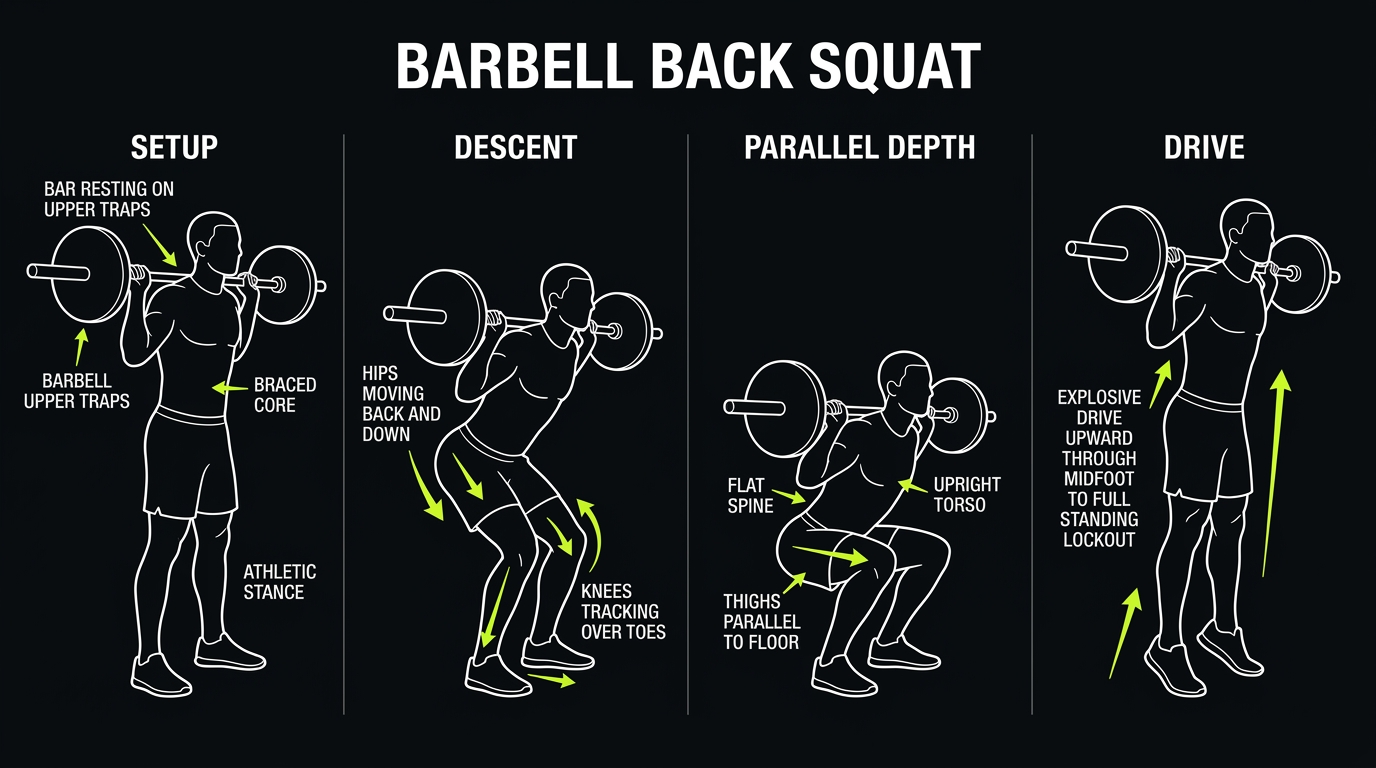
Coaching cues
- 1.Feet shoulder-width, toes slightly out
- 2.Hips back first, then knees — keep the torso rigid
- 3.Knees track over toes — don't let them cave in
- 4.Brief pause at the bottom, then explode up
- 5.Core braced and back flat throughout
Detailed training method
Athletes with knee issues can substitute box squats; lower-back problems can use front squats to reduce spinal load
Related calculators
Related exercises
Goblet Squat
The best first squat for jumping — the goblet squat teaches the correct pattern (upright torso, braced core) as a foundation for barbell squats and jumping
Pause Squat
A back-squat variation with a 3-second hold at the bottom — the pause removes bounce and momentum, forcing controlled depth and strength from a dead stop
Barbell Front Squat
With the bar on the clavicles and front delts and elbows high, squat with a more upright torso
Related articles
How Long Until You See Results From Jump Training?
A realistic vertical jump improvement timeline: what changes at 2, 4, 8 and 12 weeks, and why starting level, training quality and recovery decide the pace.
How to Break a Jump Training Plateau
A plateau means the body has adapted to the current stimulus. Diagnose the weak link, change the variables, deload and fix recovery.
How Deep Should You Squat to Jump Higher?
Full, half and quarter squats each have a role in jump training. Here is how to periodize squat depth instead of choosing one forever.
Why Am I Not Improving at Jumping? The 5 Real Causes
Trained for months with no jump gains? The five most common causes of a vertical jump plateau — programming, load management, technique, recovery and measurement — and a simple test to find which one is yours.
How Fast Do You Lose Your Jump? The Detraining Timeline
One week off barely costs anything. Eight weeks off costs a lot — but muscle memory brings it back faster than you think.
Rest Intervals for Jump Training: The Complete Guide
Rest length changes what a set actually trains. Here are the exact intervals for strength, power, hypertrophy and rehab work.
How Much Do Height, Weight and Skeleton Matter for Jumping?
Training level explains 60–80% of jump performance. Height matters far less than relative strength and body composition.
What Bodyweight Is Best for Jumping? (And Should You Cut?)
The answer is relative strength, not a scale number. Here is the math that decides whether you should lose fat or build strength first.
Which Training Gives the Most Jump Per Hour?
The ROI ranking: foundational strength first, then power conversion, depth jumps, technique — and supplements last.
Should Knees Never Pass the Toes? A Myth Explained
Banning forward knee travel is over-generalized, non-specific and can even increase lumbar shear. Here is what to actually watch.
How to Design a Full Jump-Training Macrocycle
The 12–16 week structure: base adaptation, max strength, power conversion, then peak and test. With RPE and volume targets for each phase.
How to Know Whether to Add Weight or Volume
Progressive overload is the engine — but one variable at a time. Here is the double progression rule for strength and the contact rule for plyometrics.
Strength Deficit vs Velocity Deficit: Which One Is Limiting Your Jump?
Two athletes can jump the same height for opposite reasons. Learn to tell a strength deficit from a velocity deficit, and train the right bottleneck.