Strength Deficit vs Velocity Deficit: Which One Is Limiting Your Jump?
Two athletes can jump the same height for opposite reasons. Learn to tell a strength deficit from a velocity deficit, and train the right bottleneck.
A strength deficit means your force output is high relative to your jump expression; a velocity deficit means you can jump quickly but lack the force reserve behind that speed. They require opposite training priorities, which is why guessing is expensive.
You do not always need a lab force-velocity profile to tell them apart. BounceLab uses a simplified strength-adjusted jump index, and this guide shows the same logic with free field tests.
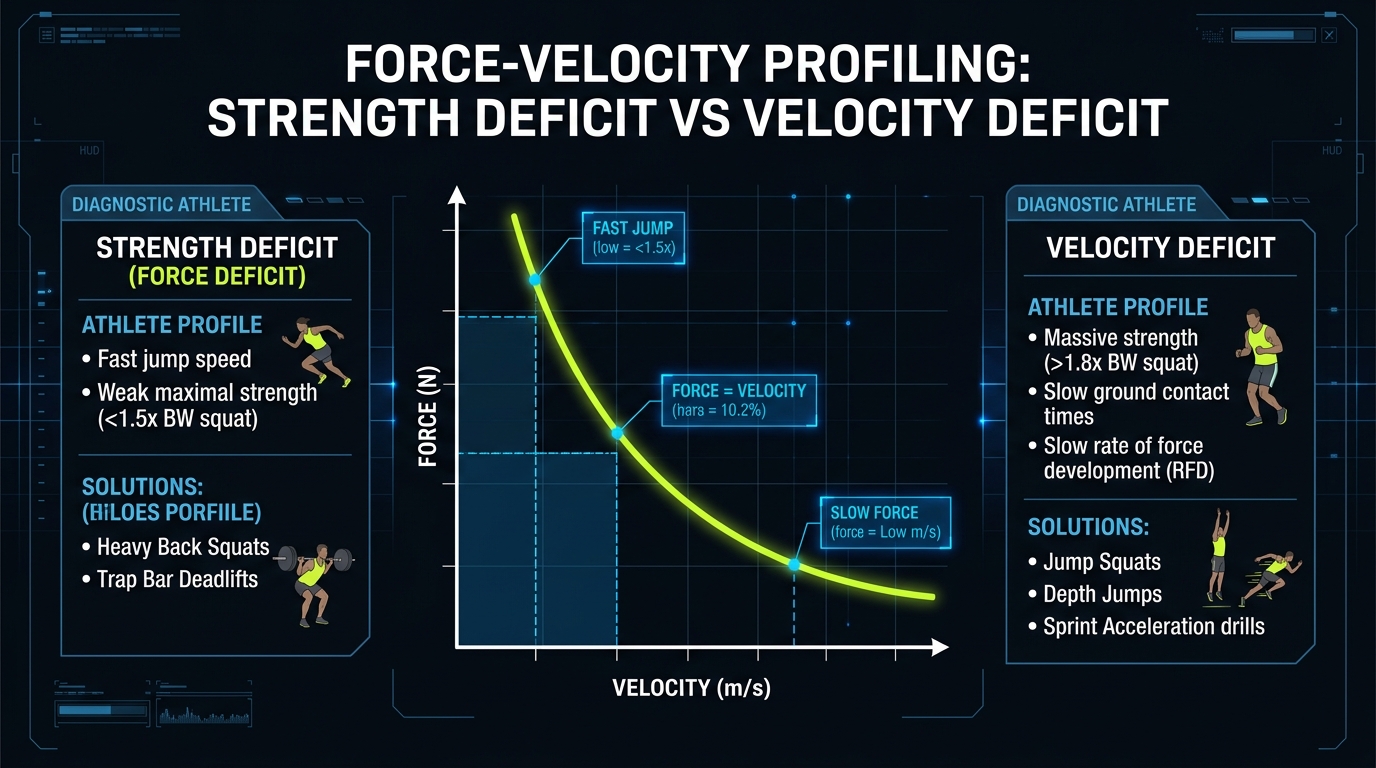
The two bottlenecks
A strength deficit (sometimes called a force deficit) describes an athlete whose jump is already efficient but whose maximum-force reserve is low. A velocity deficit describes the opposite: plenty of strength, but not enough speed of force development to use it during the 150–300ms ground contact of a jump.
The BounceLab proxy
BounceLab compares your CMJ with the height expected from your relative squat (a coaching heuristic, not a full Samozino profile). If your jump is clearly above that expected value, you have a strength deficit. If your jump is clearly below it, you have a strength surplus — the conversion/velocity side is the bottleneck.
This is intentionally simpler than a multi-load F-V profile. Use it as a directional screen, not a lab verdict.
Free field-test shortcuts
If you do not have a force plate or a 1RM test handy, combine these signals:
- CMJ−SJ gap: a large gap means good elastic/reactive use; a small gap means reactive/conversion work deserves attention.
- Relative squat: below roughly 1.3–1.5× bodyweight, strength is usually the first ceiling to raise.
- Loaded jump speed: if jump height drops more than expected when a light load is added, strength reserve is often the issue.
- Sprint/jump mismatch: a fast 30m time with a modest vertical jump points toward force production, while a high jump with a slow sprint often points toward RFD work.
How to train a strength deficit
Prioritize heavy lower-body strength for 2–3 sessions per week: back squat, trap-bar deadlift, Bulgarian split squat and hip thrust. Keep plyometrics low-volume and low-impact so they stay fresh while strength rises.
Re-test relative squat and CMJ together every 4–6 weeks. When CMJ is no longer running ahead of strength, the deficit is closing.
How to train a velocity deficit
Keep strength maintenance at 1–2 sessions per week and shift volume toward jump squats at light loads, box jumps, short ground-contact hurdle hops, depth jumps for advanced athletes, and short sprints.
The goal is faster force expression, not more maximum strength. Use rest long enough that every jump is maximal.
When the profile says balanced
A balanced profile means strength and jump output track each other. Train both qualities together with a periodized strength-to-power block, and spend the remaining energy on technique and recovery instead of chasing one side.
Key takeaways
- Strength deficit: jump expression is ahead of force reserve — train heavy strength first.
- Velocity deficit: strength is there but force is too slow — train RFD and plyometrics.
- BounceLab's strength-adjusted jump index is a directional proxy, not a lab F-V profile.
- CMJ−SJ gap, relative squat and loaded jump tests provide free supporting evidence.
- Re-test with identical protocols before changing direction.
Related calculators
References
- Samozino et al. (2012) Med Sci Sports Exerc
- Jiménez-Reyes et al. (2017) Scand J Med Sci Sports
- Morin & Samozino (2016) Sports Med
- NSCA Essentials of Strength Training and Conditioning (4th ed.), Ch. 18
Keep reading
TESTING & ASSESSMENT
CMJ vs Squat Jump: The Simplest Jump Bottleneck Test
The difference between your countermovement jump and squat jump reveals whether strength or elastic use is your limiting factor.
TESTING & ASSESSMENT
The Force-Velocity Profile: What It Is and Whether You Need It
The F-V profile tells you whether strength or speed is your bottleneck — and when you are not ready for it yet.
TESTING & ASSESSMENT
How to Track Jump Progress Scientifically
One standard test, fixed conditions, weekly frequency and the smallest worthwhile change — the protocol that turns jump data into decisions.
Related exercises
Barbell Back Squat
The king of strength training and an irreplaceable foundation movement for jump training
Jump Squat
The most direct vertical-power entry — explode from a shallow squat, then reorganize your posture after landing
Box Jump
The first-choice entry to plyometrics — the box jump teaches fast force production and coordinated landing, a cornerstone of jump training