Jump Squat
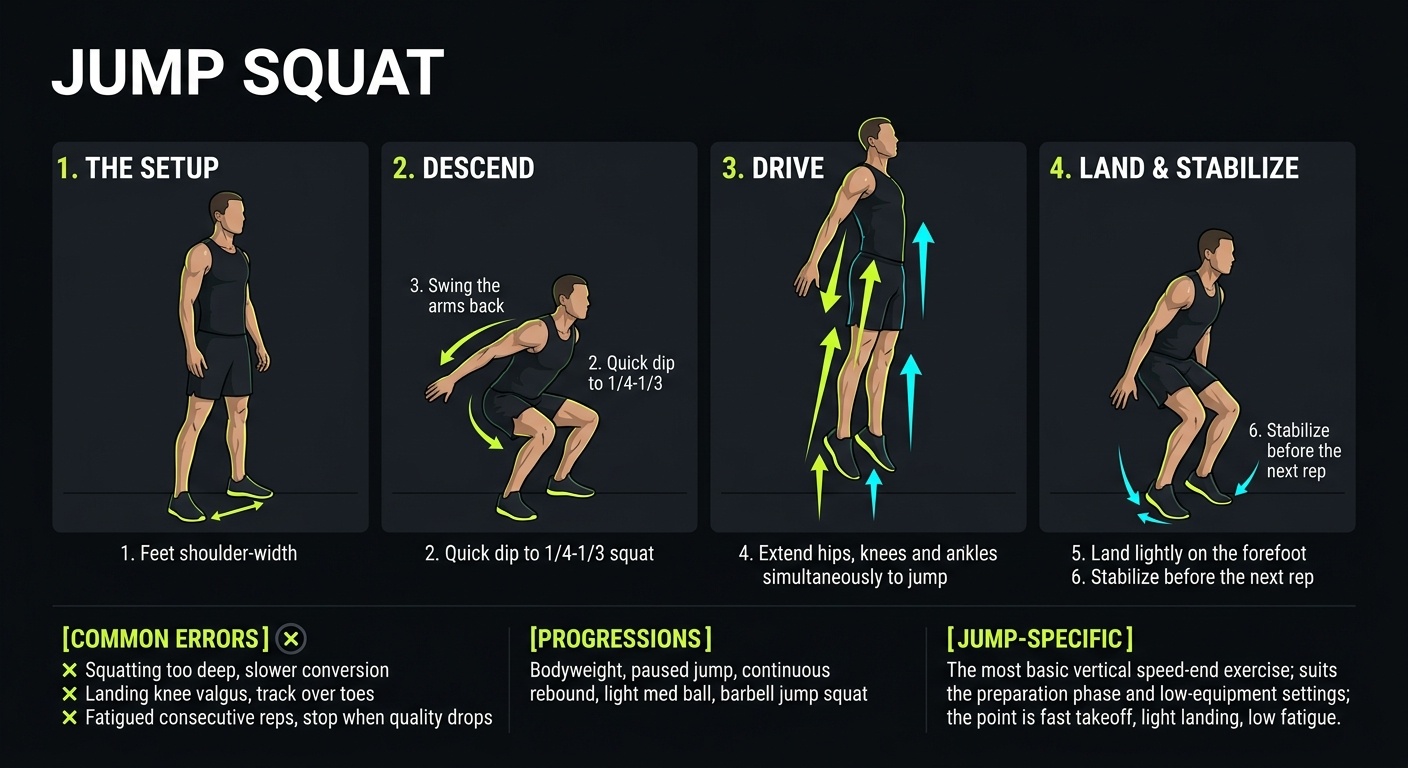
The most direct vertical-power entry — explode from a shallow squat, then reorganize your posture after landing. Great for building takeoff rhythm in the preparation phase, and as a speed-end exercise when equipment is limited.
Coaching cues
- 1.Pre-squat to 1/4-1/3 depth — don't go too deep
- 2.Extend hips, knees and ankles together; feet leave fast
- 3.Land light and stable with knees over toes
- 4.Stop when quality drops — don't chase fatigue
Detailed training method
Related calculators
Related exercises
Box Jump
The first-choice entry to plyometrics — the box jump teaches fast force production and coordinated landing, a cornerstone of jump training
Depth Drop
The preparatory exercise for depth jumps — the depth drop teaches safe, efficient absorption of landing impact (eccentric strength), laying the safety foundation for explosive rebounds
Single-Leg Landing Control
The safety prerequisite for every single-leg jump — step off a low box or hop forward, land on one leg, and stick the landing for 2 seconds
Related articles
How Long Until You See Results From Jump Training?
A realistic vertical jump improvement timeline: what changes at 2, 4, 8 and 12 weeks, and why starting level, training quality and recovery decide the pace.
How to Break a Jump Training Plateau
A plateau means the body has adapted to the current stimulus. Diagnose the weak link, change the variables, deload and fix recovery.
How to Split Strength and Plyometric Training
Combined strength and plyometric training beats either alone. Here are the phase ratios, same-day ordering rules and common mistakes.
CMJ vs Squat Jump: The Simplest Jump Bottleneck Test
The difference between your countermovement jump and squat jump reveals whether strength or elastic use is your limiting factor.
How Deep Should the Countermovement Be in a CMJ?
Deeper is not better. Research points to a natural, fluid dip around 90–100° of knee flexion — and speed matters more than depth.
How Much Do Height, Weight and Skeleton Matter for Jumping?
Training level explains 60–80% of jump performance. Height matters far less than relative strength and body composition.
The Force-Velocity Profile: What It Is and Whether You Need It
The F-V profile tells you whether strength or speed is your bottleneck — and when you are not ready for it yet.
Which Training Gives the Most Jump Per Hour?
The ROI ranking: foundational strength first, then power conversion, depth jumps, technique — and supplements last.
Strength Deficit vs Velocity Deficit: Which One Is Limiting Your Jump?
Two athletes can jump the same height for opposite reasons. Learn to tell a strength deficit from a velocity deficit, and train the right bottleneck.