The Force-Velocity Profile: What It Is and Whether You Need It
The F-V profile tells you whether strength or speed is your bottleneck — and when you are not ready for it yet.
The force-velocity profile fits the muscle's force-velocity relationship to your jumps at different loads. It turns 'am I weak or slow?' from a guess into a number.
It is also a test you should not run until you have a strength base — the data is only actionable once the foundation exists.
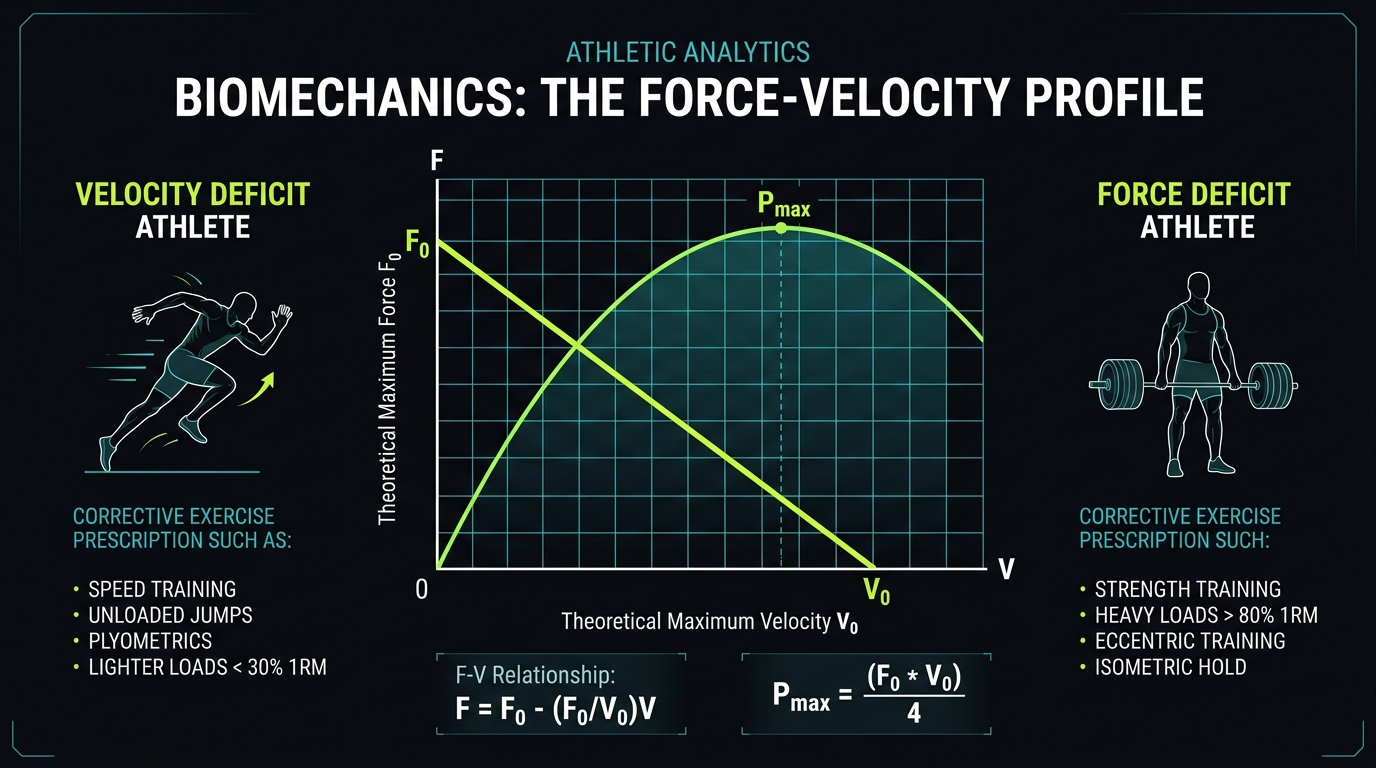
What it measures
Four outputs come from the profile: F₀ (theoretical max force at zero velocity), V₀ (theoretical max velocity at zero load), Sfv (the F-V slope, or force-velocity balance) and Pmax (peak power = F₀ × V₀ / 4).
What the diagnosis means
If your Sfv deviates more than 40% from optimal, targeted training can improve the balance by 15–30%. A force deficit points to strength training; a velocity deficit points to speed work.
How often to test
Once per training cycle (8–12 weeks) is right — the variables change slowly, and weekly testing only adds noise. And if your squat is below 1.5x bodyweight, build the strength base before testing at all.
How the profile is built
The profile fits CMJ or SJ height at several loads — typically bodyweight plus 20–40% of 1RM — to a linear force-velocity relationship. From that line it estimates F₀ (max force), V₀ (max velocity), the slope Sfv (force-velocity balance) and Pmax (peak power).
Interpreting deficits and surpluses
A force deficit (low F₀, shallow slope) points to strength training; a velocity deficit (low V₀, steep slope) points to speed work. When Sfv deviates more than 40% from optimal, targeted training can improve the balance by 15–30%.
Pmax is the overall power ceiling — it tells you how much output is available, while Sfv tells you which side is limiting it.
When to use it and when to skip
Use the profile once per 8–12 week cycle when the squat is at least 1.5x bodyweight. Skip it if the strength base is missing or if the testing protocol would disrupt training.
For a free, lower-tech alternative, the CMJ−SJ gap described in the related article gives a directional version of the same diagnosis.
Key takeaways
- F-V profile separates force deficits from velocity deficits.
- Test once per 8–12 week cycle, not weekly.
- No strength base, no F-V test — build to a 1.5x squat first.
- Sfv deviation over 40% is the threshold for targeted correction.
- The CMJ−SJ gap is a free, directional alternative to a full profile.
Related calculators
References
- Jiménez-Reyes et al. (2017) Scand J Med Sci Sports
- Samozino et al. (2012) Med Sci Sports Exerc
- Morin & Samozino (2016) Sports Med
- PubMed: Force-velocity profile and jump performance
Keep reading
TESTING & ASSESSMENT
CMJ vs Squat Jump: The Simplest Jump Bottleneck Test
The difference between your countermovement jump and squat jump reveals whether strength or elastic use is your limiting factor.
TESTING & ASSESSMENT
How to Track Jump Progress Scientifically
One standard test, fixed conditions, weekly frequency and the smallest worthwhile change — the protocol that turns jump data into decisions.
TESTING & ASSESSMENT
Which Training Gives the Most Jump Per Hour?
The ROI ranking: foundational strength first, then power conversion, depth jumps, technique — and supplements last.
Related exercises
Jump Squat
The most direct vertical-power entry — explode from a shallow squat, then reorganize your posture after landing
Barbell Jump Squat
Loaded speed-strength training — with a light barbell, convert the squat pattern into maximal takeoff speed
Power Clean
Pull the bar explosively from the floor to the front shoulders (caught in a quarter squat)