Which Training Gives the Most Jump Per Hour?
The ROI ranking: foundational strength first, then power conversion, depth jumps, technique — and supplements last.
If you only have a few hours per week, spend them in the order that produces the most centimeters per hour.
ROI thinking is about sequence: strength first, conversion second, elasticity third, technique fourth, supplements last. The order is the plan.
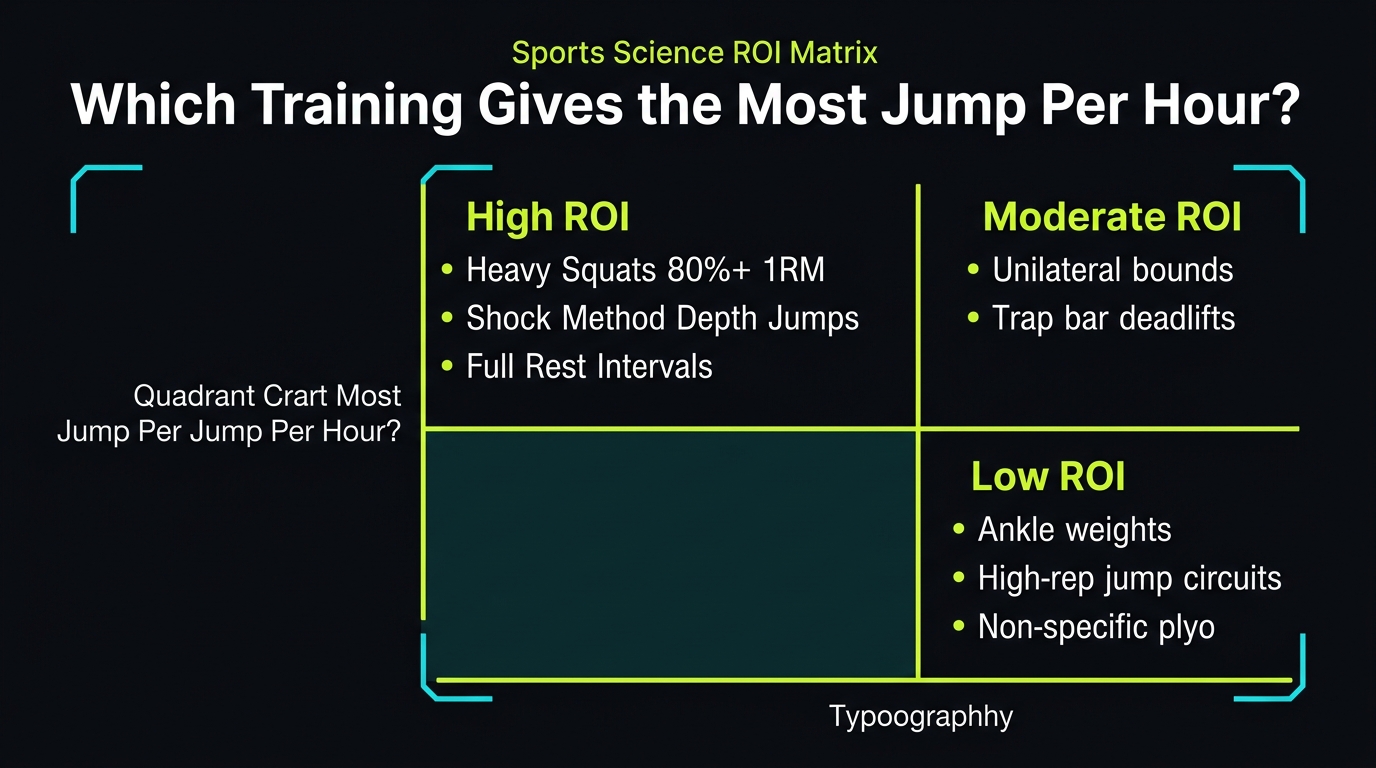
The ROI ranking
From highest to lowest return:
- Foundational strength: squats and deadlifts build the reserve — the highest ROI when your relative squat is below 1.5x.
- Strength-to-power conversion: loaded jump squats (~30% 1RM) and power cleans turn strength into speed.
- Depth jumps: once the strength base is met, they can accelerate reactive-strength gains — some classic studies on trained athletes reported large CMJ improvements, but those results don't transfer automatically to every athlete.
- Sport-specific technique: approach-takeoff optimization transfers another 5–15%.
- Supplements and nutrition: creatine plus caffeine add roughly 2–5% acutely — on top of optimized training, not instead of it.
Why strength comes first
Combined strength and plyometric training beats either alone, but the sequencing matters: below a relative squat of about 1.5x bodyweight, foundational strength is the highest-ROI work because it raises the ceiling every other quality converts.
The conversion step
Strength only helps the jump if it is expressed at speed. Loaded jump squats at roughly 30% 1RM, power cleans and hang cleans convert the strength reserve into power output — this is the step most athletes skip, and it is why their squat goes up without their jump following.
The diminishing-returns ladder
Expected returns shrink as you climb the ladder:
- Strength: largest gains, especially below a 1.5x relative squat.
- Conversion: large gains once strength exists.
- Depth jumps and reactive work: moderate gains on top of a strength base.
- Technique: small but free gains — a few percent from takeoff optimization.
- Nutrition and supplements: the last 2–5%, acute and supportive.
Key takeaways
- Build the strength base before anything else.
- Convert strength to power before chasing technique.
- Supplements are the last 2–5%, not the foundation.
- Follow the order: strength, conversion, elasticity, technique, supplements.
- At a relative squat below 1.5x, nothing beats strength hours.
Related calculators
References
- Sánchez-Sixto et al. (2021) Sports Med
- Verkhoshansky & Siff (2009) Supertraining, Ch. 6
- Markovic (2007) Br J Sports Med
- PubMed: Loaded jump squat and vertical jump performance
Keep reading
TESTING & ASSESSMENT
CMJ vs Squat Jump: The Simplest Jump Bottleneck Test
The difference between your countermovement jump and squat jump reveals whether strength or elastic use is your limiting factor.
TESTING & ASSESSMENT
The Force-Velocity Profile: What It Is and Whether You Need It
The F-V profile tells you whether strength or speed is your bottleneck — and when you are not ready for it yet.
TESTING & ASSESSMENT
How to Track Jump Progress Scientifically
One standard test, fixed conditions, weekly frequency and the smallest worthwhile change — the protocol that turns jump data into decisions.
Related exercises
Barbell Back Squat
The king of strength training and an irreplaceable foundation movement for jump training
Jump Squat
The most direct vertical-power entry — explode from a shallow squat, then reorganize your posture after landing
Depth Jump
The gold-standard jump exercise — the depth jump maximizes SSC (stretch-shortening cycle) use, directly raising reactive strength and jump height