Power Clean
Pull the bar explosively from the floor to the front shoulders (caught in a quarter squat). The power clean is the foundation Olympic movement, training coordinated triple extension (ankle, knee, hip) — the core pattern of jump takeoff. Its ground reaction forces and RFD are among the most efficient neural-adaptation stimuli for jumping.
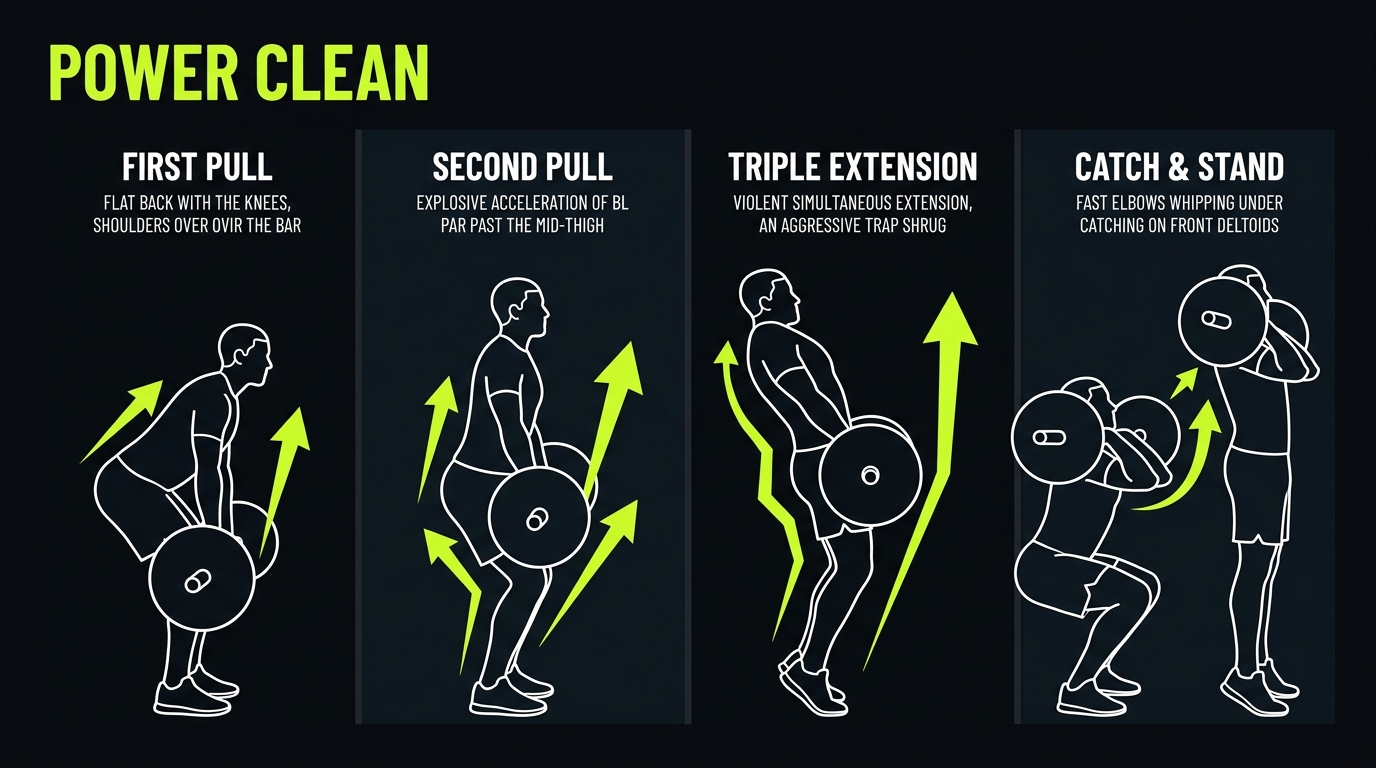
Coaching cues
- 1.First pull: floor to knees — keep the back angle
- 2.Second pull: knees to mid-thigh — bar accelerates close to the body
- 3.Third pull: full triple extension + shrug + high pull
- 4.Catch: elbows whip under the bar fast
- 5.Keep the bar close the whole time — closer is more efficient
Detailed training method
Requires professional coaching; use light weights until technique is sound; caution with wrist/shoulder injuries
Related calculators
Related exercises
Hang Clean
Starting from mid-thigh (hang position), skip the first pull from the floor and perform the second and third pulls directly
Jump Shrug
From the hang position, perform triple extension plus a maximal shrug; the feet may leave the ground (jump), but the arms don't pull — the bar rises only from lower-body explosion
Clean Pull
Keeps the most critical second pull and triple-extension explosion of the clean while removing the catch
Related articles
How to Break a Jump Training Plateau
A plateau means the body has adapted to the current stimulus. Diagnose the weak link, change the variables, deload and fix recovery.
Rest Intervals for Jump Training: The Complete Guide
Rest length changes what a set actually trains. Here are the exact intervals for strength, power, hypertrophy and rehab work.
Do You Need Protein Powder and Supplements for Jump Training?
Food comes first, always. When diet is covered, creatine and caffeine have real evidence — BCAAs and most other powders do not.
The Force-Velocity Profile: What It Is and Whether You Need It
The F-V profile tells you whether strength or speed is your bottleneck — and when you are not ready for it yet.
Will Jump Training Make Your Calves and Thighs Bulky?
Jump training's parameters favor neural adaptation and power, not size. Here is why the bulk fear is mostly unfounded.
Is Jump Height Genetic? (Can It Be Trained?)
Genetics explain roughly 40–80% of jump variance depending on the population — which means training and environment explain the rest.
How to Design a Full Jump-Training Macrocycle
The 12–16 week structure: base adaptation, max strength, power conversion, then peak and test. With RPE and volume targets for each phase.