Will Jump Training Make Your Calves and Thighs Bulky?
Jump training's parameters favor neural adaptation and power, not size. Here is why the bulk fear is mostly unfounded.
Hypertrophy is tightly linked to training parameters — and jump training uses the parameters that grow power, not size.
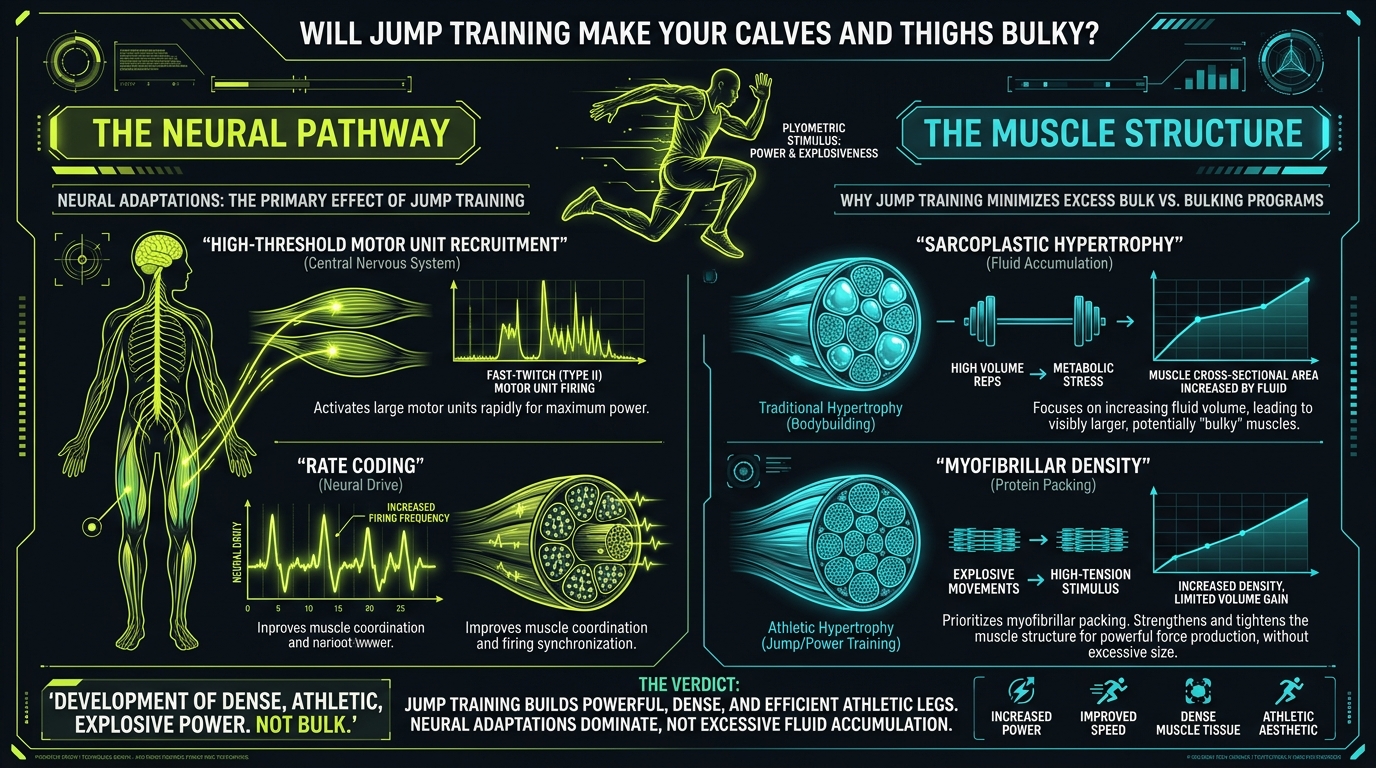
The size of your legs is a product of training parameters, not the exercise label. Jump training's parameters — low reps, high power, long rest — are the opposite of the hypertrophy recipe.
The parameter story
Typical jump training — low reps, high power, long rest — favors neural adaptation and power output, with small hypertrophy effects. Size comes from the bodybuilding recipe: moderate reps (8–12 RM), short rests (60–90 s) and high volume.
What jumpers actually look like
Elite jumpers usually have defined, athletic legs — functional muscle, not show muscle. The training that makes you jump higher makes you more powerful and more defined.
The female-specific worry
Female testosterone is roughly 5–10% of male levels, so natural hypertrophy potential is limited. Jump training will make you firmer and more defined — not bulky.
The hypertrophy recipe vs the power recipe
Size follows the bodybuilding parameters: moderate reps (8–12 RM), short rests (60–90 seconds) and high weekly volume. Jump training uses low reps, maximal intent, long rest and moderate volume — a combination that favors neural adaptation and power with small hypertrophy effects.
Why jumpers look lean and defined
Power athletes carry functional muscle, and the sport's training plus body-composition demands keep body fat low enough that the muscle reads as defined rather than bulky. The look is a byproduct of the training, not its goal.
For athletes worried about bulk
If size gain is a concern, protect the power profile:
- Keep reps low and intent maximal.
- Rest 2–5 minutes between power sets.
- Do not add bodybuilding-style accessory volume.
- Track CMJ, not leg circumference.
- If size changes, cut accessory volume before touching power work.
Key takeaways
- Power training does not produce bodybuilding levels of size.
- Size requires high-rep, short-rest, high-volume work.
- Female athletes can train jumps without meaningful bulk.
- Size follows training parameters, not the movement pattern.
- If you are worried about bulk, cut accessory volume, not power work.
Related calculators
References
- Schoenfeld et al. (2016) J Strength Cond Res
- NSCA Essentials of Strength Training and Conditioning (4th ed.), Ch. 15
- PubMed: Resistance training parameters and muscle hypertrophy
Keep reading
COMMON MYTHS
Should Knees Never Pass the Toes? A Myth Explained
Banning forward knee travel is over-generalized, non-specific and can even increase lumbar shear. Here is what to actually watch.
COMMON MYTHS
Does Jump Training Stunt Growth or Make You Shorter?
No scientific evidence shows strength or plyometric training stunts height. The international consensus says youth training is safe and beneficial.
COMMON MYTHS
Is Jump Height Genetic? (Can It Be Trained?)
Genetics explain roughly 40–80% of jump variance depending on the population — which means training and environment explain the rest.