Does Jump Training Stunt Growth or Make You Shorter?
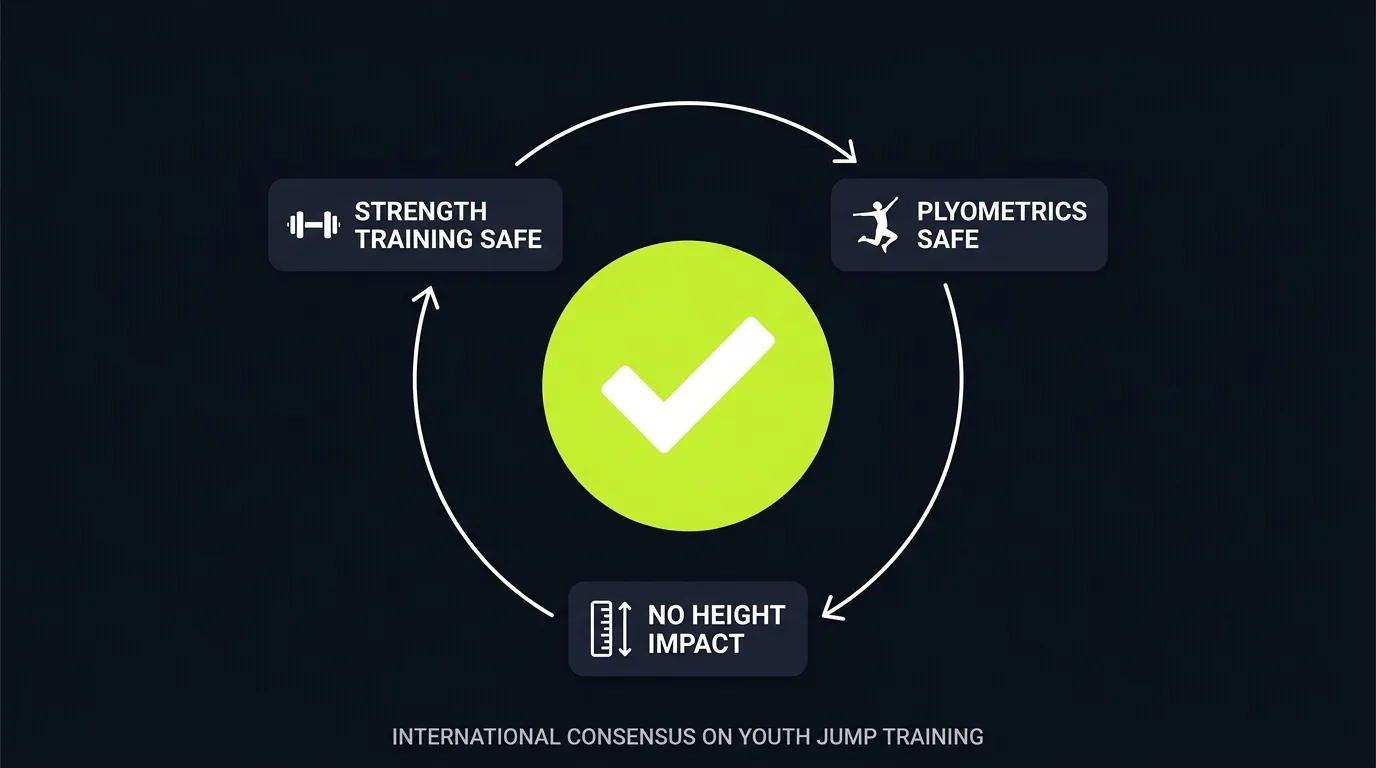
No scientific evidence shows strength or plyometric training stunts height. The international consensus says youth training is safe and beneficial.
This is one of the most harmful myths about youth training — because it stops young athletes from doing the safest, most beneficial work available.
The myth survives because a kernel of truth — growth-plate injuries are serious — gets inflated into a false conclusion that training causes them.
What the evidence says
There is no scientific evidence that strength or plyometric training stunts height. Appropriate resistance training actually increases bone density and skeletal health.
Where the myth comes from
Growth-plate injuries do occur — but only from severe acute trauma like high-velocity impacts, not from normal training loads. The international consensus (NSCA, ACSM, IOC) is that supervised youth strength training is safe and beneficial.
What actually affects height
Genetics (70–80%), malnutrition, chronic disease, severe sleep deprivation and hormonal imbalance. Training is not on the list.
The evidence base
No scientific evidence links strength or plyometric training to stunted height. Appropriate resistance training increases bone density and skeletal health, and the position statements from the NSCA, the 2014 International Consensus and the ACSM all support supervised youth strength training.
Growth-plate injuries: what actually causes them
Growth-plate injuries come from severe acute trauma — high-velocity impacts, falls and collisions — not from progressive, supervised loading. The risk profile changes when training is unsupervised, max-effort and technically poor, which is exactly what the position statements regulate against.
What youth programs should prioritize
A safe, effective youth program follows these rules:
- Technique and coordination before load.
- Bodyweight movements as the base.
- Low-intensity plyometrics with landing control.
- No maximal lifts; loads kept below ~85% 1RM.
- Qualified supervision at every session.
Key takeaways
- No evidence links training to stunted growth.
- Growth-plate injuries come from trauma, not normal loading.
- Proper youth training improves bone density and long-term athleticism.
- Growth-plate injuries come from trauma, not supervised progressive loading.
- Youth training under supervision increases bone density and reduces injury rates.
Related calculators
References
- Faigenbaum et al. (2009) J Strength Cond Res
- Lloyd et al. (2014) Br J Sports Med
- ACSM Youth Strength Training Position
- PubMed: Resistance training for children and adolescents (2017)
Keep reading
COMMON MYTHS
Should Knees Never Pass the Toes? A Myth Explained
Banning forward knee travel is over-generalized, non-specific and can even increase lumbar shear. Here is what to actually watch.
COMMON MYTHS
Will Jump Training Make Your Calves and Thighs Bulky?
Jump training's parameters favor neural adaptation and power, not size. Here is why the bulk fear is mostly unfounded.
COMMON MYTHS
Is Jump Height Genetic? (Can It Be Trained?)
Genetics explain roughly 40–80% of jump variance depending on the population — which means training and environment explain the rest.
Related exercises
Goblet Squat
The best first squat for jumping — the goblet squat teaches the correct pattern (upright torso, braced core) as a foundation for barbell squats and jumping
Box Jump
The first-choice entry to plyometrics — the box jump teaches fast force production and coordinated landing, a cornerstone of jump training