Should Knees Never Pass the Toes? A Myth Explained
Banning forward knee travel is over-generalized, non-specific and can even increase lumbar shear. Here is what to actually watch.
'Never let your knees pass your toes' is one of the most repeated — and most over-generalized — cues in strength training.
The rule exists for a reason — anterior knee stress rises with forward travel — but the research shows that knee-to-toe distance is determined by anatomy, and the real risks sit elsewhere.
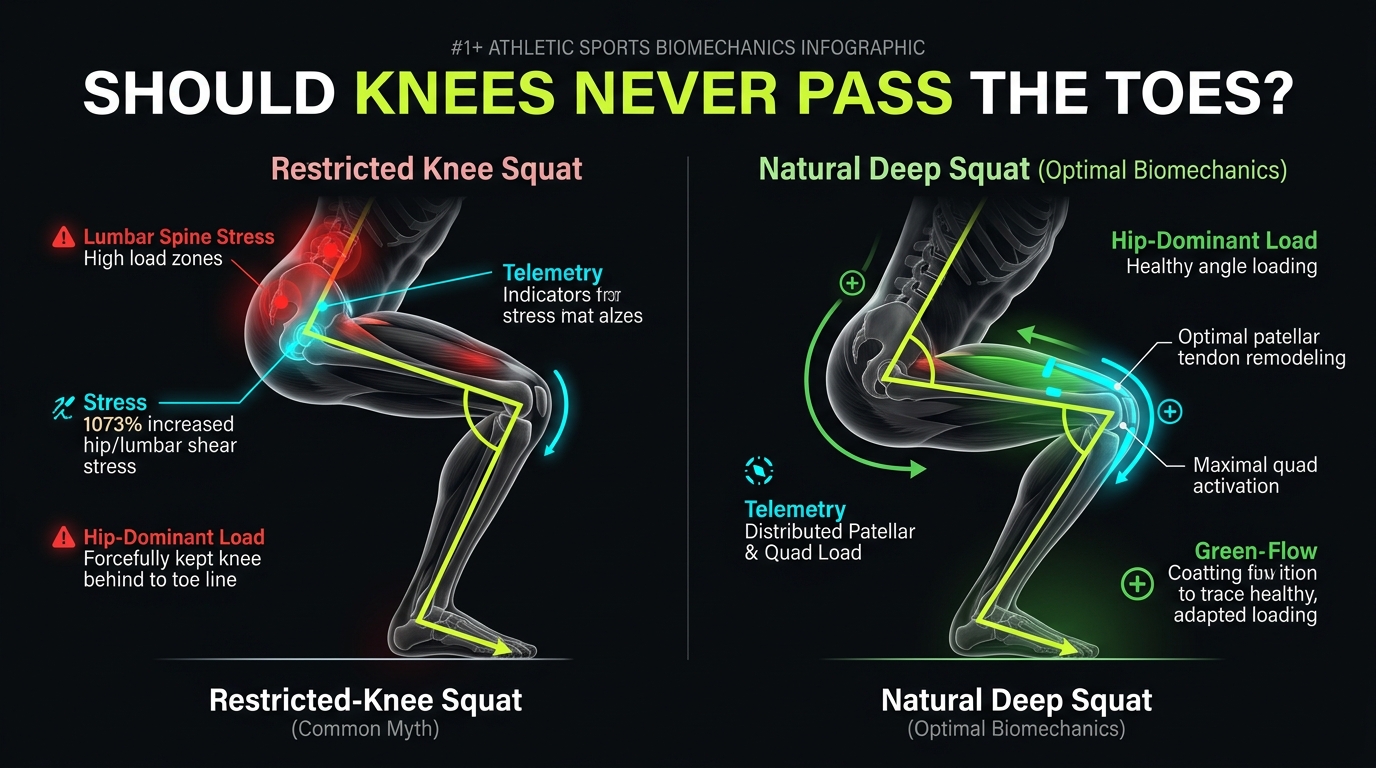
Anatomy decides knee travel
How far the knees pass the toes depends on femur and tibia length ratios. Long femurs with short shins mean the knees must pass the toes in a full squat — a normal anatomical variation, not an error.
The cue can backfire
Banning forward knee travel forces excessive torso lean, which increases lumbar shear — the opposite of safe. And since the knees pass the toes during every jump takeoff anyway, avoiding it in training is non-specific.
What to watch instead
Judge overall biomechanics: a neutral spine, heels down and knees tracking over the toes — never caving inward. Stance width and depth are individual variables, not rules.
Where the rule comes from
Early coaching cues restricted forward knee travel to reduce patellofemoral stress. But research reviews, including Fry and Schoenfeld, show the amount of knee travel is dictated by femur-to-tibia length ratios — long femurs require the knees to pass the toes in a full squat.
The actual risk factors
Knee valgus (knees caving inward), heel lift, lumbar flexion and load beyond control predict injury better than knee position. Forward knee travel itself is normal in both squats and jump takeoffs — avoiding it in training is non-specific.
How to coach it correctly
Replace the blanket rule with a movement checklist:
- Neutral spine throughout the rep.
- Heels stay down.
- Knees track over the toes — never caving inward.
- Stance width and depth chosen for your anatomy.
- Depth controlled, not forced.
Key takeaways
- Knee travel is anatomy, not a universal rule.
- Banning it can shift load to the lower back.
- Watch spine, heels and knee tracking instead.
- Knee travel is determined by your femur-to-tibia ratio.
- Watch knee valgus, heel lift and spinal position — not knee-to-toe distance.
Related calculators
References
- Fry et al. (2003) J Strength Cond Res
- Schoenfeld (2010) J Strength Cond Res
- Hartmann et al. (2012) Sports Med
- PubMed: Knee position and squat biomechanics
Keep reading
COMMON MYTHS
Does Jump Training Stunt Growth or Make You Shorter?
No scientific evidence shows strength or plyometric training stunts height. The international consensus says youth training is safe and beneficial.
COMMON MYTHS
Will Jump Training Make Your Calves and Thighs Bulky?
Jump training's parameters favor neural adaptation and power, not size. Here is why the bulk fear is mostly unfounded.
COMMON MYTHS
Is Jump Height Genetic? (Can It Be Trained?)
Genetics explain roughly 40–80% of jump variance depending on the population — which means training and environment explain the rest.