How to Break a Jump Training Plateau
A plateau means the body has adapted to the current stimulus. Diagnose the weak link, change the variables, deload and fix recovery.
A plateau is not a failure — it is the body telling you the current stimulus has been fully absorbed. Breaking it requires systematic change rather than simply training harder.
These are the five levers, ordered from most specific to most general.
Before touching the program, rule out the cheap explanations: inconsistent testing, a bad week of sleep or accumulated fatigue. Then attack the training itself in a systematic order.
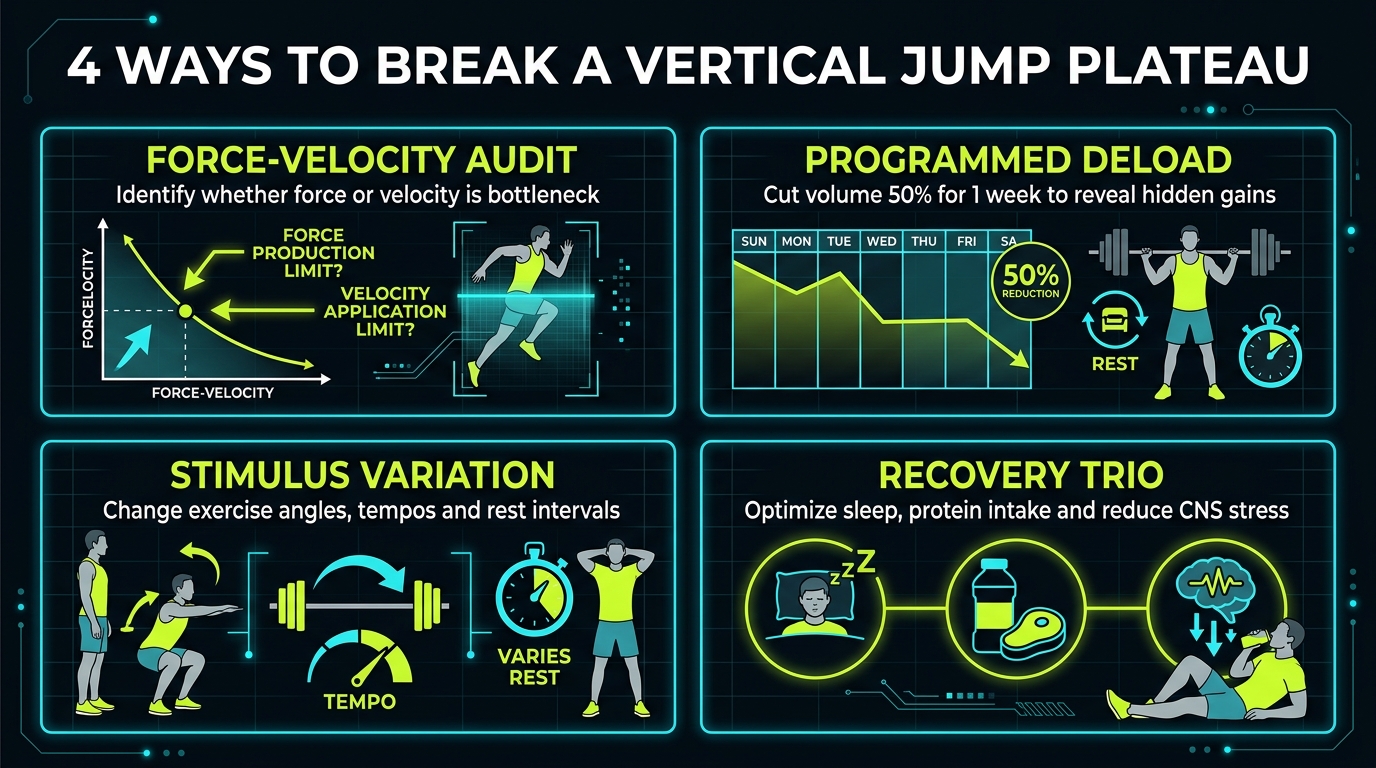
Diagnose the force-velocity profile
The most precise fix starts with knowing which side of the F-V profile you are weak on. Jiménez-Reyes and colleagues showed that athletes with a force deficit (strong but not high) respond best to speed-type training, while athletes with a velocity deficit (high but weak) respond best to strength-type training. A standardized assessment is the cleanest way to find out.
Change the training variables
Any change breaks adaptation: sets, reps, load, rest, exercise order or exercise selection. You do not need to overhaul the program — one meaningful variable change is usually enough to restart progress.
Deload before you push
Reduce volume by 50–70% for one week. Fatigue can hide fitness: after a deload, athletes often perform better than before it. Sometimes you step back to leap forward.
Fix the recovery trio
Chronic stress raises cortisol, lowers testosterone and blocks progress even when training is perfect. Sleep, nutrition and stress are not optional extras; they are training inputs.
Use contrast training
Alternating high-intensity low-volume work with low-intensity high-volume work keeps the nervous system adapting without accumulating excessive fatigue. This is a simple but effective way to add variation without guessing.
Quantify the imbalance with an F-V profile
The force-velocity profile fits jump performance at different loads to estimate theoretical max force (F₀), max velocity (V₀) and their balance (Sfv). When Sfv deviates more than 40% from optimal, targeted training can improve the balance by 15–30%.
The diagnosis is directional: a force deficit means prioritize strength-type training; a velocity deficit means prioritize speed-type training. Testing once per 8–12 week cycle is enough — the variables change slowly.
A four-week plateau-breaker
Week 1: deload volume to 50–70% of normal. Weeks 2–3: change the main stimulus in the direction of your diagnosed deficit — heavier strength or faster speed work — and keep everything else constant. Week 4: retest under identical conditions.
If the number moved, keep the change. If not, change a different variable and repeat. Changing several variables at once makes it impossible to know what worked.
The recovery audit
Before blaming the program, audit the last two weeks of sleep, nutrition and stress. Chronic stress raises cortisol and suppresses testosterone, which blocks adaptation; sleep below 7 hours measurably lowers force output.
A plateau that coincides with a recovery breakdown is a recovery problem, not a programming problem — fix the environment before changing the stimulus.
Key takeaways
- Diagnose force vs velocity deficit before changing the program.
- Change one training variable at a time and re-test before judging it.
- A deload week often unlocks the next block.
- If recovery is broken, no program change will save you.
- Use an F-V profile to quantify the imbalance instead of guessing weak or slow.
- Hold a change for 2–3 weeks, retest, and only then decide.
Related calculators
References
- Jiménez-Reyes et al. (2017) Scand J Med Sci Sports
- Samozino et al. (2012) Med Sci Sports Exerc
- PubMed: Force-velocity profile and vertical jump
- Morin & Samozino (2016) Sports Med
Keep reading
TRAINING PROGRESS
How Long Until You See Results From Jump Training?
A realistic vertical jump improvement timeline: what changes at 2, 4, 8 and 12 weeks, and why starting level, training quality and recovery decide the pace.
TRAINING PROGRESS
Why Am I Not Improving at Jumping? The 5 Real Causes
Trained for months with no jump gains? The five most common causes of a vertical jump plateau — programming, load management, technique, recovery and measurement — and a simple test to find which one is yours.
TRAINING PROGRESS
How Fast Do You Lose Your Jump? The Detraining Timeline
One week off barely costs anything. Eight weeks off costs a lot — but muscle memory brings it back faster than you think.
Related exercises
Jump Squat
The most direct vertical-power entry — explode from a shallow squat, then reorganize your posture after landing
Power Clean
Pull the bar explosively from the floor to the front shoulders (caught in a quarter squat)
Barbell Back Squat
The king of strength training and an irreplaceable foundation movement for jump training