Why Am I Not Improving at Jumping? The 5 Real Causes
Trained for months with no jump gains? The five most common causes of a vertical jump plateau — programming, load management, technique, recovery and measurement — and a simple test to find which one is yours.
If you have trained consistently and the jump height is not moving, the problem is almost never effort. It is almost always one of five structural causes — and every one of them is fixable once you name it.
The five causes are ordered roughly by how often they appear in practice: programming first, then strength, then volume, then recovery — with measurement last, because it can either expose or hide every other cause.
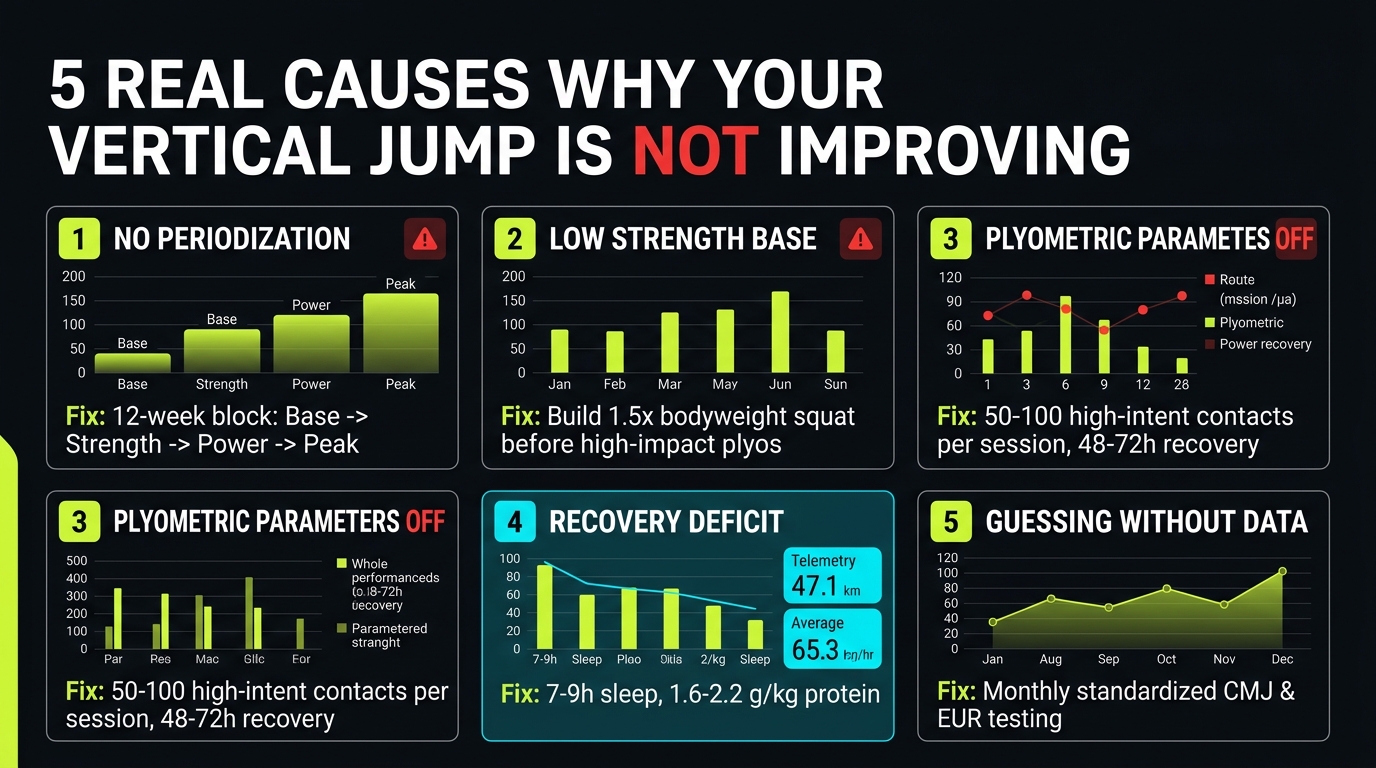
No periodization
Doing the same work every week lets the body adapt and the stimulus stops being effective. A real cycle moves through base → strength → power → peak, so the stimulus keeps changing.
Strength base too low
Plyometric gains are limited below roughly a 1.5x bodyweight squat. If you cannot squat that yet, jumping more is not the answer — building strength is.
Wrong plyometric parameters
Two to three sessions per week with 50–100 quality contacts is the productive band. Too much masks power with fatigue; too little under-stimulates.
Recovery gaps
Sleep under 7 hours measurably lowers force output, and poor nutrition limits anabolism. Training cannot outrun a broken recovery system.
No objective assessment
What is not measured is not managed. Without a diagnosis you are guessing whether strength, elasticity, technique or recovery is the bottleneck.
The assessment-first checklist
Before changing anything, verify that the problem is real: use the same test, the same time of day, the same shoes and the same warm-up every week, and collect 2–3 weeks of data.
Then audit the cheap explanations — sleep below 7 hours, a spike in life stress, or a recent illness. A 'plateau' that only exists in inconsistent measurements is not a plateau.
How to fix each cause
Each cause has a direct countermeasure:
- No periodization → run a 12-week block: base → strength → power → peak.
- Strength base too low → 6–8 weeks of strength emphasis before more plyometrics.
- Plyometric parameters off → 50–100 quality contacts across 2–3 sessions per week.
- Recovery gaps → 7–9 hours of sleep and 1.6–2.2 g/kg of protein daily.
- No assessment → a standardized battery with CMJ, approach reach and strength tests.
When improvement is real but invisible
Advanced athletes gain more slowly: a 1–2 cm jump increase after a full block is a meaningful result, not a failure. Strength and technique improvements also precede jump-height changes, so re-test at 4–6 week windows rather than weekly if you are prone to overreacting to noise.
Key takeaways
- Periodize the training cycle instead of repeating the same week.
- Build the strength base before expecting plyometrics to pay off.
- Keep plyometric volume in the 50–100 contacts, 2–3 sessions/week band.
- Assess first — guessing wastes months.
- Audit testing consistency and recovery before changing the program.
- Fix one cause at a time and re-test after 4–6 weeks.
Related calculators
References
- Sánchez-Sixto et al. (2021) J Strength Cond Res
- Reilly & Edwards (2007) Sports Med
- NSCA Essentials of Strength Training and Conditioning (4th ed.), Ch. 21
- Bompa & Buzzichelli (2019) Periodization: Theory and Methodology of Training (6th ed.)
Keep reading
TRAINING PROGRESS
How Long Until You See Results From Jump Training?
A realistic vertical jump improvement timeline: what changes at 2, 4, 8 and 12 weeks, and why starting level, training quality and recovery decide the pace.
TRAINING PROGRESS
How to Break a Jump Training Plateau
A plateau means the body has adapted to the current stimulus. Diagnose the weak link, change the variables, deload and fix recovery.
TRAINING PROGRESS
How Fast Do You Lose Your Jump? The Detraining Timeline
One week off barely costs anything. Eight weeks off costs a lot — but muscle memory brings it back faster than you think.
Related exercises
Barbell Back Squat
The king of strength training and an irreplaceable foundation movement for jump training
Depth Jump
The gold-standard jump exercise — the depth jump maximizes SSC (stretch-shortening cycle) use, directly raising reactive strength and jump height
Box Jump
The first-choice entry to plyometrics — the box jump teaches fast force production and coordinated landing, a cornerstone of jump training