How Fast Do You Lose Your Jump? The Detraining Timeline
One week off barely costs anything. Eight weeks off costs a lot — but muscle memory brings it back faster than you think.
Breaks are inevitable — travel, exams, injuries. What matters is knowing how fast performance actually declines, and the minimum dose that keeps it from declining at all.
Detraining follows a curve, not a cliff: the first week costs almost nothing, the second month costs real height, and the recovery is faster than the original build.
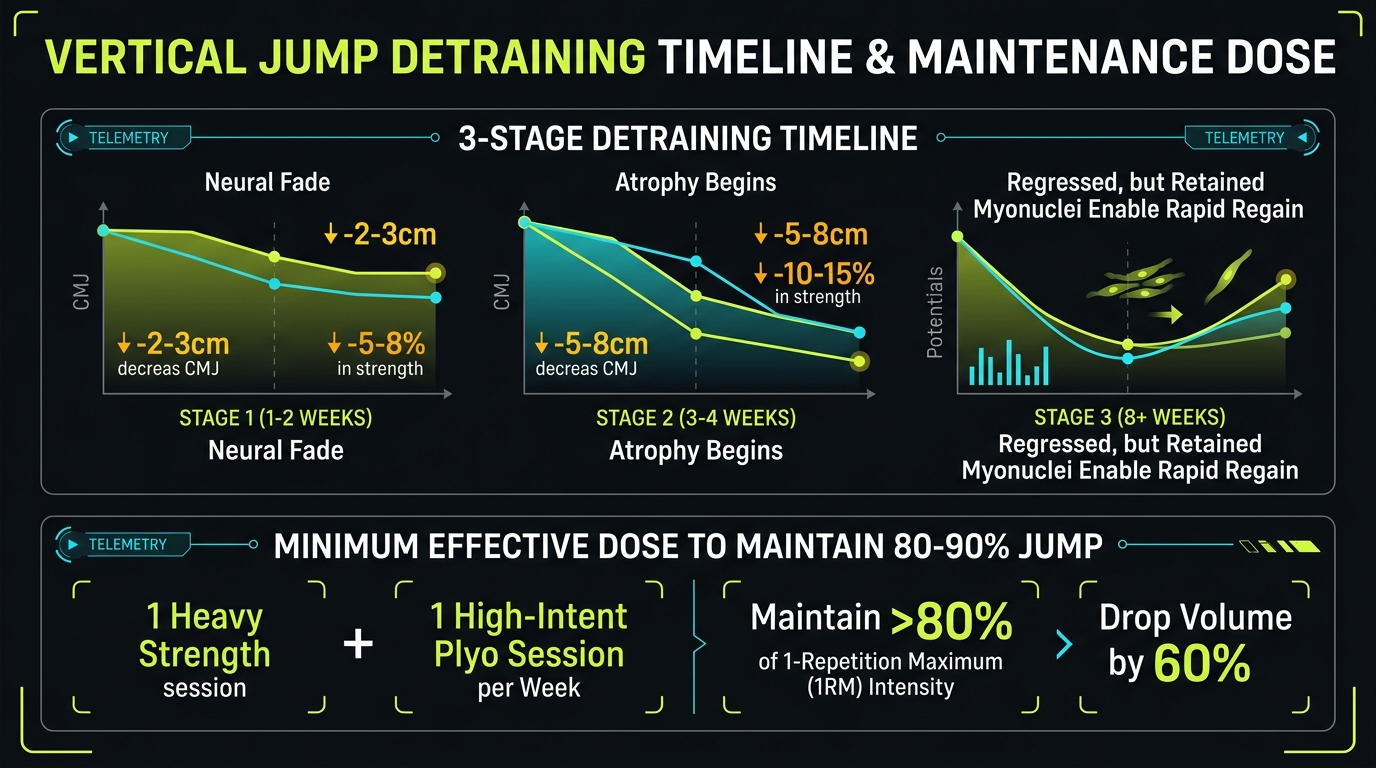
The detraining timeline
Losses come in stages:
- 1–2 weeks off: mild neural decline, 5–8% strength loss; jump height barely changes or drops 2–3 cm.
- 3–4 weeks: muscle cross-sectional area starts falling, strength down 10–15%, CMJ down 5–8 cm.
- 8+ weeks: significant regression — but retained myonuclei make regain fast.
The minimum maintenance dose
One strength session plus one plyometric session per week maintains 80–90% of your condition. That is the floor for any break longer than two weeks.
Regaining what you lost
After a full break, 4–8 weeks of retraining returns most athletes to baseline thanks to muscle memory. The second climb is faster than the first.
What detrains first
Neural factors decline first: motor-unit recruitment and coordination fade within 1–2 weeks, which is why strength drops 5–8% before muscle size changes at all. Muscle cross-sectional area follows in weeks 3–4 as strength losses reach 10–15%.
Jump height is slightly more resilient early because it depends on technique and elasticity as well as raw strength — but the same curve applies to it by week 4.
The maintenance dose in practice
One strength session plus one plyometric session per week maintains 80–90% of condition. If you only have one session, combine both: a short strength block followed by low-volume jumps, prioritizing frequency over length.
Maintenance intensity matters more than maintenance volume — keep loads heavy (above 80% 1RM) and jumps maximal, just fewer of them.
Muscle memory and regain
Retained myonuclei are the biological basis of muscle memory: the infrastructure for regrowth survives the break, so regain is faster than the original build. Plan short breaks around re-test windows and treat the first 2 weeks back as re-adaptation, not lost time.
Key takeaways
- Short breaks cost little; 8+ weeks cost real height.
- 1 strength + 1 plyometric session per week prevents most detraining.
- Regain is faster than the original build thanks to muscle memory.
- Neural output detrains before muscle size does.
- When time is short, one strength + one plyo session per week preserves most of your jump.
Related calculators
References
- Mujika & Padilla (2000) Sports Med
- Bruusgaard et al. (2010) PNAS
- PubMed: Detraining and muscle strength systematic review
Keep reading
TRAINING PROGRESS
How Long Until You See Results From Jump Training?
A realistic vertical jump improvement timeline: what changes at 2, 4, 8 and 12 weeks, and why starting level, training quality and recovery decide the pace.
TRAINING PROGRESS
How to Break a Jump Training Plateau
A plateau means the body has adapted to the current stimulus. Diagnose the weak link, change the variables, deload and fix recovery.
TRAINING PROGRESS
Why Am I Not Improving at Jumping? The 5 Real Causes
Trained for months with no jump gains? The five most common causes of a vertical jump plateau — programming, load management, technique, recovery and measurement — and a simple test to find which one is yours.