How Long Until You See Results From Jump Training?
A realistic vertical jump improvement timeline: what changes at 2, 4, 8 and 12 weeks, and why starting level, training quality and recovery decide the pace.
If you are asking how long jump training takes, the honest answer is: the first measurable gains usually show up in 2–4 weeks, but the gains you actually keep come from consistent 8–12 week blocks. The timeline below comes from the neuromuscular adaptation research compiled in the BounceLab knowledge base.
Understand what changes at each phase and you will stop judging a program too early — and know exactly when a program is not working.
Progress is also non-linear: the body adapts in waves, and short windows of flat numbers are normal even inside a successful program. The difference between a plateau and a phase of consolidation is whether your measurement protocol is stable enough to trust.
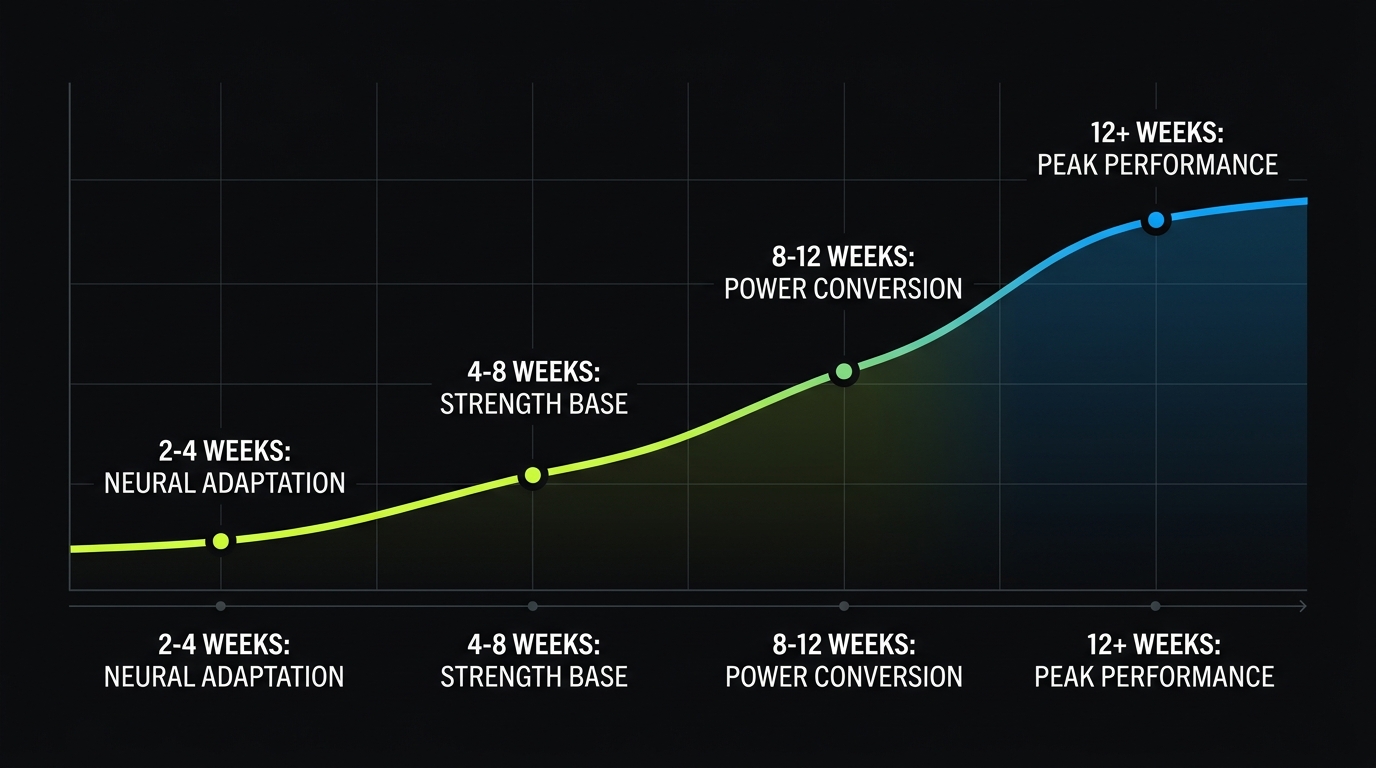
The adaptation timeline
Jumping is driven by nervous system output first and muscle size second, which is why the timeline is front-loaded with neural gains.
- 2–4 weeks (neural): better motor-unit recruitment and intermuscular coordination. Expect roughly +2–5 cm on the countermovement jump (CMJ) if technique is solid.
- 4–8 weeks (strength): muscle fiber cross-sectional area and maximal strength climb; squat and other strength markers change clearly.
- 8–12 weeks (conversion): plyometric effects appear as new strength converts into power; CMJ gains of 5–15 cm are common in this window.
- 12+ weeks: periodized gains compound, but the curve flattens — this is normal and where re-testing matters most.
Why the first gains feel like magic
Early jumps in performance are mostly neural: your brain learns to recruit more motor units, in better order, and coordinates the hip-knee-ankle chain more efficiently. No structural change is needed for the first centimeters, which is why beginners and returning athletes can improve quickly.
What decides your rate of progress
The same program produces very different timelines depending on the athlete. The main variables are:
- Starting level: a lower starting level usually means faster early gains.
- Training quality: intent matters — jump training works when every set is performed with maximal effort and clean technique.
- Consistency: missed sessions break the accumulation of stimulus.
- Recovery: sleep below 7 hours measurably lowers force output and slows adaptation.
The 12-week rule
If you have trained consistently for 12 weeks with no measured change in CMJ, approach reach or standing broad jump, the program needs adjustment — not more patience. Re-test with the same protocol, check your recovery and training load, then change the stimulus.
What is changing under the hood
At the neural level, training improves motor-unit recruitment, firing rate and intermuscular coordination. These changes appear first because they do not require new tissue — which is why early gains arrive in weeks, not months.
Research on the first weeks of lower-limb resistance training confirms that enhanced contractile function and corticospinal excitability precede measurable strength and architectural adaptations. Structural changes such as muscle fiber cross-sectional area, tendon stiffness and bone adaptation take weeks to accumulate, but they support the larger and more durable gains seen at 8–12 weeks and beyond.
How to measure so the numbers mean something
Use the same test, the same time of day, the same shoes and the same warm-up every week. The countermovement jump with a free arm swing is the most stable and sensitive choice for tracking.
Take the best of three attempts with 2–3 minutes of rest, and judge the trend across weeks rather than single days. Daily fluctuation of 2–3 cm is normal; only changes beyond roughly 1–2 cm (the smallest worthwhile change for trained athletes) are real.
Beginner vs advanced timelines
A beginner can gain centimeters within weeks because neural adaptation starts from a low baseline. An advanced athlete may train an entire block for a 1–2 cm gain that is still meaningful — the same absolute change represents a different relative improvement at a higher starting level.
Key takeaways
- Expect neural gains in 2–4 weeks, strength gains in 4–8, and conversion into jump height at 8–12 weeks.
- Always measure with the same test protocol so comparisons are valid.
- No change after 12 consistent weeks means adjust the plan, not just grind on.
- Use a stable weekly test protocol; changes under ~1–2 cm are noise.
- Advanced athletes should expect smaller, slower gains — that is normal, not failure.
Related calculators
References
- Verkhoshansky & Siff (2009) Supertraining, Ch. 5
- NSCA Essentials of Strength Training and Conditioning (4th ed.), Ch. 18
- PubMed: Plyometric training and vertical jump performance
- Sáez de Villarreal et al. (2009) J Strength Cond Res — plyometric training meta-analysis
- PubMed: Corticospinal excitability precedes strength adaptations (2023)
- Hopkins (2000) Sports Med — smallest worthwhile change
- Reilly & Edwards (2007) Sports Med
Keep reading
TRAINING PROGRESS
How to Break a Jump Training Plateau
A plateau means the body has adapted to the current stimulus. Diagnose the weak link, change the variables, deload and fix recovery.
TRAINING PROGRESS
Why Am I Not Improving at Jumping? The 5 Real Causes
Trained for months with no jump gains? The five most common causes of a vertical jump plateau — programming, load management, technique, recovery and measurement — and a simple test to find which one is yours.
TRAINING PROGRESS
How Fast Do You Lose Your Jump? The Detraining Timeline
One week off barely costs anything. Eight weeks off costs a lot — but muscle memory brings it back faster than you think.
Related exercises
Box Jump
The first-choice entry to plyometrics — the box jump teaches fast force production and coordinated landing, a cornerstone of jump training
Jump Squat
The most direct vertical-power entry — explode from a shallow squat, then reorganize your posture after landing
Barbell Back Squat
The king of strength training and an irreplaceable foundation movement for jump training