Vertical Jump Height Calculator
Measure your vertical jump the way coaches do: enter standing reach and jump reach to get jump height, plus the standard protocol for a valid wall-and-chalk test.
Results
- Vertical jump height
- 55 cm
- Jump reach minus standing reach (wall-and-chalk method)
- Athlete percentile
- ~P66
- P50-P75 · combined-athlete CMJ norms
CMJ jump-height norms — combined athletes (Plyomat, per-athlete bests)
| Percentile | Jump height | Your result |
|---|---|---|
| P10 | 30.8 cm | At or above |
| P25 | 36.8 cm | At or above |
| P50 | 47 cm | At or above |
| P75 | 59.4 cm | Below |
| P90 | 68.9 cm | Below |
| P95 | 78.1 cm | Below |
How it works & limitations
Standard wall-and-chalk protocol
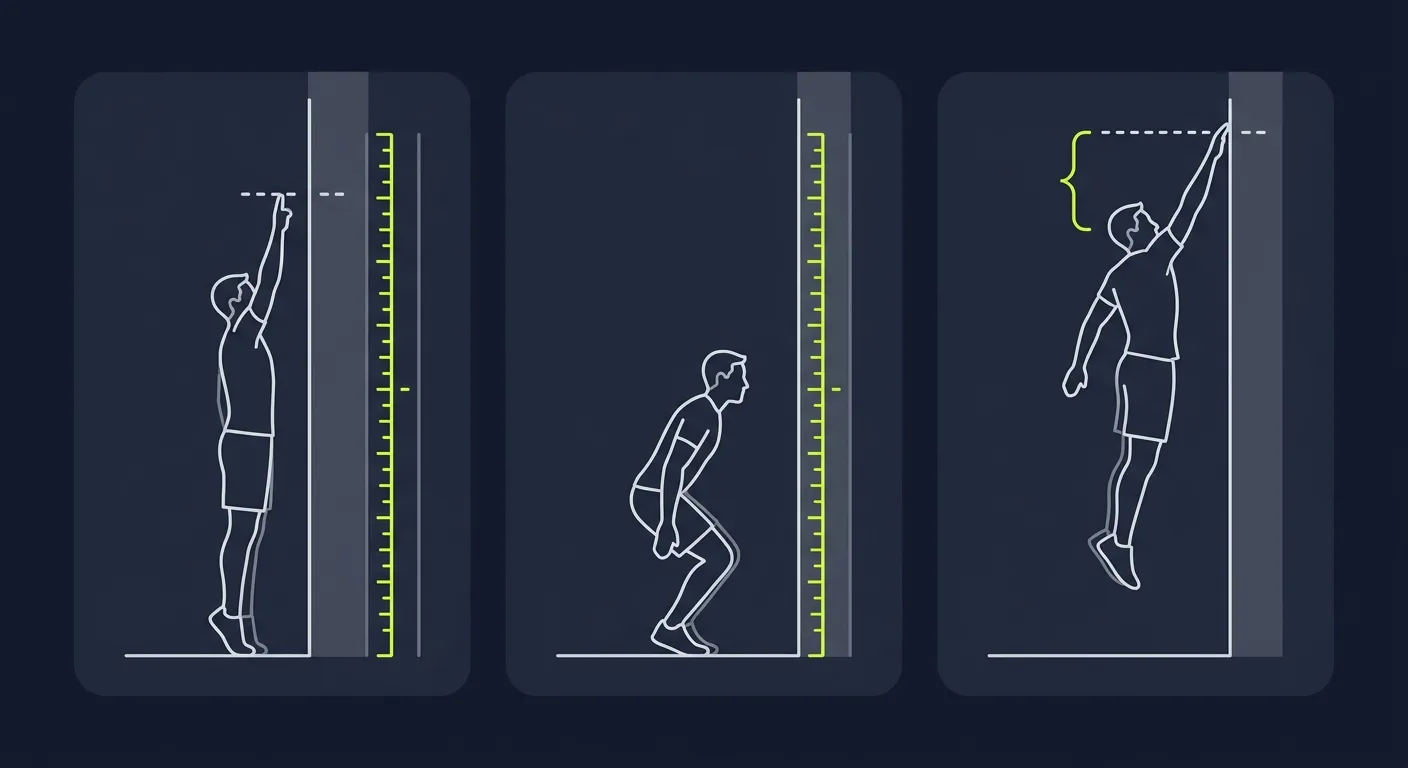
Stand side-on to a wall with both feet flat on the floor, reach up with the hand closest to the wall and mark the highest point your fingertips can touch (standing reach). From the same position, dip into a countermovement, jump as high as possible and touch the wall again at the peak of the jump. Land on the same spot with control. Take three attempts and keep the best. Jump height = jump reach - standing reach. Keep the same wall, same shoes and same time of day when tracking progress, because reach and footwear change the result.
Reading the percentile
The percentile compares your jump against per-athlete bests recorded on Plyomat devices (2026 reference dataset). This is an athlete sample, so a general-population result will usually fall lower than the same number would in a non-athlete table. Percentile is a rough reference, not a performance grade: device, jump instruction and warm-up all change jump height.
Power estimates
When bodyweight is added, three regression equations estimate lower-body power from jump height and mass. Sayers and Harman estimate peak power; Lewis estimates average power. Published cross-validation shows typical errors around 5-10% compared with force plates, so treat the numbers as estimates and always compare using the same equation.
Sources
Last updated 2026-08-13
- Moir, G. (2008). Three different methods of calculating vertical jump height from force platform data in men and women. Journal of Strength and Conditioning Research, 22(1), 202-208.
- Sayers, S. P., Harackiewicz, D. V., Harman, E. A., Frykman, P. N., & Rosenstein, M. T. (1999). Cross-validation of three jump power equations. Medicine & Science in Sports & Exercise, 31(4), 572-577.
- Harman, E. A., Rosenstein, M. T., Frykman, P. N., Rosenstein, R. M., & Kraemer, W. J. (1991). Estimation of human power output from vertical jump. Journal of Applied Sport Science Research, 5(3), 116-120.
- Plyomat. Vertical Jump Norms (per-athlete bests, 2026).
Field-testing result, not a laboratory measurement. Compare only measurements taken with the same protocol; percentile ranges are athlete-reference values, not diagnostic thresholds.
Frequently asked questions
How do I measure vertical jump height correctly?
Stand flat-footed beside a wall and mark your highest reach with chalk on your dominant hand (standing reach). Jump and touch the wall at the highest point of your jump, landing on the same spot. Best of three attempts: jump reach minus standing reach is your jump height.
Is the wall test as accurate as a force plate?
The wall-and-chalk test is a valid field method, but it measures the height of your hand, not your center of mass. It can differ from force-plate jump height because of arm reach and technique, so use the same protocol every time when tracking progress.