Exercise Library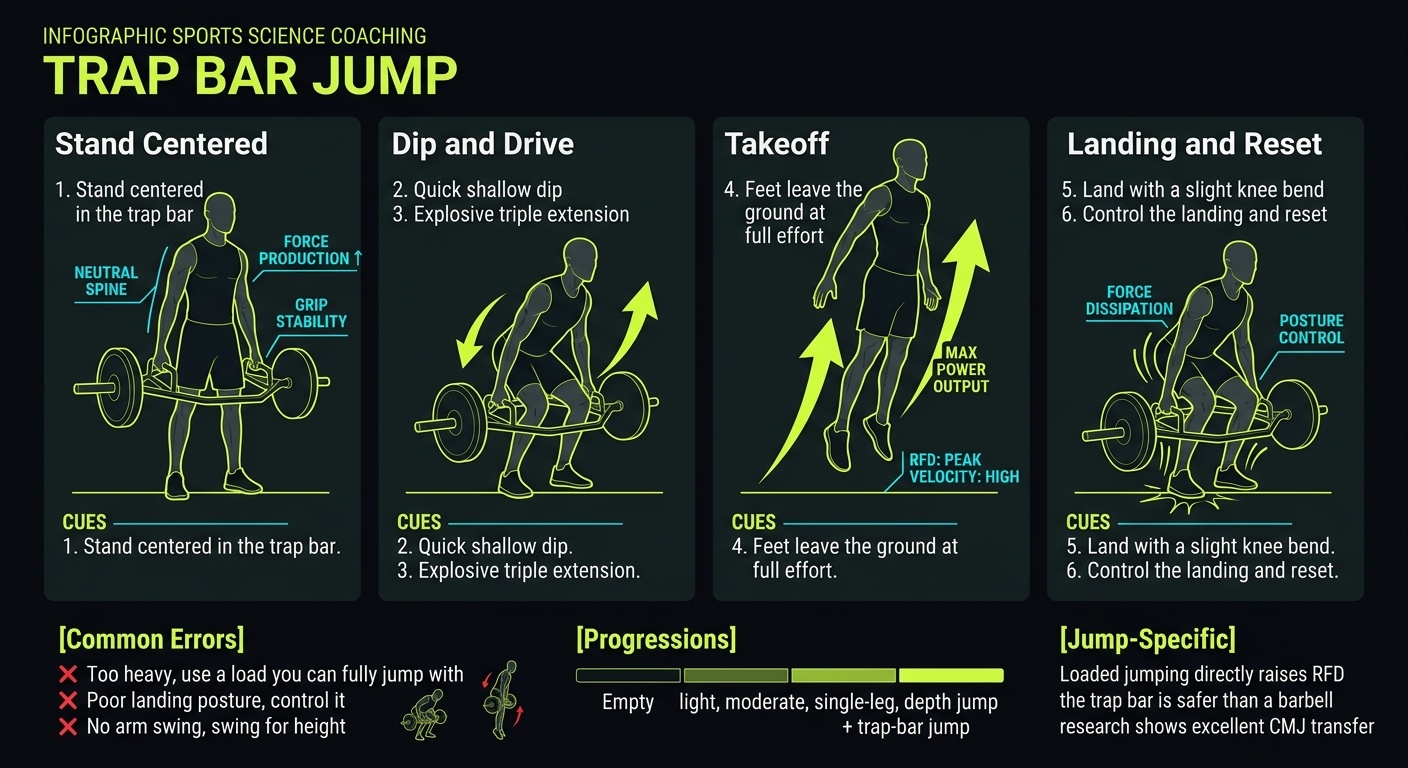
PLYOMETRICS / REACTIVEintermediate
Trap Bar Jump
A more spine-friendly loaded vertical jump — the trap bar places load at the sides with a natural path, ideal for training RFD and takeoff speed in the conversion phase.
Glutes, quads, hamstrings, calves4-6 sets × 3-5 reps @10-30% trap-bar deadlift 1RM
Coaching cues
- 1.Stand centered in the trap bar with a neutral torso
- 2.Quick shallow dip then jump all out
- 3.Load must not reduce jump velocity
- 4.Absorb the landing and reset — no forced rebounds
Detailed training method
[Steps]1. Stand centered in the trap bar→2. Quick shallow dip→3. Explosive triple extension→4. Feet leave the ground at full effort→5. Land with a slight knee bend→6. Control the landing and reset
[Common Errors]✗ Too heavy→use a load you can fully jump with ✗ Poor landing posture→control it ✗ No arm swing→swing for height
[Progressions]Empty bar→light→moderate→single-leg→depth jump + trap-bar jump
[Jump-Specific]Loaded jumping directly raises RFD; the trap bar is safer than a barbell; research shows excellent CMJ transfer
Use a non-slip surface; the bar's landing path must be controlled
Related calculators
Related exercises
Box Jump
The first-choice entry to plyometrics — the box jump teaches fast force production and coordinated landing, a cornerstone of jump training
Depth Drop
The preparatory exercise for depth jumps — the depth drop teaches safe, efficient absorption of landing impact (eccentric strength), laying the safety foundation for explosive rebounds
Single-Leg Landing Control
The safety prerequisite for every single-leg jump — step off a low box or hop forward, land on one leg, and stick the landing for 2 seconds