Do You Need Protein Powder and Supplements for Jump Training?
Food comes first, always. When diet is covered, creatine and caffeine have real evidence — BCAAs and most other powders do not.
Supplements have a strict priority order: whole food first, targeted supplements only to fill a gap. Here is what the evidence actually supports.
The evidence hierarchy is short: diet first, then creatine and caffeine, then everything else. Most supplement money is spent on products with no jump-specific data.
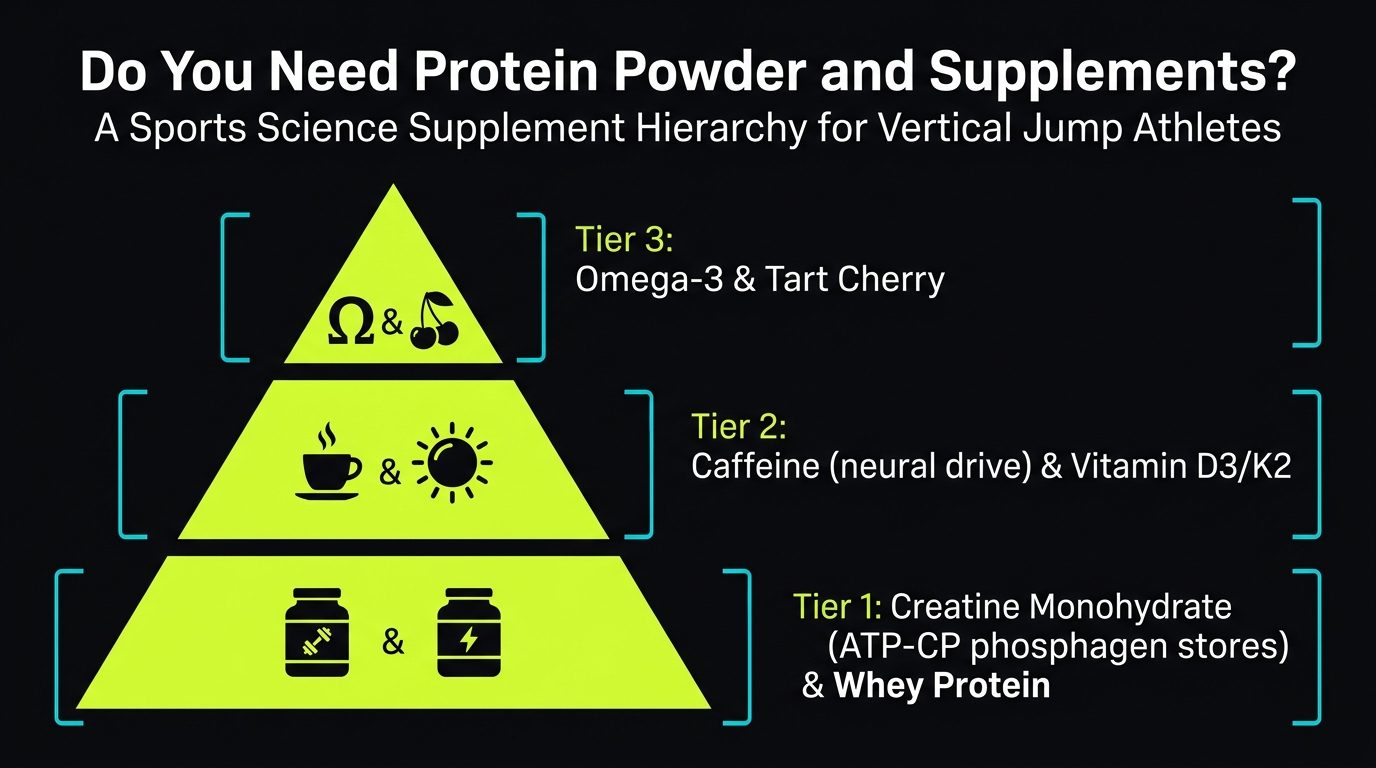
The priority order
Consider supplements only when you cannot reach your protein target from food — for example, needing 150 g/day but getting 100 g from meals. Whey protein is the convenient way to close that gap.
What has evidence
Four supplements consistently show value for jump athletes:
- Whey protein: 30 g post-training delivers amino acids fast.
- Creatine monohydrate: 5 g/day improves power, sprint and jump performance.
- Caffeine: 3–6 mg/kg taken 60 minutes pre-training acutely raises power output 2–5%.
- Beta-alanine: 3–5 g/day helps efforts lasting 60–240 seconds.
What to skip
BCAAs (whole protein is better), glutamine and L-carnitine have little or no evidence for jump training. Fix the diet first; supplements are the last 2–5%, not the foundation.
What the meta-analyses say about creatine
Creatine monohydrate at 5 g/day has the strongest evidence base for power athletes. Network meta-analyses show it significantly improves jump performance and sprint performance versus placebo, and systematic reviews link it to improvements in body composition and strength.
Beta-alanine (3–5 g/day) also shows jump-performance benefits in network meta-analyses, particularly for efforts lasting 60–240 seconds — relevant for repeated jumps and training sessions.
Caffeine as an acute tool
Caffeine at 3–6 mg/kg taken 60 minutes before training acutely raises power output, and meta-analyses confirm an ergogenic effect on vertical jump performance with small-to-moderate effect sizes.
It is a tool, not a daily requirement: use it before key sessions or test days, and be aware that tolerance reduces its effect with daily use.
A rational supplement stack
If you use anything, this is the evidence-ordered version:
- Creatine monohydrate: 5 g/day, every day.
- Caffeine: 3–6 mg/kg, 60 minutes before key sessions only.
- Whey protein: only to close a real protein gap from food.
- Beta-alanine: 3–5 g/day if repeated high-intensity efforts are a training focus.
- Skip: BCAAs, glutamine, L-carnitine.
Key takeaways
- Whole food beats every supplement.
- Creatine and caffeine are the two with the clearest jump-specific evidence.
- Skip BCAAs and most powders until the diet is already right.
- Creatine and beta-alanine have the clearest jump evidence; caffeine is an acute tool, not a daily habit.
- If diet covers protein, most supplements are unnecessary.
Related calculators
References
- Kreider et al. (2017) J Int Soc Sports Nutr
- Thomas et al. (2016) J Acad Nutr Diet
- Network meta-analysis: creatine and beta-alanine on jump performance (2026)
- PubMed: Caffeine and jumping performance meta-analysis (2023)
Keep reading
NUTRITION & RECOVERY
Sleep and Vertical Jump: The Lever You're Ignoring
Sleep below 7 hours cuts strength 10–15%. Here is the evidence and a practical protocol for sleep that actually improves jumping.
NUTRITION & RECOVERY
What Should You Eat for Jump Training?
Protein, carbs, fat, timing and hydration for a 70 kg jump athlete — plus the two things to strictly avoid. How to fuel power training, pre-session and recovery with evidence-based numbers.
NUTRITION & RECOVERY
How to Speed Up Recovery from DOMS
Muscle soreness peaks at 24–72 hours and is a normal training response. What works, what does nothing, and how to tell it from injury.