Sleep and Vertical Jump: The Lever You're Ignoring
Sleep below 7 hours cuts strength 10–15%. Here is the evidence and a practical protocol for sleep that actually improves jumping.
No supplement, program or coach cue matters as much as sleep if you are under-rested. It is the most underrated lever in jump training because it sits underneath everything else: strength, skill, motivation and injury risk.
Think of sleep as the recovery phase of every training session: the stimulus is applied during the workout, but the adaptation is built while you sleep.
What the evidence says
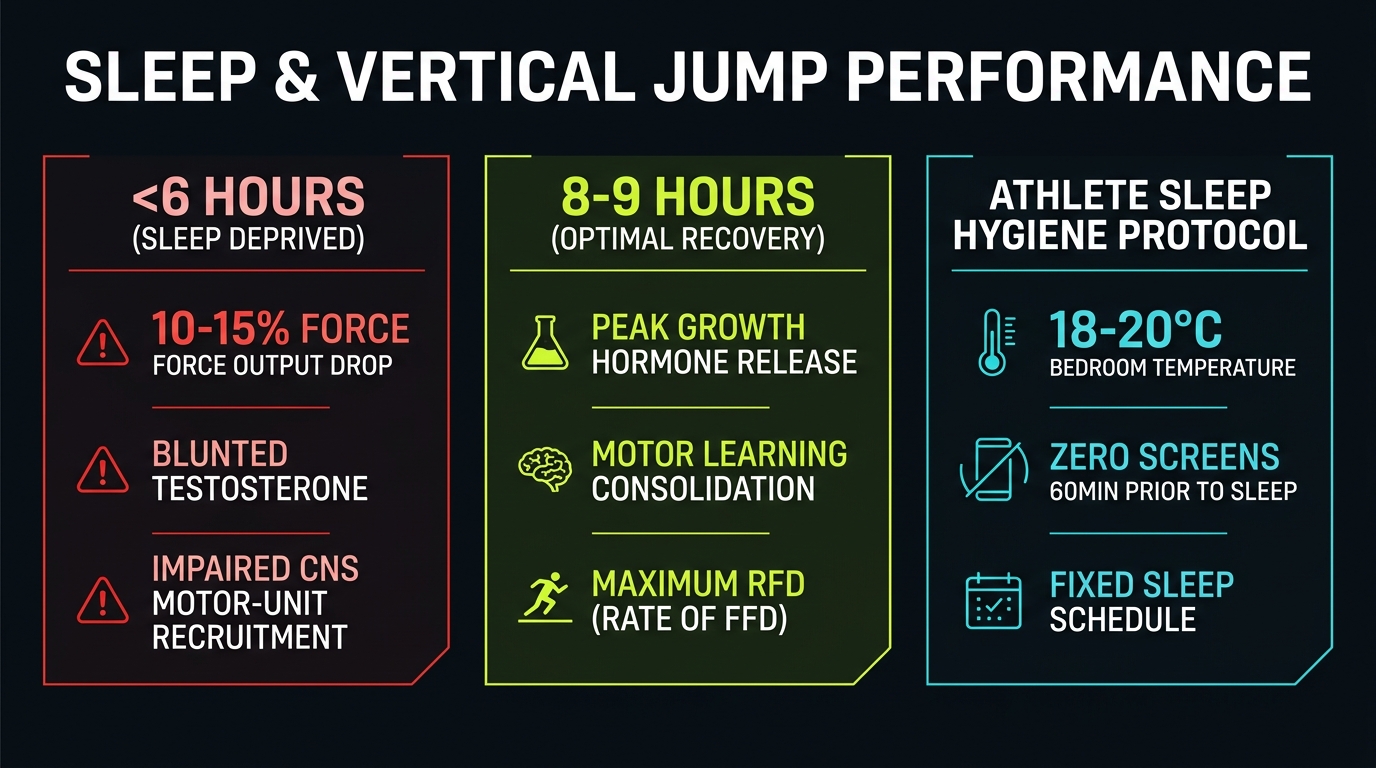
The numbers are hard to argue with:
- Under 6 hours of sleep drops strength output 10–15%.
- Sleep deprivation lowers testosterone, slowing muscle repair and growth.
- REM sleep is a key window for motor-skill consolidation — including jump technique.
- A Stanford basketball study showed that extended sleep (8+ hours) improved sprint speed and shooting accuracy.
How to optimize sleep
A practical protocol, in order of impact:
- Fixed bed and wake times within 30 minutes, every day.
- No screens for 1 hour before bed — blue light suppresses melatonin.
- A completely dark bedroom at 18–20°C.
- A warm shower before bed (40°C × 15 min); the core cooling afterward induces sleep.
- Avoid caffeine 5–6 hours before bed and heated discussions late at night.
How much is enough
Most athletes need 7–9 hours. If your jump tests are flat while training is on point, check sleep first — it is cheaper and more reliable than any training change.
The sleep-performance data
The Stanford sleep-extension study on collegiate basketball players is the clearest example: extending sleep to 8+ hours improved sprint speed, shooting accuracy and reaction time. Systematic reviews of basketball players consistently confirm a strong relationship between sleep and on-court performance.
The mechanisms are direct: sleep below 6 hours drops strength output 10–15%, sleep deprivation lowers testosterone, and REM sleep consolidates the motor skills — including jump technique — trained during the day.
Sleep debt and training quality
Under-rested athletes produce less power, perceive the same session as harder, and make more technique errors — all of which quietly lower the quality of every rep. Chronic debt compounds because it slows recovery from each session, creating a downward spiral that looks like a training plateau.
A sleep-first troubleshooting protocol
When jump numbers go flat, run this for one week before changing the program:
- Fix bed and wake times within 30 minutes.
- Target 8–9 hours of time in bed.
- No screens for 1 hour before bed.
- Dark, cool room at 18–20°C.
- Log sleep duration and next-day CMJ, then compare after 7 days.
Key takeaways
- Sleep under 6 hours costs 10–15% of strength output.
- Fixed schedule, dark cool room and no late screens are the highest-impact fixes.
- When progress stalls, audit sleep before changing the program.
- Sleep extension improves sprint, shooting and reaction time in athletes.
- Treat sleep as a training variable: log it like volume and RPE.
Related calculators
References
- Reilly & Edwards (2007) Sports Med
- Leproult & Van Cauter (2011) JAMA
- Mah et al. (2011) Sleep
- PubMed: Sleep extension and basketball performance (Mah et al., 2011)
Keep reading
NUTRITION & RECOVERY
What Should You Eat for Jump Training?
Protein, carbs, fat, timing and hydration for a 70 kg jump athlete — plus the two things to strictly avoid. How to fuel power training, pre-session and recovery with evidence-based numbers.
NUTRITION & RECOVERY
Do You Need Protein Powder and Supplements for Jump Training?
Food comes first, always. When diet is covered, creatine and caffeine have real evidence — BCAAs and most other powders do not.
NUTRITION & RECOVERY
How to Speed Up Recovery from DOMS
Muscle soreness peaks at 24–72 hours and is a normal training response. What works, what does nothing, and how to tell it from injury.
Related exercises
Contrast Bath Therapy
Professional recovery after high-intensity jump sessions — contrast baths boost circulation and metabolic-waste clearance, speeding lower-limb recovery
Foam Rolling: Quadriceps
Essential quad recovery after jump training — foam rolling relieves the most loaded muscle group, preventing patellar overload and muscle stiffness