How to Speed Up Recovery from DOMS
Muscle soreness peaks at 24–72 hours and is a normal training response. What works, what does nothing, and how to tell it from injury.
Delayed-onset muscle soreness is the normal response to eccentric work — the kind jumping is full of. It peaks at 24–72 hours, and while you cannot make it disappear, you can speed the recovery and avoid making it worse.
DOMS is not a training failure — it is the signature of eccentric work. The goal is not to eliminate it but to recover well enough to train again.
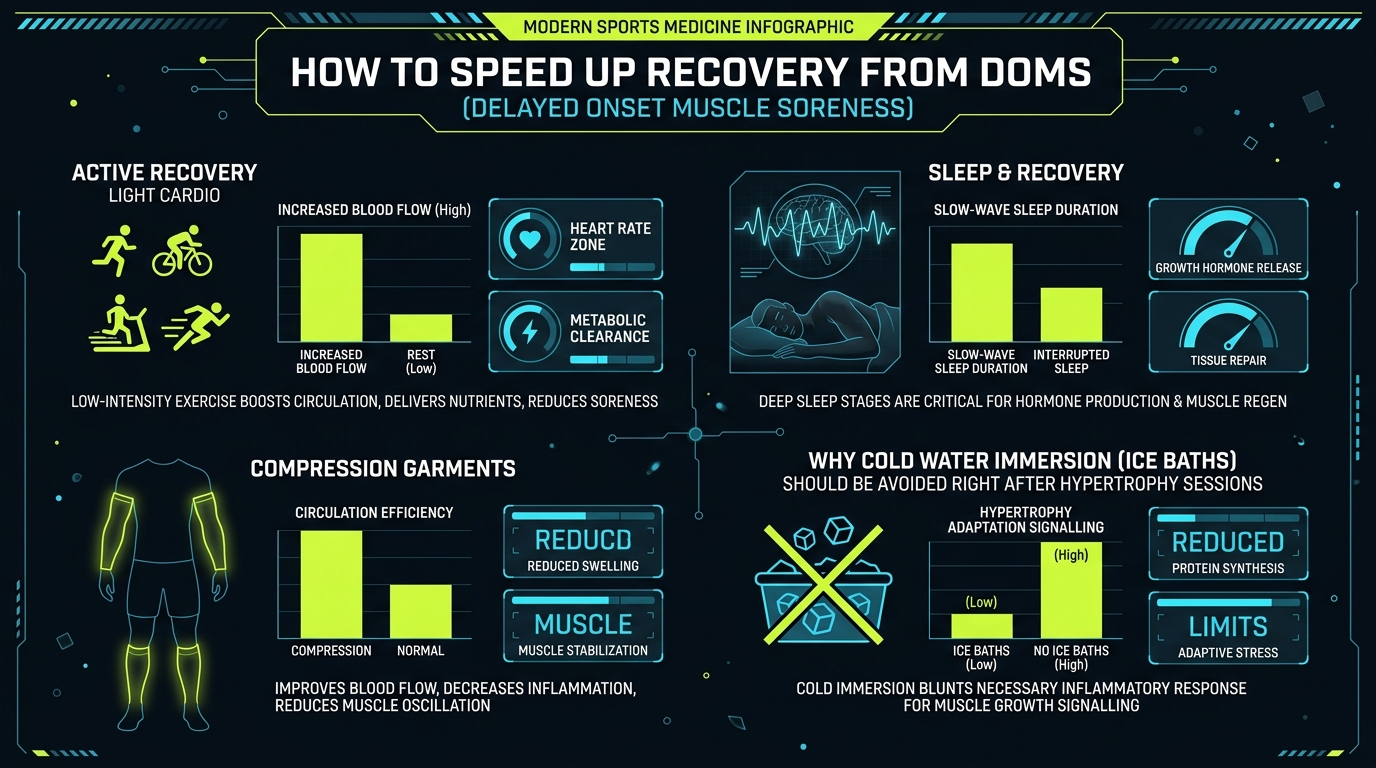
What actually works
Four interventions with evidence behind them:
- Light active recovery: 15–20 minutes of low-intensity cycling or walking improves blood flow.
- Adequate sleep: growth hormone pulses during slow-wave sleep are the natural repair window.
- Protein intake: 20–40 g every 3–4 hours continuously feeds repairing muscle.
- Foam rolling or massage: moderate pressure reduces perceived soreness.
What does not help
Ice baths may blunt hypertrophy adaptations, NSAIDs suppress protein synthesis, and stretching does not reduce DOMS. Skip all three unless a professional prescribes them.
DOMS vs injury
DOMS is normal and fades in 48–72 hours. Sharp pain, one-sided pain or joint pain is not DOMS — treat it as an injury signal.
Why eccentric work causes DOMS
Eccentric contractions — the lowering and landing phases of jumping — produce microscopic muscle damage and inflammation that peak 24–72 hours later. The same exposure becomes less painful with repeated training, which is why DOMS fades as an athlete adapts.
The recovery hierarchy
Order the interventions by evidence:
- Sleep: growth hormone pulses during slow-wave sleep are the main repair window.
- Protein: 20–40 g every 3–4 hours feeds the repair process.
- Light active recovery: 15–20 minutes of cycling or walking improves blood flow.
- Foam rolling or massage: reduces perceived soreness, not damage.
- Skip ice baths and NSAIDs unless prescribed — both may blunt adaptation.
Training through DOMS
Light training is fine while movement quality is intact. Heavy plyometrics with significant DOMS are not: fatigued, sore muscles produce sloppy landings and raise injury risk.
Delay maximal jump efforts for 48–72 hours after a heavy eccentric session, and use the sore window for technique, mobility and low-impact work.
Key takeaways
- Active recovery, sleep, protein and foam rolling speed DOMS recovery.
- Ice baths, NSAIDs and stretching do not help and may hurt adaptation.
- Sharp, one-sided or joint pain is not DOMS.
- DOMS fades with adaptation — repeated eccentric work makes it milder.
- Train light through DOMS, but delay maximal jumps until movement quality is back.
Related calculators
References
- Cheung et al. (2003) Sports Med
- Jäger et al. (2017) J Int Soc Sports Nutr
- Barnett (2006) Sports Med
- PubMed: Eccentric exercise, muscle damage and recovery
Keep reading
NUTRITION & RECOVERY
Sleep and Vertical Jump: The Lever You're Ignoring
Sleep below 7 hours cuts strength 10–15%. Here is the evidence and a practical protocol for sleep that actually improves jumping.
NUTRITION & RECOVERY
What Should You Eat for Jump Training?
Protein, carbs, fat, timing and hydration for a 70 kg jump athlete — plus the two things to strictly avoid. How to fuel power training, pre-session and recovery with evidence-based numbers.
NUTRITION & RECOVERY
Do You Need Protein Powder and Supplements for Jump Training?
Food comes first, always. When diet is covered, creatine and caffeine have real evidence — BCAAs and most other powders do not.
Related exercises
Contrast Bath Therapy
Professional recovery after high-intensity jump sessions — contrast baths boost circulation and metabolic-waste clearance, speeding lower-limb recovery
Foam Rolling: Quadriceps
Essential quad recovery after jump training — foam rolling relieves the most loaded muscle group, preventing patellar overload and muscle stiffness
Foam Rolling: Calves
Protect the 'spring' of jumping — calf foam rolling prevents Achilles tendinopathy and plantar fasciitis while maintaining tendon elasticity