What Should You Eat for Jump Training?
Protein, carbs, fat, timing and hydration for a 70 kg jump athlete — plus the two things to strictly avoid. How to fuel power training, pre-session and recovery with evidence-based numbers.
Jump training is power training, and power training runs on a specific fuel mix. The numbers below are for a ~70 kg athlete; scale them with bodyweight.
Nutrition for power athletes is less about 'clean eating' and more about covering three non-negotiables: total protein, training-day carbohydrate and hydration. Everything else is fine-tuning.
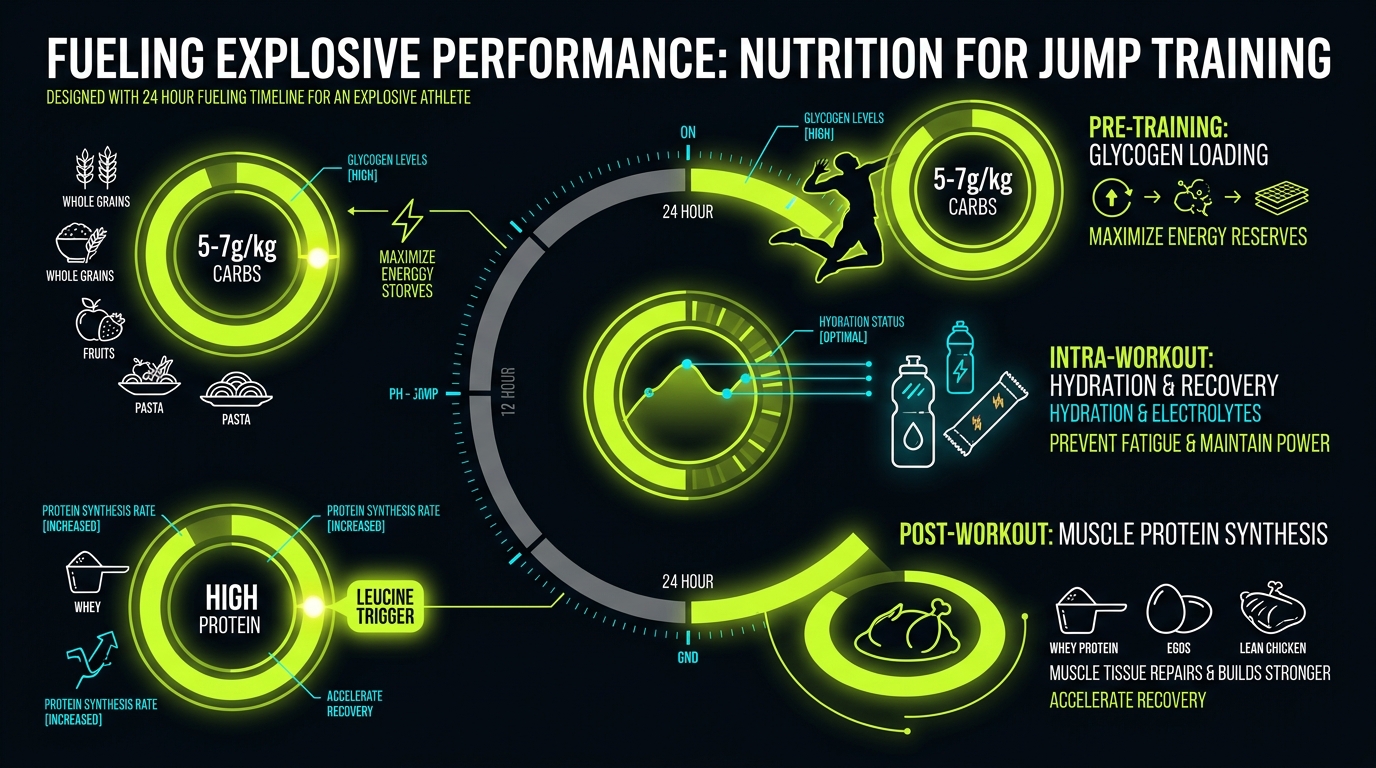
The daily targets
For a 70 kg athlete:
- Protein: 1.6–2.2 g/kg/day (~112–154 g), spread across 4–5 meals of 30–40 g each.
- Carbs: 4–6 g/kg/day on training days (~280–420 g) — glycolysis fuels high-intensity power work.
- Fat: 0.8–1.2 g/kg/day, favoring monounsaturated fat and omega-3 from fatty fish.
Timing and hydration
In the 30–60 minutes after training, take 20–40 g protein with 40–80 g carbs. Drink 3–4 L of water daily — even 1% dehydration lowers power output by 2–3%.
Strictly avoid
Alcohol suppresses protein synthesis by up to 30% for 24–48 hours, and highly processed foods displace the whole-food base your training depends on.
Protein distribution and the 30–40 g meals
Total daily protein is the primary target — 1.6–2.2 g/kg — but distribution matters for consistency: 4–5 meals of 30–40 g each keeps muscle protein synthesis stimulated through the day.
Systematic reviews show protein intake provides modest performance benefits, mainly by supporting strength adaptation and glycogen recovery when combined with carbohydrate. The post-training window is real but secondary to hitting the daily total.
Carbohydrate periodization
High-intensity power training runs on glycolysis, so training days need 4–6 g/kg of carbohydrate. Lighter or rest days can run lower without hurting performance.
In the 30–60 minutes after training, combine 20–40 g of protein with 40–80 g of carbs to refuel glycogen and start repair.
Hydration and the 2–3% rule
Even 1% dehydration lowers power output by 2–3%, and the effect grows with the deficit. Drink 3–4 L per day and check urine color as a simple guide.
Alcohol is the one thing to strictly avoid near training: it suppresses protein synthesis by up to 30% for 24–48 hours.
Key takeaways
- Hit 1.6–2.2 g/kg protein and 4–6 g/kg carbs on training days.
- Refuel within 30–60 minutes after sessions.
- 1% dehydration costs 2–3% power — drink through the day.
- Spread protein across 4–5 meals; timing matters less than the daily total.
- Carbohydrate and hydration are performance fuels, not optional extras.
Related calculators
References
- Thomas et al. (2016) J Acad Nutr Diet
- Maughan & Shirreffs (2010) Scand J Med Sci Sports
- Jäger et al. (2017) J Int Soc Sports Nutr
- Frontiers in Nutrition: Protein intake and athletic performance meta-analysis (2024)
Keep reading
NUTRITION & RECOVERY
Sleep and Vertical Jump: The Lever You're Ignoring
Sleep below 7 hours cuts strength 10–15%. Here is the evidence and a practical protocol for sleep that actually improves jumping.
NUTRITION & RECOVERY
Do You Need Protein Powder and Supplements for Jump Training?
Food comes first, always. When diet is covered, creatine and caffeine have real evidence — BCAAs and most other powders do not.
NUTRITION & RECOVERY
How to Speed Up Recovery from DOMS
Muscle soreness peaks at 24–72 hours and is a normal training response. What works, what does nothing, and how to tell it from injury.