Rest Intervals for Jump Training: The Complete Guide
Rest length changes what a set actually trains. Here are the exact intervals for strength, power, hypertrophy and rehab work.
Rest is not dead time — it is what decides whether a set trains strength, power, size or endurance. The right interval depends entirely on the goal of the set.
Rest intervals are also the cheapest programming tool you have: changing them changes the adaptation of the same exercise without changing the movement.
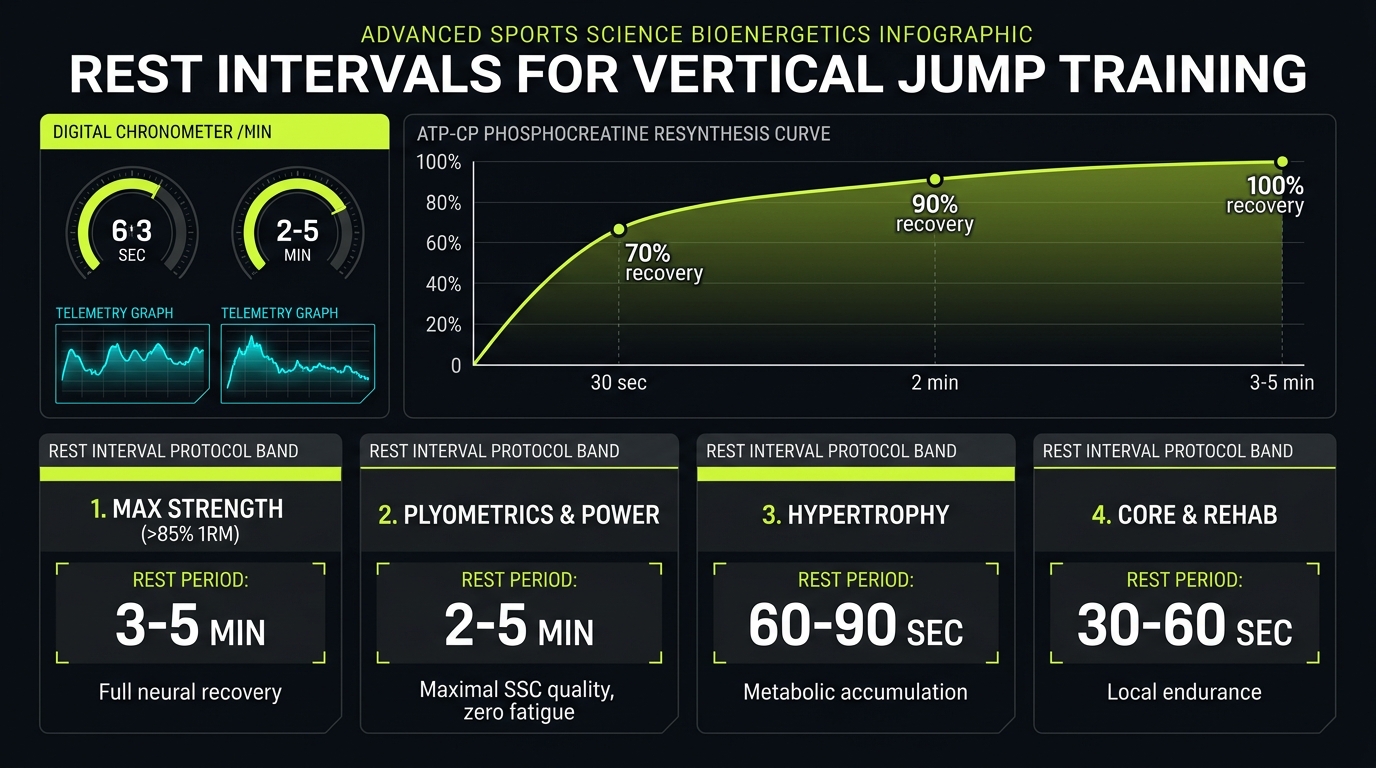
Intervals by goal
Use these bands as defaults:
- Max strength (above 85% 1RM): 3–5 minutes — fully restore ATP-CP.
- Plyometric/power: 2–5 minutes — every jump must be maximal.
- Hypertrophy accessory: 60–90 seconds — metabolic stress drives growth.
- Core/rehab: 30–60 seconds — low-load, high-control work tolerates short rest.
The most common error
Too little rest in plyometrics — under 90 seconds — turns later sets into fatigued jumping instead of explosive jumping. Fewer sets at full quality beat more sets at reduced quality.
The physiology of the rest interval
Maximal power output depends on phosphocreatine (ATP-CP), which takes roughly 2–3 minutes to restore most of the way and 3–5 minutes for full recovery. Strength and power work therefore needs the longer bands, while hypertrophy work uses short rest to accumulate metabolic stress.
When rest is too short, later sets look like the same exercise but train something else: fatigue tolerance instead of force or power.
Intervals in mixed sessions
In a session that combines strength and plyometrics, rest each according to its own goal: 3–5 minutes after heavy sets, 2–5 minutes between jump sets. Use a clock, not 'when I feel ready' — perceived readiness systematically underdoses recovery in hard sessions.
How to test your own rest
Track jump height across sets: if set 3 drops more than roughly 10% below set 1, rest is too short. If output stays stable and RPE stays low, the interval is appropriate — and if you need to shorten it, do so deliberately and measure the cost.
Key takeaways
- Strength and power work needs 2–5 minutes of rest.
- Short rest converts power work into conditioning.
- When in doubt, rest longer and jump higher.
- Clock your rest; 'when I feel ready' underdoses recovery.
- If set 3 drops more than ~10% from set 1, rest longer.
Related calculators
References
- NSCA Essentials of Strength Training and Conditioning (4th ed.), Ch. 15
- Verkhoshansky & Siff (2009) Supertraining, Ch. 4
- PubMed: Rest interval and power output in resistance training
Keep reading
TRAINING METHODS
How Many Jump Training Sessions Per Week Do You Actually Need?
Training frequency by experience level, safe plyometric contact volume, and the warning signs that tell you to cut back.
TRAINING METHODS
How Deep Should You Squat to Jump Higher?
Full, half and quarter squats each have a role in jump training. Here is how to periodize squat depth instead of choosing one forever.
TRAINING METHODS
How to Split Strength and Plyometric Training
Combined strength and plyometric training beats either alone. Here are the phase ratios, same-day ordering rules and common mistakes.
Related exercises
Power Clean
Pull the bar explosively from the floor to the front shoulders (caught in a quarter squat)
Depth Jump
The gold-standard jump exercise — the depth jump maximizes SSC (stretch-shortening cycle) use, directly raising reactive strength and jump height
Barbell Back Squat
The king of strength training and an irreplaceable foundation movement for jump training