How Many Jump Training Sessions Per Week Do You Actually Need?
Training frequency by experience level, safe plyometric contact volume, and the warning signs that tell you to cut back.
More jump training is not automatically better. Frequency decisions should be driven by experience level, total jump contacts and how well you recover — not by how motivated you feel.
Here is the frequency framework used by the BounceLab knowledge base, with the volume limits that keep plyometrics productive instead of destructive.
Frequency also interacts with intensity: two hard sessions with poor recovery can be worse than one quality session. The numbers below assume each session is performed fresh enough to produce maximal intent.
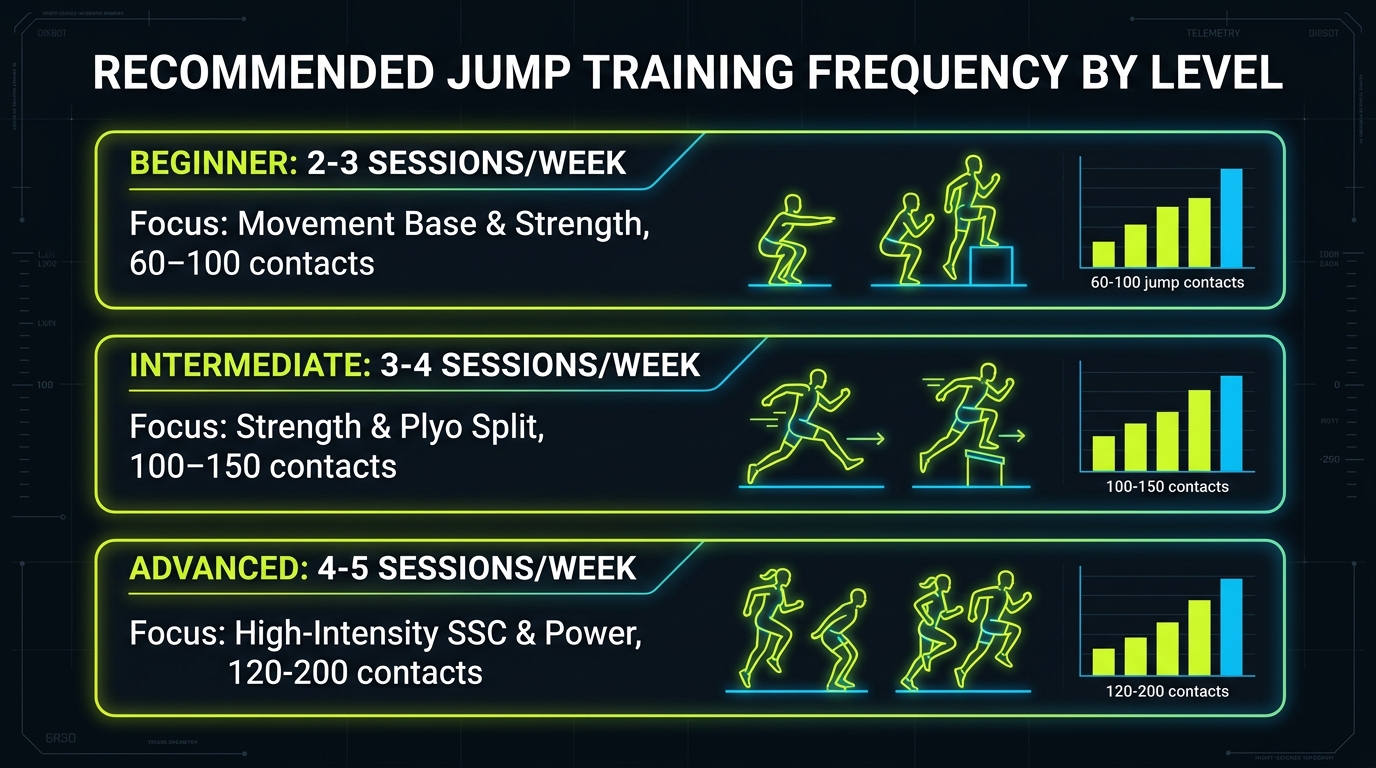
Frequency by experience level
A practical starting point:
- Beginner (under 6 months): 2–3 sessions/week, 45–60 minutes, focused on movement patterns and base strength.
- Intermediate (6–24 months): 3–4 sessions/week, 60–90 minutes, split into lower-body strength and plyometrics.
- Advanced (over 2 years): 4–5 sessions/week, 60–90 minutes; double sessions become possible when recovery supports them.
The 50–100 contact rule
Plyometric volume is best tracked by foot contacts, not minutes. Research-based recommendations for jump training sit around 50–100 quality contacts per session. Too little under-stimulates; too much masks power with fatigue and raises injury risk.
Use RPE, not the calendar
The best in-session gauge is perceived effort at 7–8 out of 10. If you cannot produce maximal intent on a jump, the session is no longer training power — it is training fatigue.
Overtraining warning signs
Cut volume immediately if you notice a cluster of these:
- Persistent soreness that does not clear between sessions.
- Insomnia or poor sleep quality.
- Low mood or loss of motivation.
- Elevated resting heart rate.
A week that works
A common split is high-intensity plyometrics twice per week (for example Monday and Thursday), strength twice (Tuesday and Friday) and one low-intensity or recovery session, with at least 48 hours between hard plyometric sessions.
Beginners can compress this to two plyometric and two strength sessions; advanced athletes can add a third low-volume plyometric day when recovery supports it.
Session versus weekly volume
Within a session, 50–100 quality contacts is the productive band. Across the week, NSCA guidelines suggest 60–100 contacts for beginners, 100–150 for intermediate and 120–200 for advanced athletes.
Count every single-foot or both-feet landing as one contact and log it — minutes do not tell you how much loading the legs actually received.
Progressing frequency safely
Add one session per week at a time and hold it for 2–3 weeks before adding another. If jump tests drop more than 5% or RPE climbs across sessions, remove the added session before reducing the ones that were already working.
Key takeaways
- Beginners need 2–3 sessions/week; advanced athletes can push 4–5 with proper splits.
- Keep plyometric contacts around 50–100 per session and make every rep maximal.
- Treat persistent soreness, insomnia, low mood and elevated resting heart rate as a stop signal.
- Space hard plyometric sessions at least 48 hours apart.
- Log contacts per session; add frequency only when tests and RPE are stable.
Related calculators
References
- NSCA Essentials of Strength Training and Conditioning (4th ed.), Ch. 21
- Bompa & Buzzichelli (2019) Periodization: Theory and Methodology of Training (6th ed.)
- NSCA Essentials of Strength Training and Conditioning (4th ed.), Ch. 18
Keep reading
TRAINING METHODS
How Deep Should You Squat to Jump Higher?
Full, half and quarter squats each have a role in jump training. Here is how to periodize squat depth instead of choosing one forever.
TRAINING METHODS
How to Split Strength and Plyometric Training
Combined strength and plyometric training beats either alone. Here are the phase ratios, same-day ordering rules and common mistakes.
TRAINING METHODS
Can Bodyweight Training Improve Your Jump?
Yes for absolute beginners — then it hits a ceiling. Here is where bodyweight work fits and when you must add load.
Related exercises
Box Jump
The first-choice entry to plyometrics — the box jump teaches fast force production and coordinated landing, a cornerstone of jump training
Pogo Jump
The two-foot entry of the ankle-elasticity family — pogo jumps train Achilles stiffness and elastic-energy utilization
Hurdle Hop
A great tool for continuous power and jump rhythm — hurdle hops are more dynamic than box jumps and directly strengthen SSC efficiency