Pogo Jump
The two-foot entry of the ankle-elasticity family — pogo jumps train Achilles stiffness and elastic-energy utilization. The calf-Achilles complex makes a large contribution to elastic energy return during short-contact jumps, though the exact percentage varies between individuals. Keep the knees slightly bent and bounce continuously using only the ankles and calves, with very short contact times (<150ms).
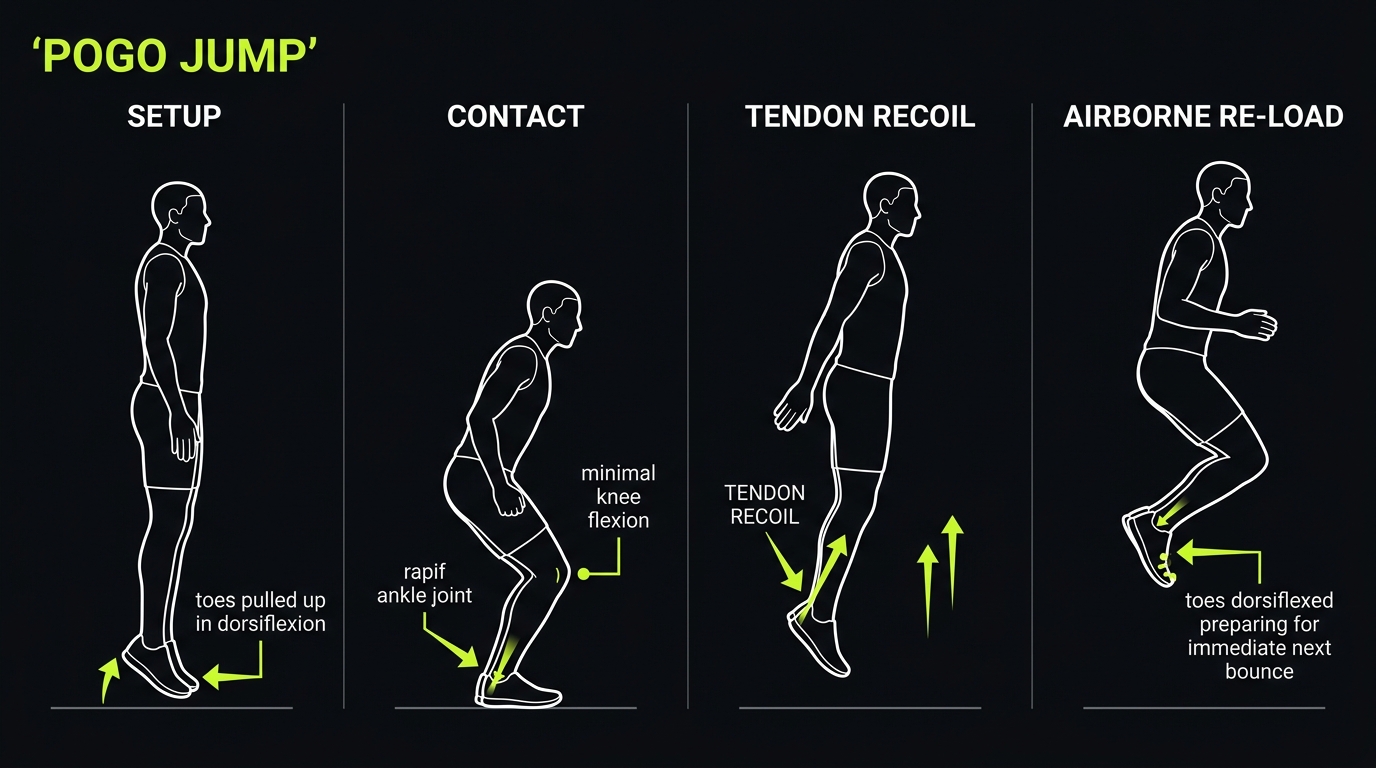
Coaching cues
- 1.Knees barely bend — only the ankles move
- 2.Forefoot touches and instantly rebounds
- 3.Torso upright, core braced
- 4.Do 30-50 continuous — build the elastic rhythm
Detailed training method
Related calculators
Related exercises
Box Jump
The first-choice entry to plyometrics — the box jump teaches fast force production and coordinated landing, a cornerstone of jump training
Depth Drop
The preparatory exercise for depth jumps — the depth drop teaches safe, efficient absorption of landing impact (eccentric strength), laying the safety foundation for explosive rebounds
Single-Leg Landing Control
The safety prerequisite for every single-leg jump — step off a low box or hop forward, land on one leg, and stick the landing for 2 seconds
Related articles
How Many Jump Training Sessions Per Week Do You Actually Need?
Training frequency by experience level, safe plyometric contact volume, and the warning signs that tell you to cut back.
What Is Plyometrics? A Safe Starting Guide
The stretch-shortening cycle explained, fast vs slow SSC, the NSCA entry criteria and low-intensity progressions for beginners.
How to Count and Control Plyometric Contacts
Foot contacts are the real volume unit for plyometrics. Learn weekly volume by level, session math and the monitoring rules that keep jumps fast.
The Right Warm-Up Before Plyometrics
Cold muscles doing high-intensity stretch-shortening work get injured. Here is the 15–20 minute warm-up protocol used before plyometric sessions.
Returning to Training After an Ankle Sprain
Grades, timeframes and the functional return criteria that matter more than the calendar — plus the staged path back to jumping.
Can You Do Plyometrics Every Day? (No — Here's Why)
The nervous system needs 48–72 hours to recover from high-intensity stretch-shortening work. Here is how to schedule it correctly.
How to Do a Deload Week (Without Losing Progress)
The three ways to deload, how often, and why performance often peaks the week after a deload — not during the hardest training.
Overcoming the Fear of Jumping After Injury
Kinesiophobia fades through graded exposure, cognitive reframing and success experiences — not through waiting.
How to Stay Motivated and Consistent Long-Term
Motivation fluctuates even for elite athletes. Identity, process tracking and minimum commitments are what survive the bad weeks.