The Right Warm-Up Before Plyometrics
Cold muscles doing high-intensity stretch-shortening work get injured. Here is the 15–20 minute warm-up protocol used before plyometric sessions.
Plyometrics demand maximal intent from the first rep, which means the warm-up has one job: make you light, warm and springy — not tired.
Think of the warm-up as part of the session's dose: it raises muscle temperature, speeds nerve conduction and prepares the tendons for high-rate loading. Skipping it does not save time — it borrows it from the session.
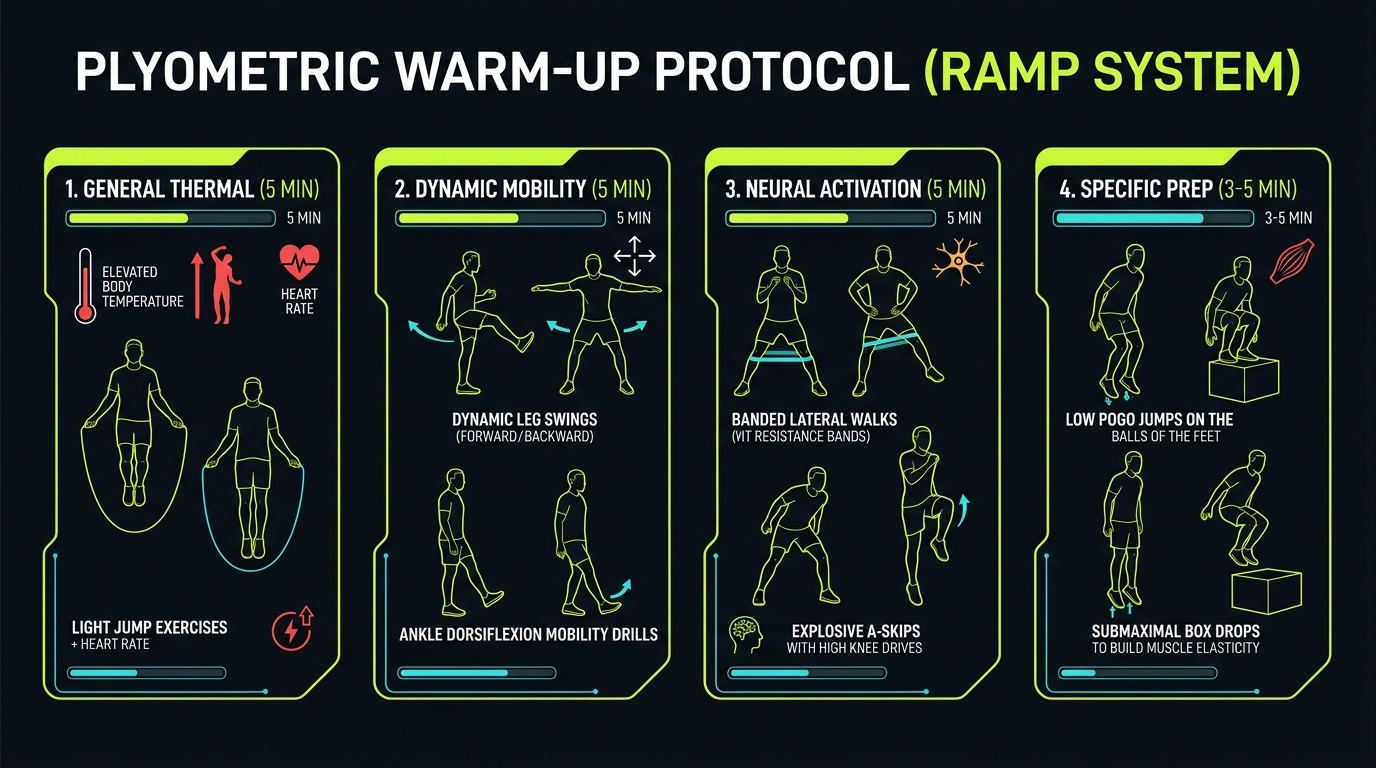
The 15–20 minute protocol
A standard progression that covers temperature, range, activation and specific prep:
- General warm-up (5 min): light aerobic work like jump rope or dynamic movement to raise body temperature.
- Dynamic stretching (5 min): leg swings front-back and lateral, hip circles, ankle alphabet.
- Activation (5 min): glute bridges 2×15, banded lateral walks, A-skips 2×15m.
- Specific prep (3–5 min): low-intensity pogo jumps 2×10, low box jumps 2×3, building toward training intensity.
The 'light and springy' test
After the warm-up you should feel ready to move fast — not breathless and not fatigued. If the warm-up tires you, it is too long or too intense. Shorten it rather than skipping it.
Why the warm-up matters physiologically
Raised muscle temperature improves force production and shortening velocity, and faster nerve conduction shortens reaction time. The tendons also benefit: higher temperature increases their ability to absorb and return elastic energy.
Protocols like FIFA 11+ show that structured, sport-specific warm-ups reduce injury rates — the plyometric warm-up is the same principle applied to one session.
Common warm-up mistakes
Most warm-ups fail in one of five ways:
- Only static stretching — it does not raise temperature or prepare fast SSC work.
- Too long — anything over 25 minutes starts stealing session quality.
- Too intense — finishing breathless means the warm-up became training.
- Skipping activation — weak glutes change landing mechanics.
- Rushing specific prep — the first maximal jump should never be a cold jump.
Adapting for morning and cold sessions
Morning sessions and cold environments need more: extend the general phase to 7–8 minutes, add an extra round of low-intensity pogo jumps, and spend more time on activation before the specific prep.
The 'light and springy' target is the same — only the time to reach it changes.
Key takeaways
- Never start high-intensity plyometrics cold.
- Follow: general → dynamic → activation → specific prep.
- Finish feeling light and springy; if you feel tired, the warm-up was too much.
- Warm up for 15–20 minutes; allow more in the morning or cold environments.
- The first maximal jump should never be a cold jump.
Related calculators
References
- FIFA 11+ Warm-up Protocol
- NSCA Essentials of Strength Training and Conditioning (4th ed.), Ch. 14
Keep reading
PLYOMETRICS
Depth Jump Technique: The Complete Guide
Box height, step-off vs jump-off, contact time, rebound direction and the common errors that turn depth jumps from a power tool into a injury risk.
PLYOMETRICS
What Is Plyometrics? A Safe Starting Guide
The stretch-shortening cycle explained, fast vs slow SSC, the NSCA entry criteria and low-intensity progressions for beginners.
PLYOMETRICS
How to Count and Control Plyometric Contacts
Foot contacts are the real volume unit for plyometrics. Learn weekly volume by level, session math and the monitoring rules that keep jumps fast.
Related exercises
A-Skip
A core warm-up and running-form movement — A-skips build hip-flexor strength and cadence, directly helping the active knee drive of jumping
Ankle Alphabet Drill
The pre-training ankle activator — alphabet drills cover every ankle movement direction, warming up for the complex ankle actions of jumping
Pogo Jump
The two-foot entry of the ankle-elasticity family — pogo jumps train Achilles stiffness and elastic-energy utilization