How to Count and Control Plyometric Contacts
Foot contacts are the real volume unit for plyometrics. Learn weekly volume by level, session math and the monitoring rules that keep jumps fast.
Minutes are a poor way to dose plyometrics. The standard unit is a foot contact: one contact is one foot or both feet landing once. Track contacts and you can compare sessions, weeks and athletes honestly.
Counting rules matter for comparison: a bilateral box jump counts as one contact, while a single-leg bound counts one contact per footfall. Agree on the rule before you trust the number.
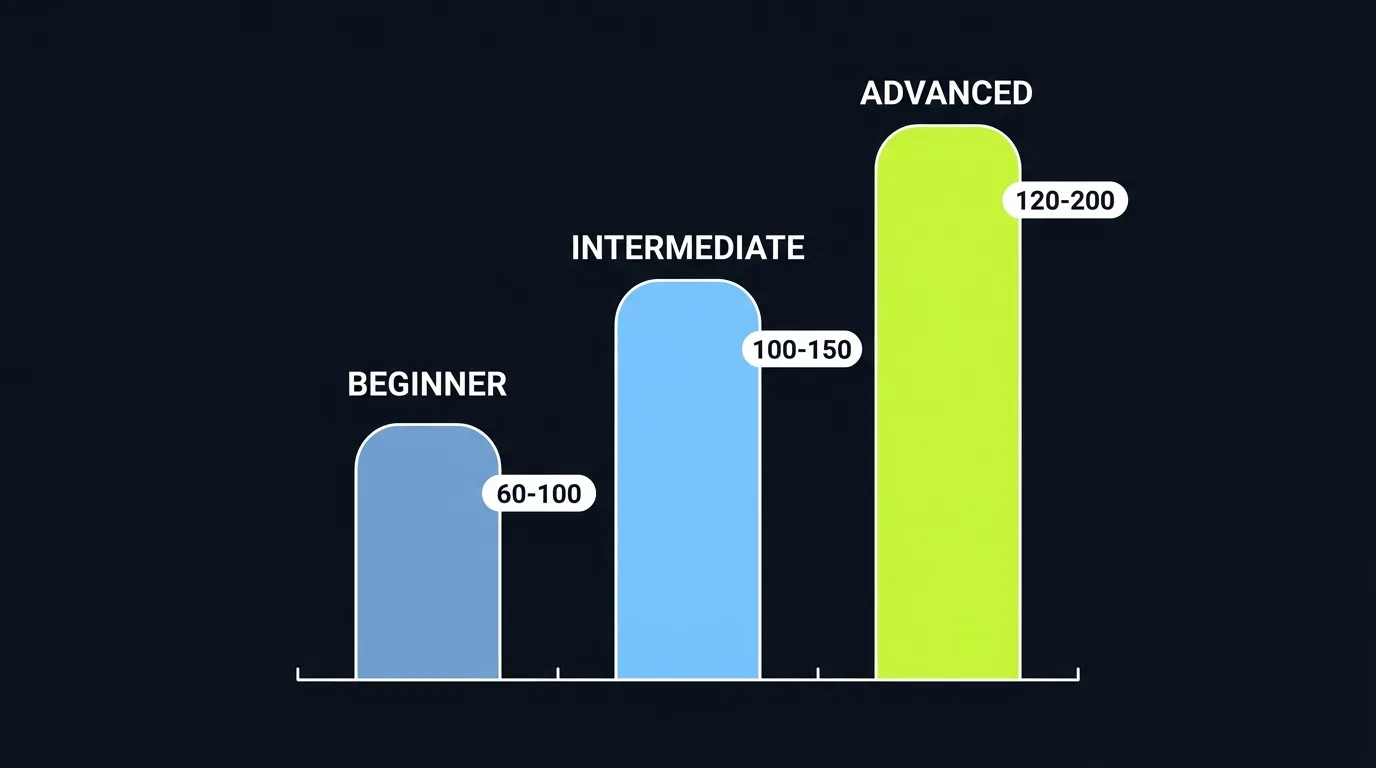
Weekly volume by experience level
NSCA-based weekly contact recommendations:
- Beginner: 60–100 contacts/week.
- Intermediate: 100–150 contacts/week.
- Advanced: 120–200 contacts/week.
Session math
A session adds up quickly: box jumps 3×5 = 15 contacts, depth jumps 4×4 = 16, hurdle hops 3×8 = 24 — total 55 contacts, comfortably inside a single-session range. Plan sets so the week lands in your band, then subtract for fatigue.
The two monitoring rules
Volume control is only useful if you react to the data. Two rules catch problems early:
- If next-week jump tests drop more than 5%, cut contacts by 20–30%.
- If RPE stays high across sessions, the volume is too high regardless of the number.
Quality beats quantity
100 full-power contacts outperform 200 fatigued ones every time. A contact that cannot be performed with maximal intent is no longer power training — it is conditioning with an injury risk.
Counting rules by exercise
Apply the same definition consistently across exercises:
- Box jumps, depth jumps and hurdle hops: one contact per landing.
- Pogo jumps: one contact per jump.
- Bounds and skips: one contact per footfall — a 10-rep single-leg bound is 10 contacts.
- Double-leg vs single-leg exercises: count footfalls, not repetitions.
Planning a contact week
A three-session week might look like: Monday 55 moderate contacts, Thursday 45 high-intensity contacts, Saturday 30 low-intensity contacts — roughly 130 for the week, inside the intermediate band.
Intensity changes the dose: the harder the jumps, the fewer contacts. When you add depth jumps or loaded jumps, subtract volume elsewhere.
Signals to cut volume
Cut 20–30% of contacts when any of these appear: next-week jump tests drop more than 5%, RPE stays high across sessions, soreness does not clear, or landings get loud.
Hold the reduced volume for a week, then add back gradually only if the signals clear.
Key takeaways
- Track plyometric volume in foot contacts, not minutes.
- Use weekly bands: 60–100 beginner, 100–150 intermediate, 120–200 advanced.
- Cut 20–30% when jump tests drop >5% or RPE stays high.
- Match contact volume to intensity: harder jumps get fewer contacts.
- Log the session's contacts before you judge the workout.
Related calculators
References
- NSCA Plyometric Volume Guidelines
- Verkhoshansky & Siff (2009) Supertraining, Ch. 6
- NSCA Essentials of Strength Training and Conditioning (4th ed.), Ch. 18
Keep reading
PLYOMETRICS
Depth Jump Technique: The Complete Guide
Box height, step-off vs jump-off, contact time, rebound direction and the common errors that turn depth jumps from a power tool into a injury risk.
PLYOMETRICS
What Is Plyometrics? A Safe Starting Guide
The stretch-shortening cycle explained, fast vs slow SSC, the NSCA entry criteria and low-intensity progressions for beginners.
PLYOMETRICS
The Right Warm-Up Before Plyometrics
Cold muscles doing high-intensity stretch-shortening work get injured. Here is the 15–20 minute warm-up protocol used before plyometric sessions.
Related exercises
Box Jump
The first-choice entry to plyometrics — the box jump teaches fast force production and coordinated landing, a cornerstone of jump training
Depth Jump
The gold-standard jump exercise — the depth jump maximizes SSC (stretch-shortening cycle) use, directly raising reactive strength and jump height
Hurdle Hop
A great tool for continuous power and jump rhythm — hurdle hops are more dynamic than box jumps and directly strengthen SSC efficiency
Pogo Jump
The two-foot entry of the ankle-elasticity family — pogo jumps train Achilles stiffness and elastic-energy utilization