Depth Jump Technique: The Complete Guide
Box height, step-off vs jump-off, contact time, rebound direction and the common errors that turn depth jumps from a power tool into a injury risk.
The depth jump is the gold-standard jump exercise — and the most commonly botched. It trains the stretch-shortening cycle harder than almost anything else, but only when executed with short ground contact and a fast, vertical rebound.
Here is the full checklist, from whether you are ready to how to fix the most common faults.
The depth jump belongs to the shock-method family: the drop loads the legs eccentrically, then the rebound must happen in a fraction of a second. That makes it the most powerful plyometric for reactive strength — and the least forgiving of technique errors.
Are you ready? Shock-method entry criteria
Unlike submaximal hops or box jumps, depth jumps impose extreme eccentric ground reaction forces (up to 4–7× bodyweight in under 200 milliseconds). That is why the NSCA and sports science consensus demand a verified preparation base before starting true shock training:
- Relative strength foundation: squatting roughly 1.5× bodyweight ensures sufficient eccentric rate of force development to brake the drop without joint collapse.
- Functional landing competency: ability to execute a quiet, symmetric depth drop from 30 cm without knee valgus.
- No acute lower-limb pathology: completely free of active patellar tendinopathy, Achilles tenderness or ankle instability.
- At least 3 months of consistent lower-body strength and low-impact plyometric preparation.
Step off — don't jump off
The most common mistake is jumping off the box. Jumping off pre-activates the muscles, short-circuits the drop and weakens the SSC stimulus. Step off, fall, land, rebound.
Contact time is the score
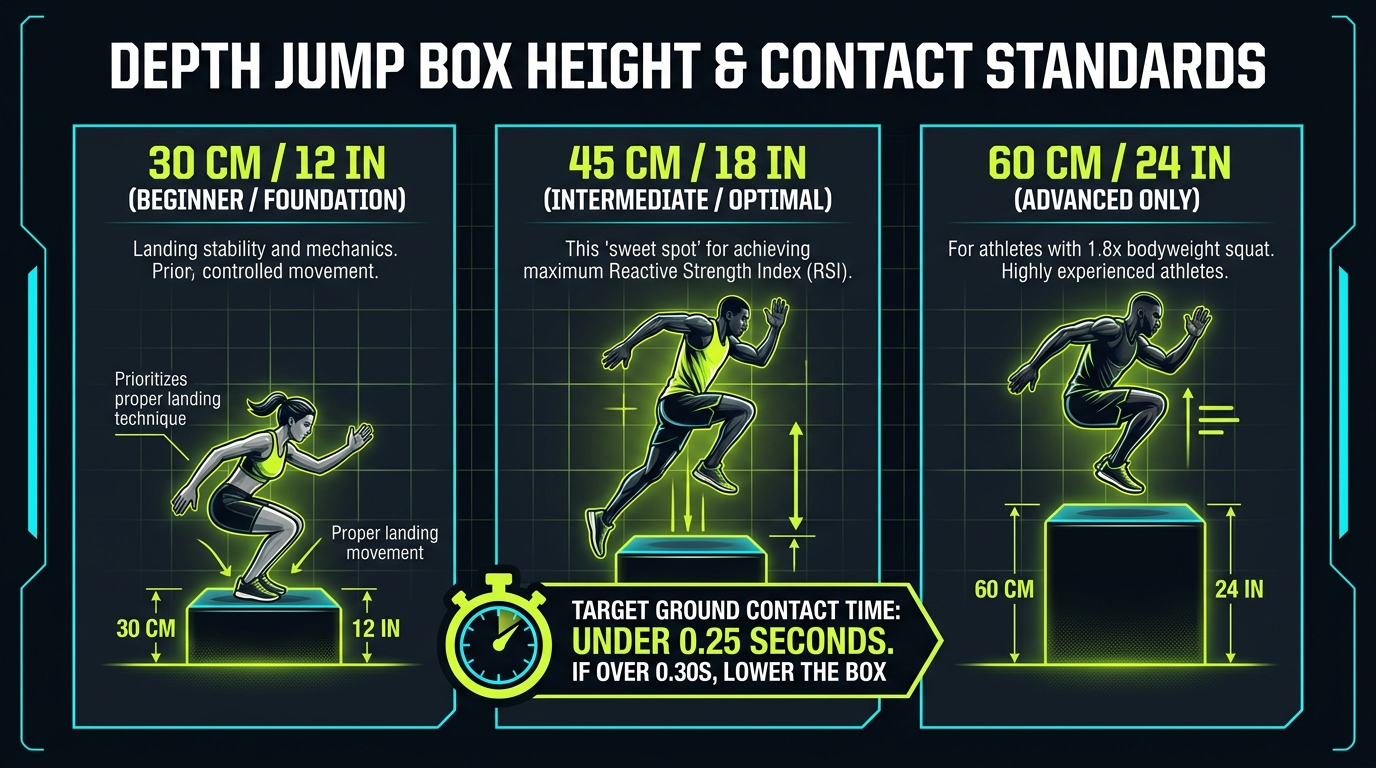
Start from a 30–45 cm box and use the test criterion: contact under 0.25 seconds and rebound over 25 cm. If contact time stretches past 0.3 seconds, the box is too high and you are doing a jump-down-then-jump-up, not a depth jump. Shorten the box before adding load.
Rebound straight up
Land on both feet with stiff ankles — no soft feet — and rebound as if the floor is red-hot. The takeoff direction is straight up, not forward. Landing posture is takeoff posture: chest tall, hips stacked, knees tracking over toes.
Common errors and fixes
Watch for these three faults in every session:
- Box too high → contact over 0.3s → lower the box.
- Loud landings → poor eccentric control → regress to depth drops and landing practice.
- Forward takeoff → leaked force → shorten the rebound target to straight up.
What the depth jump actually trains
The drop creates a rapid eccentric stretch followed by an immediate concentric rebound — a fast stretch-shortening cycle. The quality of the exercise is scored by ground contact time: under 0.25 seconds indicates a true reactive effort, while longer contacts shift the movement toward slow SSC or strength-type jumping.
This is why depth jumps are prescribed for reactive strength and tendon stiffness rather than general leg strength: they teach the body to convert a violent stretch into an immediate rebound.
The progression ladder
Begin with depth drops — step off, land and stabilize — to build landing control. Progress to depth jumps from 30 cm, then 45 cm, and only then add external loading such as a light vest.
Each level requires quiet landings and a rebound above 25 cm before moving up. If contact time stretches past 0.3 seconds, drop the box height rather than pushing through.
Programming and recovery
Depth jumps belong in the power-conversion phase of a block, not the opening weeks. Use them twice per week with 48–72 hours between sessions, 4–6 sets of 3–5 reps, and keep total weekly contacts inside your plyometric volume band.
End the session when contact time degrades or landings get loud — fatigue turns the exercise from reactive power into injury risk.
Key takeaways
- Only start depth jumps with the strength base and injury history to support them.
- Step off the box; never jump off.
- Contact under 0.25s and rebound over 25 cm from a 30–45 cm box is the quality target.
- Lower the box whenever contact time degrades.
- Master depth drops before depth jumps; add loading only after control.
- Program them in the conversion phase, twice a week, with full recovery.
Related calculators
References
- NSCA Essentials of Strength Training and Conditioning (4th ed.), Ch. 18
- Verkhoshansky & Siff (2009) Supertraining, Ch. 6
- PubMed: Reliability of the reactive strength index during depth jumps
- PubMed: Ankle contact angle and ground contact time in depth jumps
Keep reading
PLYOMETRICS
What Is Plyometrics? A Safe Starting Guide
The stretch-shortening cycle explained, fast vs slow SSC, the NSCA entry criteria and low-intensity progressions for beginners.
PLYOMETRICS
How to Count and Control Plyometric Contacts
Foot contacts are the real volume unit for plyometrics. Learn weekly volume by level, session math and the monitoring rules that keep jumps fast.
PLYOMETRICS
The Right Warm-Up Before Plyometrics
Cold muscles doing high-intensity stretch-shortening work get injured. Here is the 15–20 minute warm-up protocol used before plyometric sessions.
Related exercises
Depth Jump
The gold-standard jump exercise — the depth jump maximizes SSC (stretch-shortening cycle) use, directly raising reactive strength and jump height
Depth Drop
The preparatory exercise for depth jumps — the depth drop teaches safe, efficient absorption of landing impact (eccentric strength), laying the safety foundation for explosive rebounds
Depth to Broad Jump
An advanced depth-jump variation — trains vertical-to-horizontal power conversion, highly transferable to game situations like rebounding then pushing the fast break
Seated Box Jump
The best pure-concentric power exercise — the seated box jump removes the countermovement and starts from rest, closest to the SJ (squat jump) test pattern