What Is Plyometrics? A Safe Starting Guide
The stretch-shortening cycle explained, fast vs slow SSC, the NSCA entry criteria and low-intensity progressions for beginners.
Plyometrics are exercises that use the stretch-shortening cycle (SSC): an eccentric landing or dip, a brief isometric transition, then a concentric explosion. They are the most direct way to train vertical jump power — and the easiest to get wrong.
This guide covers what the SSC actually is and, more importantly, whether you are ready to start.
Understanding the SSC also explains why plyometrics are dosed in contacts and separated by days: the stimulus is neural and tendinous as much as muscular.
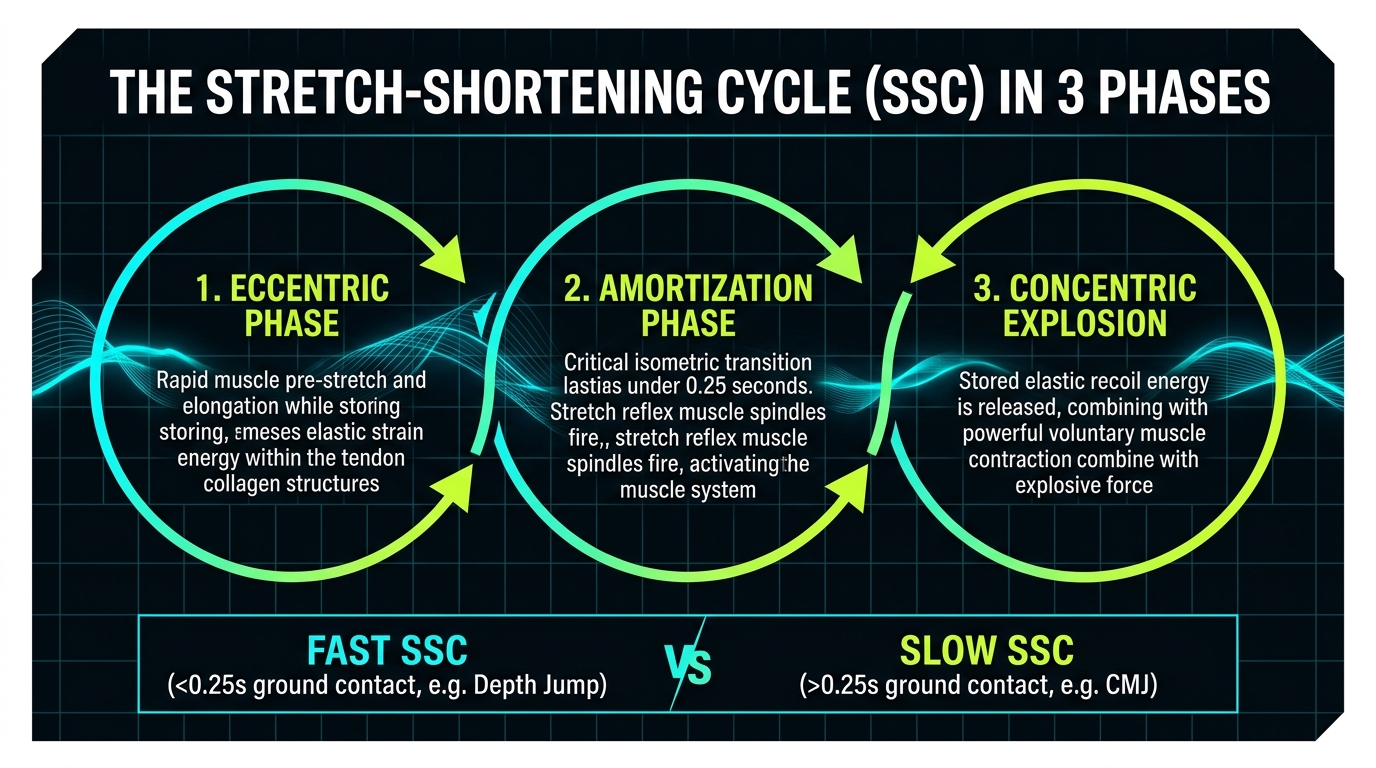
The stretch-shortening cycle
When a muscle is stretched quickly and immediately shortens, it produces more force than a pure concentric contraction. That extra output comes from stored elastic energy and the stretch reflex, and it is exactly what jumping depends on.
Fast and slow SSC are both trainable
Fast SSC movements have ground contact under 0.25 seconds (depth jumps, reactive hops); slow SSC movements last longer (box jumps, countermovement jumps). Jump athletes need both — fast SSC builds reactive power, slow SSC builds the ability to absorb and redirect force.
Entry criteria: high-impact shock vs foundational plyometrics
Traditional guidelines cite a 1.5× bodyweight squat base before plyometric training. Modern sports science consensus (Suchomel et al., 2016; Radnor et al., 2018) clarifies that this threshold applies strictly to high-impact shock methods (like depth jumps from 45cm+). Low-to-moderate plyometrics (pogos, skips, low box jumps) can and should be started early to build tissue tolerance and landing mechanics:
- High-impact shock jumps (depth jumps, loaded plyos): ~1.5× bodyweight squat base plus landing deceleration control.
- Foundational plyometrics (pogo jumps, low box jumps): appropriate for all healthy athletes with sound movement mechanics.
- Joint & tendon health: zero acute patellar or Achilles tendon pain and clean symmetric landings.
- Functional movement screen: a clean depth drop from 30 cm with quiet, stable deceleration.
Not ready for shock jumps? Start with submaximal volume
If you do not meet the high-impact criteria, that does not mean avoiding jumps — it means dosing submaximal stimulus. Pogo jumps, low box jumps, ankle hops and landing practice build tendon stiffness and neural coordination with a fraction of the impact load while your strength base develops.
The SSC in three phases
The cycle has three parts: an eccentric phase where the muscle is stretched under load, an amortization phase — the brief isometric transition — and a concentric phase where the stored energy is released.
The amortization phase is the performance variable: the shorter it is, the more elastic energy is reused. That is why fast SSC movements are defined by contact under 0.25 seconds and slow SSC movements by longer contacts.
A practical intensity ladder
Match intensity to your strength base and injury history:
- Low: pogo jumps, low box jumps, ladder drills — for beginners and return-to-training.
- Moderate: box jumps at 40–60 cm, hurdle hops — for athletes with a solid strength base.
- High: depth drops, depth jumps, loaded jumps — only with a 1.5x bodyweight squat and no acute injury history.
What plyometrics actually improve
Meta-analytic evidence shows plyometric training improves vertical jump performance, with the effects driven by rate of force development, tendon stiffness and neural output rather than muscle size.
Because the adaptation is largely neural and tendinous, quality and recovery matter more than volume: a few maximal, fresh contacts outperform many fatigued ones.
Key takeaways
- Plyometrics train the stretch-shortening cycle, the engine of jumping.
- Fast and slow SSC movements are both needed.
- Meet the strength and injury-history criteria before high-intensity work.
- Beginners should start with low-intensity plyometrics, not depth jumps.
- Dose plyometrics in contacts and space hard sessions 48–72 hours apart.
Related calculators
References
- NSCA Essentials of Strength Training and Conditioning (4th ed.), Ch. 18
- Verkhoshansky & Siff (2009) Supertraining, Ch. 6
- Suchomel et al. (2016) Sports Med — The importance of muscular strength in athletic performance
- Sáez de Villarreal et al. (2009) J Strength Cond Res — plyometric training meta-analysis
Keep reading
PLYOMETRICS
Depth Jump Technique: The Complete Guide
Box height, step-off vs jump-off, contact time, rebound direction and the common errors that turn depth jumps from a power tool into a injury risk.
PLYOMETRICS
How to Count and Control Plyometric Contacts
Foot contacts are the real volume unit for plyometrics. Learn weekly volume by level, session math and the monitoring rules that keep jumps fast.
PLYOMETRICS
The Right Warm-Up Before Plyometrics
Cold muscles doing high-intensity stretch-shortening work get injured. Here is the 15–20 minute warm-up protocol used before plyometric sessions.
Related exercises
Pogo Jump
The two-foot entry of the ankle-elasticity family — pogo jumps train Achilles stiffness and elastic-energy utilization
Box Jump
The first-choice entry to plyometrics — the box jump teaches fast force production and coordinated landing, a cornerstone of jump training
Depth Drop
The preparatory exercise for depth jumps — the depth drop teaches safe, efficient absorption of landing impact (eccentric strength), laying the safety foundation for explosive rebounds