Returning to Training After an Ankle Sprain
Grades, timeframes and the functional return criteria that matter more than the calendar — plus the staged path back to jumping.
The calendar is a poor guide for returning from an ankle sprain. Grade tells you the starting point; function tells you when you are ready. Returning too early raises re-sprain risk roughly five-fold.
The ankle's job after a sprain is to relearn stability: ligaments heal slowly, but the bigger deficit is proprioception — the joint's sense of position — which must be retrained before high-impact work.
Timeframes by grade
Lateral ankle sprains fall into three broad grades:
- Grade I (mild stretch): 1–2 weeks to light training.
- Grade II (partial tear): 4–6 weeks of gradual return.
- Grade III (complete tear): 3–6 months, with medical assessment first.
Functional return criteria
Do not return until you can pass all of these:
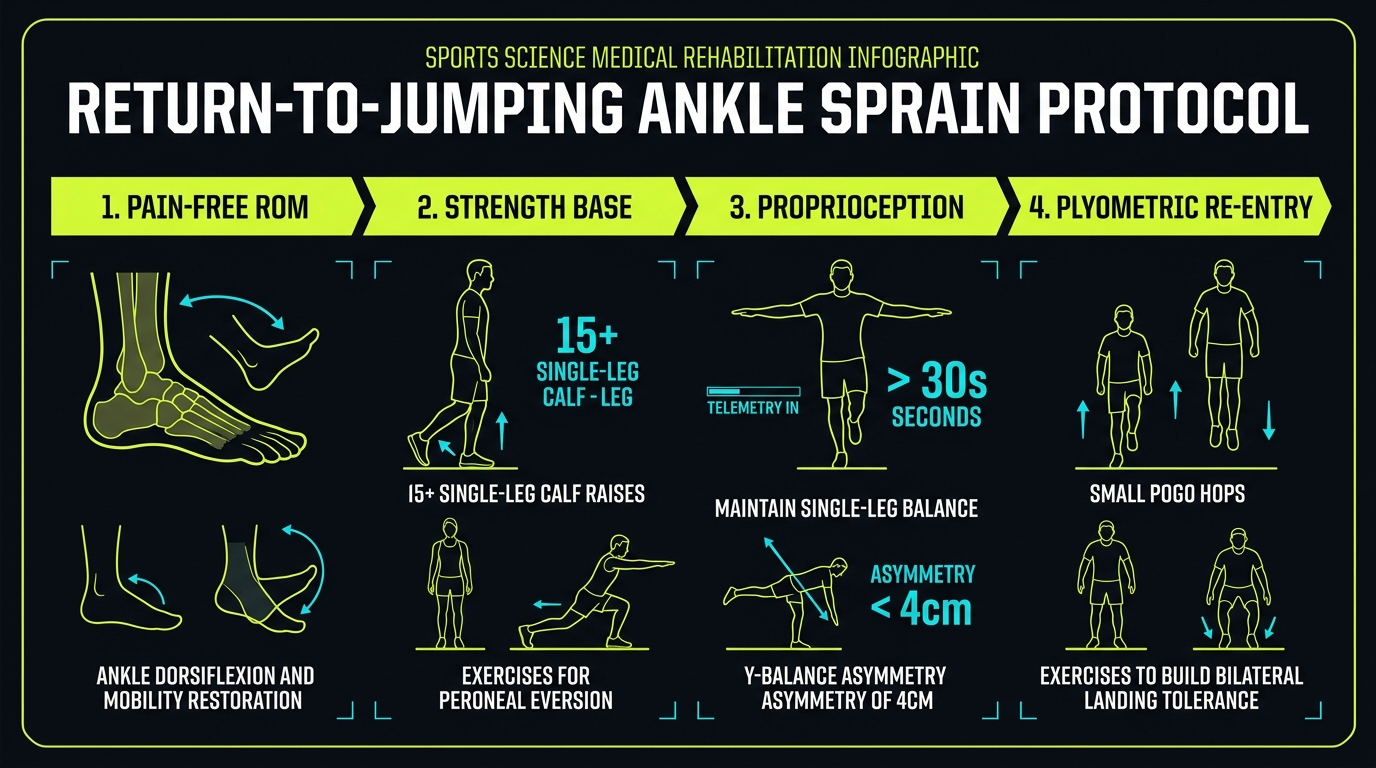
- Single-leg stand over 30s eyes open, then progress to 30s eyes closed.
- Over 15 pain-free single-leg calf raises.
- 10 single-leg small hops, stable and without fear.
- Y-Balance test with left/right difference under 4 cm.
The staged return path
Work through each stage only when the previous one is pain-free: pain-free range of motion → band resistance → proprioception → bodyweight jumps → plyometrics. Skipping stages is how sprains become chronic.
What a sprain actually damages
A lateral ankle sprain tears or stretches the lateral ligaments and often weakens the peroneal muscles, which are the ankle's dynamic stabilizers. It also damages mechanoreceptors, so the joint 'loses its map' even after pain resolves.
That combination explains why strength and balance tests predict readiness better than the date on the calendar.
Drills by stage
A progression that targets each deficit in order:
- Range of motion: ankle alphabet, banded dorsiflexion stretches.
- Strength: calf raises, banded eversion and inversion.
- Proprioception: single-leg stands, balance board, eyes-closed progressions.
- Power: pogo jumps, small single-leg hops, then full plyometrics.
The reinjury math
Returning before passing functional criteria raises re-sprain risk roughly five-fold, and repeat sprains increase the chance of chronic ankle instability. The criteria are not conservative for their own sake — they are protecting the joint's long-term function.
Key takeaways
- Grade sets the timeline; function decides readiness.
- Pass balance, strength and hop criteria before jumping again.
- Early return multiplies re-sprain risk by ~5x.
- Retrain proprioception before adding load.
- Each stage must be pain-free and fearless before advancing.
Related calculators
References
- Petersen et al. (2013) Br J Sports Med
- Verhagen et al. (2004) Am J Sports Med
- NCAA Injury Surveillance System
- PubMed: Ankle sprain functional rehabilitation
Keep reading
REHAB & INJURY PREVENTION
Patellar Tendinopathy (Jumper's Knee): Prevention & Rehab
The #1 injury in jump training, explained: why the tendon overloads, evidence-based prevention and the four rehab phases from isometrics to return.
REHAB & INJURY PREVENTION
Shin Splints: What to Do and How to Prevent Them
Medial tibial stress syndrome: acute management, the strength and surface fixes that prevent it, and the red flag that means see a doctor.
REHAB & INJURY PREVENTION
Good Pain vs Bad Pain: How to Tell the Difference in Training
Muscle soreness is normal; joint pain and movement-changing pain are not. Here is the classification used in sports medicine.
Related exercises
Single Leg Balance
The foundation for preventing the #1 jump injury (ankle sprain) — single-leg balance rebuilds proprioception and ankle stability, the safety prerequisite for all single-leg jumps
Star Excursion Balance
Dynamic balance closer to real landings than single-leg standing
Banded Ankle Distraction
A lifesaver for jumpers with limited dorsiflexion — banded distraction restores joint space and mobility, directly improving takeoff depth
Pogo Jump
The two-foot entry of the ankle-elasticity family — pogo jumps train Achilles stiffness and elastic-energy utilization