Shin Splints: What to Do and How to Prevent Them
Medial tibial stress syndrome: acute management, the strength and surface fixes that prevent it, and the red flag that means see a doctor.
Shin splints — medial tibial stress syndrome (MTSS) — is an overload response of the tibial periosteum, common when jump or run volume rises faster than the shin can adapt.
It is treatable, and usually preventable, if you fix the three drivers: volume jumps, training surface and shin strength.
MTSS is a bone-strain problem as much as a soft-tissue one: when the tibia's load exceeds its remodeling capacity, pain follows. That is why recovery is about load management, not just icing.
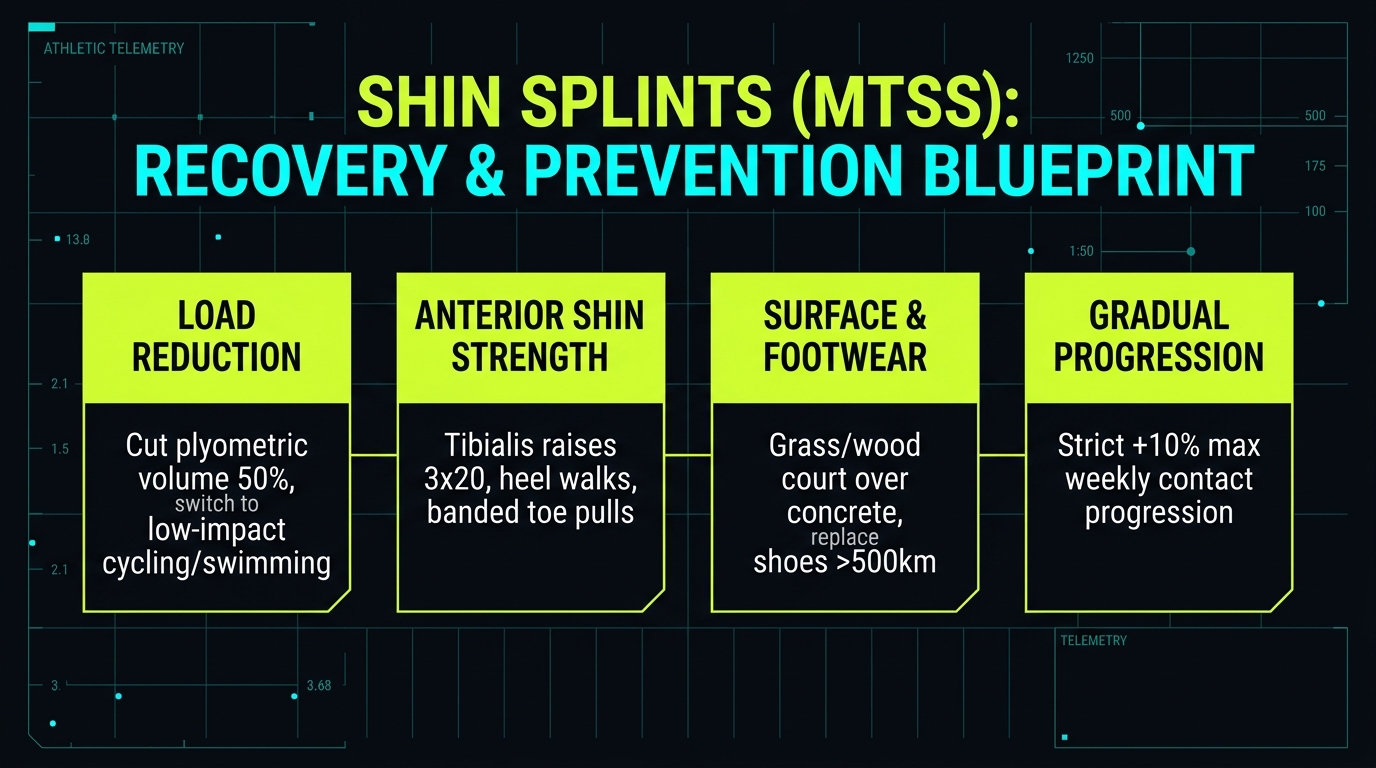
Acute management
When shins hurt, do these first:
- Cut training volume by 50% and substitute low-impact aerobic work (swimming, cycling, elliptical).
- Ice 10–15 minutes, 2–3 times per day.
- Strengthen the anterior shin: heel walking 3×30m, banded toe pulls 3×20.
- Check shoes — running shoes typically last 500–800 km.
Prevention after recovery
Returning to training without fixing the cause guarantees a repeat. Address all three:
- Progress volume gradually — weekly total jumps no more than +10%.
- Choose surfaces — grass or rubber track over concrete.
- Strengthen the arch with short-foot exercises and towel curls.
The red flag
If pain persists after 2 weeks of rest and reduced load, see a doctor to rule out a tibial stress fracture. Sharp, localized bone pain is not normal shin splints.
The overload mechanism
Repeated impacts bend the tibia slightly; bone remodeling keeps pace when loads rise gradually, but falls behind when volume spikes. The result is periosteal irritation and pain along the inner shin.
That is why the '+10% per week' rule exists for jumps and runs alike: it matches load increases to the bone's remodeling rate.
Maintaining fitness during recovery
Cut jump and run volume by half, and substitute swimming, cycling or the elliptical to keep aerobic fitness. Upper-body and core strength work can continue unchanged.
When shin pain is gone for at least two weeks, restart jumping at about 50% of your previous volume — not where you left off.
The return-to-jumping protocol
A conservative ladder that prevents recurrence:
- Two pain-free weeks before the first jump session.
- Start at 50% of previous volume.
- Add no more than 10% per week.
- Keep shin and arch strength work in the program permanently.
- Prefer grass or rubber track surfaces over concrete.
Key takeaways
- Cut volume and substitute low-impact work while pain is acute.
- Rebuild shin and arch strength before returning to full jump volume.
- Pain persisting 2+ weeks after rest needs a medical check for stress fracture.
- Recovery is load management: keep fitness with low-impact work.
- Return at 50% volume and add no more than 10% per week.
Related calculators
References
- Moen et al. (2009) Sports Med
- Warden et al. (2014) Br J Sports Med
- Beck (1998) Am J Sports Med
- PubMed: Medial tibial stress syndrome
Keep reading
REHAB & INJURY PREVENTION
Patellar Tendinopathy (Jumper's Knee): Prevention & Rehab
The #1 injury in jump training, explained: why the tendon overloads, evidence-based prevention and the four rehab phases from isometrics to return.
REHAB & INJURY PREVENTION
Returning to Training After an Ankle Sprain
Grades, timeframes and the functional return criteria that matter more than the calendar — plus the staged path back to jumping.
REHAB & INJURY PREVENTION
Good Pain vs Bad Pain: How to Tell the Difference in Training
Muscle soreness is normal; joint pain and movement-changing pain are not. Here is the classification used in sports medicine.
Related exercises
Tibialis Anterior Raise
The most neglected muscle that affects jumping — the tibialis anterior controls dorsiflexion and arch support; weakness is linked to unstable landings and shin splints
Calf-Dominant Jump Rope
The low-intensity endurance tier of the ankle-elasticity family — a low-barrier way to build ankle elasticity and calf tolerance
Foam Rolling: Calves
Protect the 'spring' of jumping — calf foam rolling prevents Achilles tendinopathy and plantar fasciitis while maintaining tendon elasticity