Exercise Library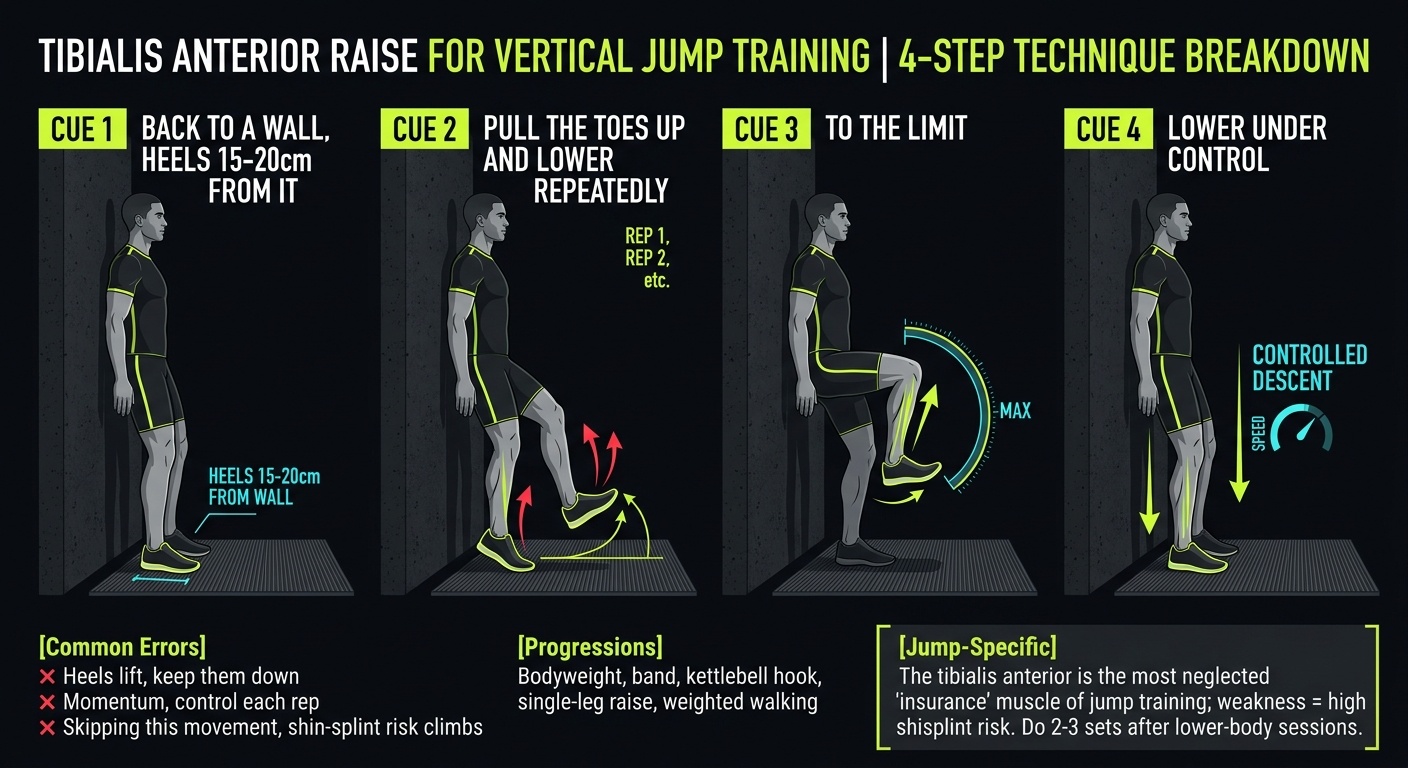
MAX STRENGTHbeginner
Tibialis Anterior Raise
The most neglected muscle that affects jumping — the tibialis anterior controls dorsiflexion and arch support; weakness is linked to unstable landings and shin splints. Repeatedly pull the toes up and lower them. Strengthening it is jump-training 'insurance'.
Tibialis anterior, ankle dorsiflexors3-4 sets × 15-20 reps
Coaching cues
- 1.Heels stay on the ground — only the forefoot moves
- 2.Pull the toes as high as possible toward the shin
- 3.Control the lowering — no free fall
- 4.Add load with a band or kettlebell hook
Detailed training method
[Steps]1. Back to a wall, heels 15-20cm from it→2. Pull the toes up and lower repeatedly→3. To the limit→4. Lower under control
[Common Errors]✗ Heels lift→keep them down ✗ Momentum→control each rep ✗ Skipping this movement→shin-splint risk climbs
[Progressions]Bodyweight→band→kettlebell hook→single-leg raise→weighted walking
[Jump-Specific]The tibialis anterior is the most neglected 'insurance' muscle of jump training; weakness = high shin-splint risk. Do 2-3 sets after lower-body sessions
Related exercises
Goblet Squat
The best first squat for jumping — the goblet squat teaches the correct pattern (upright torso, braced core) as a foundation for barbell squats and jumping
Pause Squat
A back-squat variation with a 3-second hold at the bottom — the pause removes bounce and momentum, forcing controlled depth and strength from a dead stop
Barbell Back Squat
The king of strength training and an irreplaceable foundation movement for jump training