Good Pain vs Bad Pain: How to Tell the Difference in Training
Muscle soreness is normal; joint pain and movement-changing pain are not. Here is the classification used in sports medicine.
Not all pain is the same. DOMS and injury signals look different, feel different and demand opposite responses — and confusing them is how small problems become big ones.
Learning to classify pain takes minutes, and it is the single most useful injury-prevention skill a jumper can learn.
Good pain: DOMS
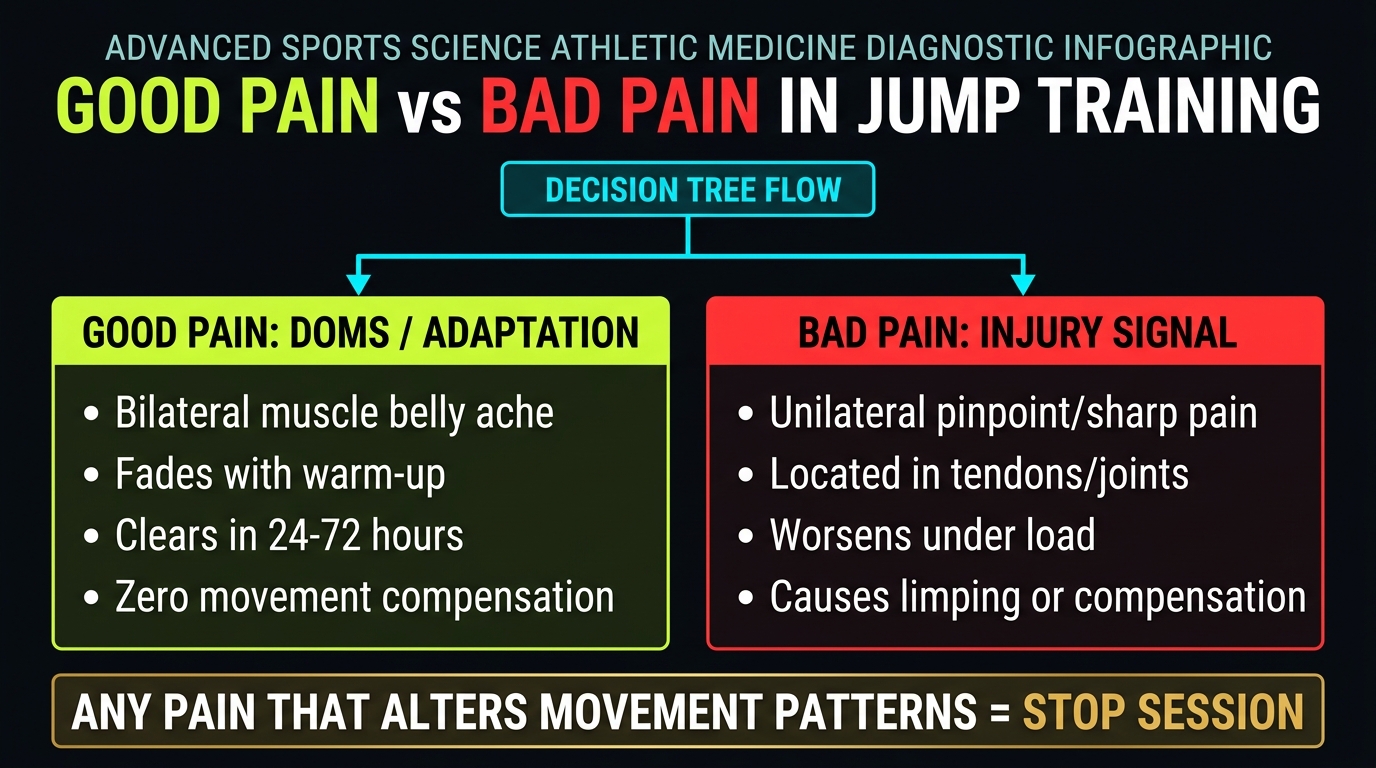
Delayed-onset muscle soreness is bilateral and symmetric, feels like a pleasant ache on pressure, fades over time, does not change movement quality and disappears within 24–72 hours.
Bad pain: injury signal
Injury pain is usually unilateral, sharp, stabbing or burning, located inside a joint, worse with pressure, and accompanied by swelling or heat — or it makes you change the movement with a limp or protective compensation.
The iron rule
Any pain that changes your movement pattern means stop. Training through compensation patterns does not build resilience — it transfers the load somewhere else and causes chain injuries.
Why classification matters
DOMS is a normal training response that fades and can be trained through; injury pain requires unloading. Misclassification works in both directions: treating DOMS like an injury loses training, and treating an injury like DOMS makes it worse.
A decision tree for pain during a session
Run this check when something hurts:
- Symmetric muscle ache that fades as you warm up → continue, monitor.
- Sharp, unilateral or joint-level pain → stop that exercise.
- Swelling, heat or locking → stop the session.
- Pain that changes your movement pattern → stop and reassess the next day.
When to get help
See a professional when pain lasts more than 72 hours without improving, wakes you at night, is accompanied by swelling or weakness, or produces numbness. DOMS does none of these things.
Key takeaways
- DOMS is symmetric, muscle-level, and fades in 24–72 hours.
- Sharp, unilateral, joint-level or movement-changing pain is a stop signal.
- Never train through compensation patterns.
- Pain that fades as you warm up is usually manageable; pain that worsens is a signal.
- Movement-changing pain always means stop.
Related calculators
References
- NSCA Essentials of Strength Training and Conditioning (4th ed.), Ch. 21
- PubMed: Exercise-induced muscle damage and DOMS
Keep reading
REHAB & INJURY PREVENTION
Patellar Tendinopathy (Jumper's Knee): Prevention & Rehab
The #1 injury in jump training, explained: why the tendon overloads, evidence-based prevention and the four rehab phases from isometrics to return.
REHAB & INJURY PREVENTION
Shin Splints: What to Do and How to Prevent Them
Medial tibial stress syndrome: acute management, the strength and surface fixes that prevent it, and the red flag that means see a doctor.
REHAB & INJURY PREVENTION
Returning to Training After an Ankle Sprain
Grades, timeframes and the functional return criteria that matter more than the calendar — plus the staged path back to jumping.
Related exercises
Foam Rolling: Quadriceps
Essential quad recovery after jump training — foam rolling relieves the most loaded muscle group, preventing patellar overload and muscle stiffness
Foam Rolling: Calves
Protect the 'spring' of jumping — calf foam rolling prevents Achilles tendinopathy and plantar fasciitis while maintaining tendon elasticity