Exercise Library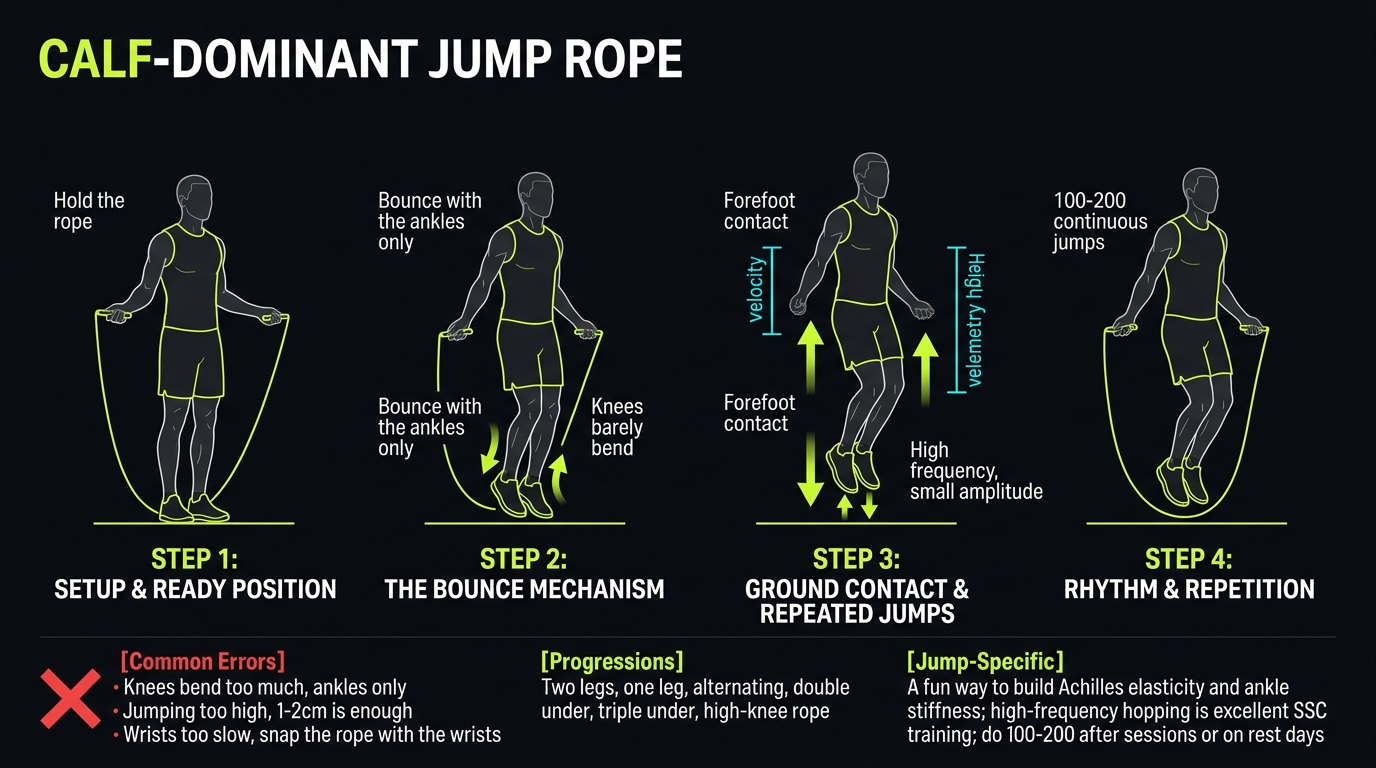
PREHAB & RECOVERYbeginner
Calf-Dominant Jump Rope
The low-intensity endurance tier of the ankle-elasticity family — a low-barrier way to build ankle elasticity and calf tolerance. Use small, high-frequency jumps with quick forefoot contact — ideal as a warm-up, recovery-day or preparation-phase low-intensity elastic stimulus.
Gastrocnemius, soleus, Achilles, plantar fascia2-4 sets × 60-120s, or 100-200 jumps
Coaching cues
- 1.Jump height only 1-2cm
- 2.Knees slightly bent — don't turn it into squat jumps
- 3.Rotate the rope with the wrists, not big arm swings
- 4.Reduce reps with ankle or Achilles discomfort
Detailed training method
[Steps]1. Hold the rope→2. Bounce with the ankles only→3. Knees barely bend→4. Forefoot contact→5. High frequency, small amplitude→6. 100-200 continuous jumps
[Common Errors]✗ Knees bend too much→ankles only ✗ Jumping too high→1-2cm is enough ✗ Wrists too slow→snap the rope with the wrists
[Progressions]Two legs→one leg→alternating→double under→triple under→high-knee rope
[Jump-Specific]A fun way to build Achilles elasticity and ankle stiffness; high-frequency hopping is excellent SSC training; do 100-200 after sessions or on rest days
Related calculators
Related exercises
Foam Rolling: Quadriceps
Essential quad recovery after jump training — foam rolling relieves the most loaded muscle group, preventing patellar overload and muscle stiffness
Banded Ankle Distraction
A lifesaver for jumpers with limited dorsiflexion — banded distraction restores joint space and mobility, directly improving takeoff depth
Single Leg Balance
The foundation for preventing the #1 jump injury (ankle sprain) — single-leg balance rebuilds proprioception and ankle stability, the safety prerequisite for all single-leg jumps