Limb Symmetry Index Calculator (LSI)
Calculate limb symmetry index from involved and uninvolved limb test scores, with the 90% return-to-sport threshold used in ACL and lower-limb rehab research.
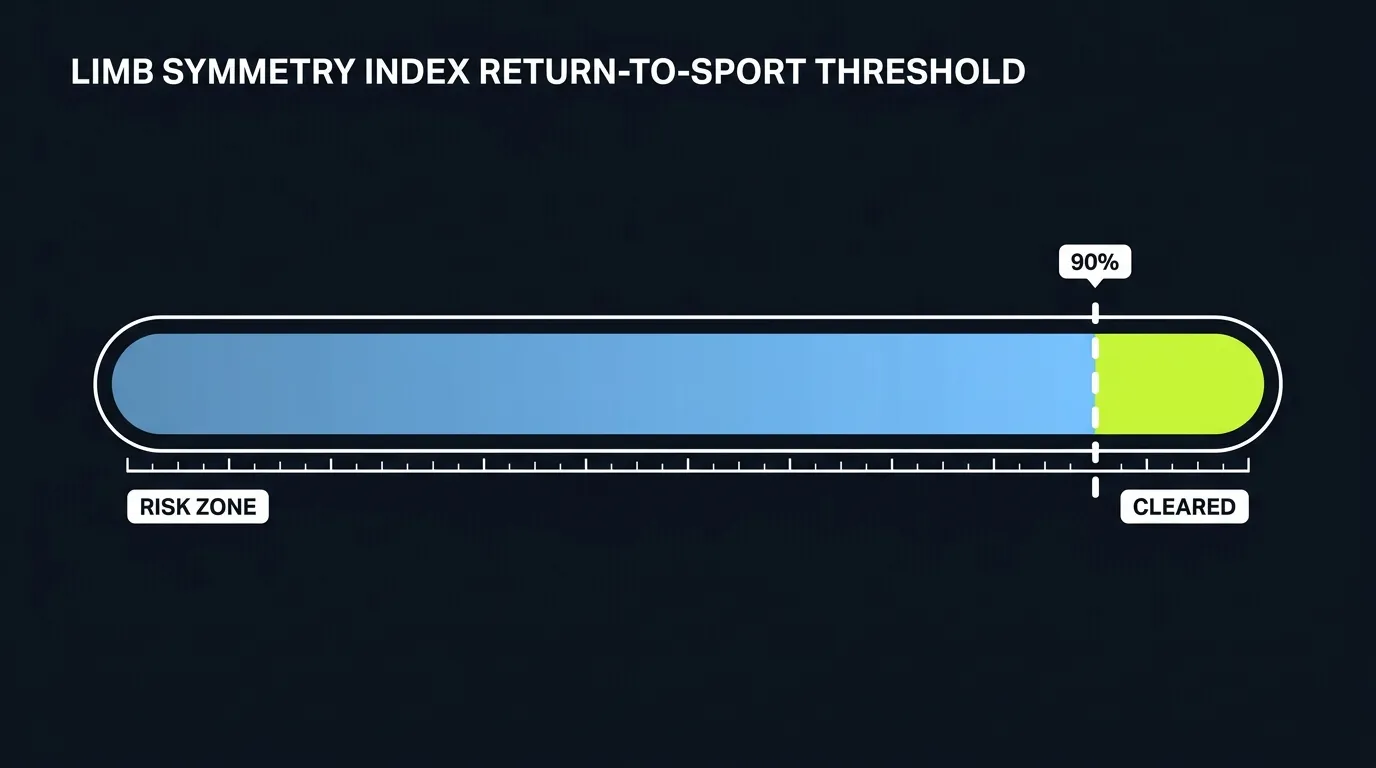
Results
- Limb symmetry index
- 88.2%
- Involved / uninvolved x 100 · Single-leg hop for distance - a common functional test in ACL rehab.
- Interpretation
- Below threshold
- 85-90% still shows asymmetry; keep rehab before progressing.
- Absolute deficit
- 20
- Uninvolved minus involved score - track this alongside the percentage
Common LSI interpretation
| LSI | Interpretation |
|---|---|
| 95%+ | Stricter clinician target for strength tests |
| 90%+ | Most commonly reported return-to-sport threshold |
| 85-90% | Below threshold - asymmetry remains |
| < 85% | Clear asymmetry - continue rehab |
Typical return-to-sport checklist (combine, don't rely on one test)
| Criterion | Common target |
|---|---|
| Limb symmetry (functional tests) | 90%+ |
| Limb symmetry (strength tests) | 95-100% |
| No pain or swelling with testing | Required |
| Sport-specific movement quality | Clinician assessment |
| Psychological readiness | Questionnaire + interview |
How it works & limitations
Why 90% is the benchmark
An LSI of 90% or higher on functional tests is the most commonly reported return-to-sport criterion in the ACL and lower-limb rehab literature. Many clinicians aim for 95-100% on strength measures because hop tests tend to recover before strength does.
Use the same test on both sides - and add a baseline
LSI is only valid when both limbs perform the identical test with the identical protocol. A side-to-side ratio can look normal even when both limbs have lost strength after a long layoff, so comparing the involved limb to its pre-injury baseline is an important additional check.
LSI is one piece of the decision
LSI should be combined with strength testing, clinical assessment, movement quality and psychological readiness - it is never a return-to-sport decision on its own. Reinjury risk drops most when a set of criteria is met rather than any single number.
Sources
Last updated 2026-08-13
- Grindem, H., Snyder-Mackler, L., Moksnes, H., Engebretsen, L., & Risberg, M. A. (2016). Simple decision rules can reduce reinjury risk by 84% after ACL reconstruction: the Delaware-Oslo ACL cohort study. British Journal of Sports Medicine, 50(13), 804-808.
- Return to sport following anterior cruciate ligament reconstruction: a scoping review of criteria determining return to sport readiness. (2024). PMC11732813.
Educational reference, not a return-to-sport clearance. Work with a qualified clinician before returning to sport after injury.
Frequently asked questions
What is a good limb symmetry index for return to sport?
An LSI of 90% or higher is the most commonly reported threshold in return-to-sport research, and many clinicians aim for 95-100% on strength tests before clearing athletes for sport. LSI alone should never decide return to sport.
Can hop tests overestimate symmetry?
Yes. Single-leg hop distance often returns to near-normal before muscle strength does, because athletes compensate with other joints. Use LSI from strength and hop tests together, and always interpret it with clinical judgement.