Overcoming the Fear of Jumping After Injury
Kinesiophobia fades through graded exposure, cognitive reframing and success experiences — not through waiting.
Fear of re-injury after recovery is normal — and it is also trainable. The worst thing you can do is wait for the fear to disappear on its own.
Kinesiophobia is a protective response that outlives its usefulness. It responds to the same principle as strength: graded exposure with a success log.
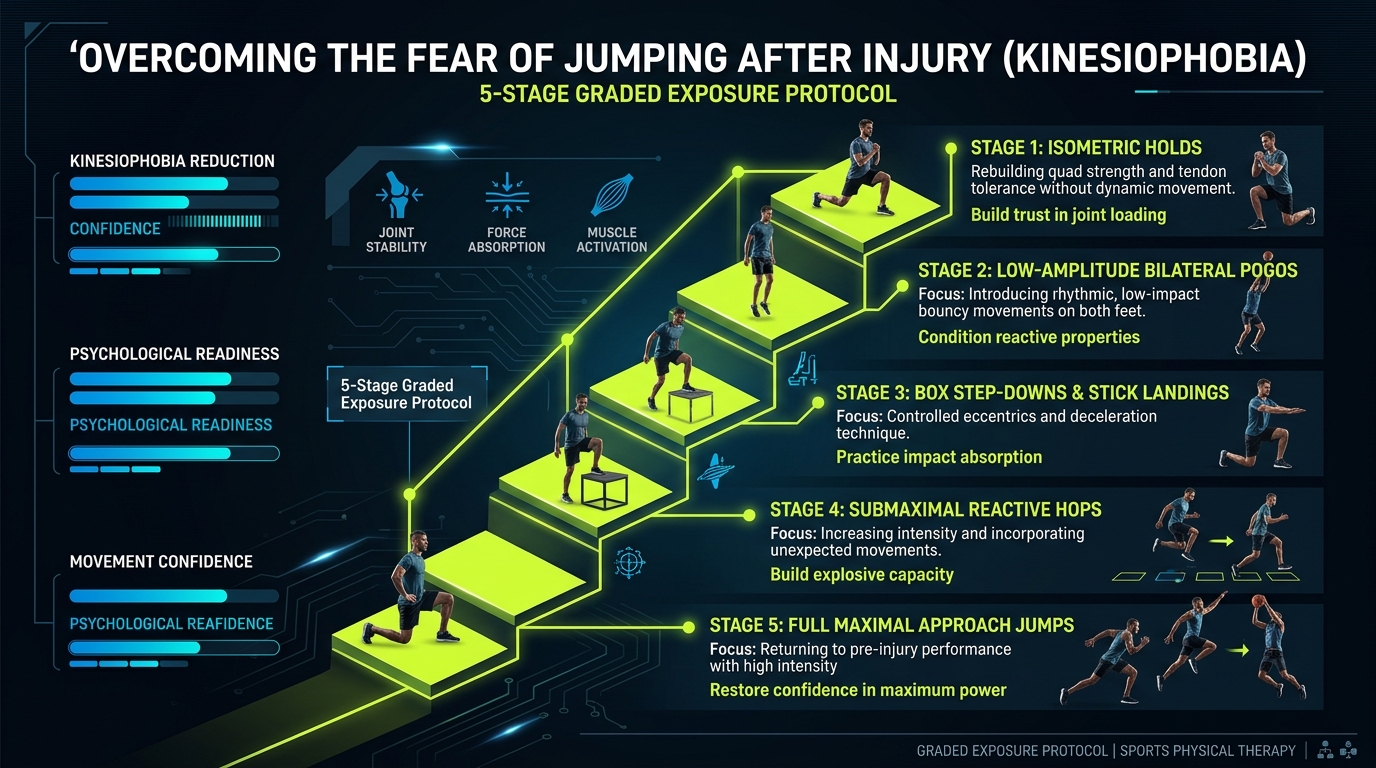
Graded exposure
Climb a ladder of increasing demands, advancing only when each step feels fearless: two-foot pogo jumps → low box jumps (20 cm) → mid box (40 cm) → depth drop (30 cm) → depth jump (30 cm) → high box jumps → depth jumps (45 cm+).
Challenge the thoughts
Identify automatic negative thoughts ('I'll get hurt') and challenge them with facts ('I've safely done this 100 times'). Externalize attention — focus on 'jump onto that box' rather than 'will my knee hurt'.
Reduce uncertainty, build evidence
Use flat surfaces, crash pads, full warm-ups and a training partner. Record each completed level — after roughly 10 successes, fear naturally fades. If it persists, a sport psychologist is the right call.
Why graded exposure works
Fear fades through repeated safe exposure: every completed step updates the brain's prediction from 'this is dangerous' to 'this is manageable'. The fear-avoidance model shows that avoidance maintains fear, while graded exposure extinguishes it.
The exposure ladder in detail
Advance only when each step feels fearless:
- Two-foot pogo jumps.
- Low box jumps (20 cm).
- Mid box jumps (40 cm).
- Depth drop (30 cm).
- Depth jump (30 cm).
- High box jumps.
- Depth jumps (45 cm+).
Supporting the process
Reduce uncertainty with flat surfaces, crash pads, a full warm-up and a training partner. Challenge catastrophic thoughts with your track record, externalize attention to the target ('jump onto that box'), and if you are stuck at one level for four or more weeks, work with a sport psychologist.
Key takeaways
- Gradually increase jump demands, one fearless step at a time.
- Challenge catastrophe thoughts with your track record.
- ~10 completed success experiences is usually enough to reset confidence.
- Advance only when a step feels fearless — that is the protocol, not weakness.
- Record every completed level; ~10 successes reset the fear.
Related calculators
References
- Ardern et al. (2013) Br J Sports Med
- Vlaeyen & Linton (2000) Pain
- PubMed: Kinesiophobia and graded exposure after sport injury
Keep reading
PSYCHOLOGY
Nervous on Test Day? How to Perform Under Pressure
Test anxiety is physiological over-activation — and it responds to simulation, routines, breath control and reframing.
PSYCHOLOGY
How to Stay Motivated and Consistent Long-Term
Motivation fluctuates even for elite athletes. Identity, process tracking and minimum commitments are what survive the bad weeks.
TRAINING PROGRESS
How Long Until You See Results From Jump Training?
A realistic vertical jump improvement timeline: what changes at 2, 4, 8 and 12 weeks, and why starting level, training quality and recovery decide the pace.
Related exercises
Pogo Jump
The two-foot entry of the ankle-elasticity family — pogo jumps train Achilles stiffness and elastic-energy utilization
Depth Drop
The preparatory exercise for depth jumps — the depth drop teaches safe, efficient absorption of landing impact (eccentric strength), laying the safety foundation for explosive rebounds
Single Leg Box Jump
Highly specific single-leg jump training — trains single-leg takeoff, stable box landings and left/right power differences; suits basketball layups, volleyball approach jumps and more