How to Stay Motivated and Consistent Long-Term
Motivation fluctuates even for elite athletes. Identity, process tracking and minimum commitments are what survive the bad weeks.
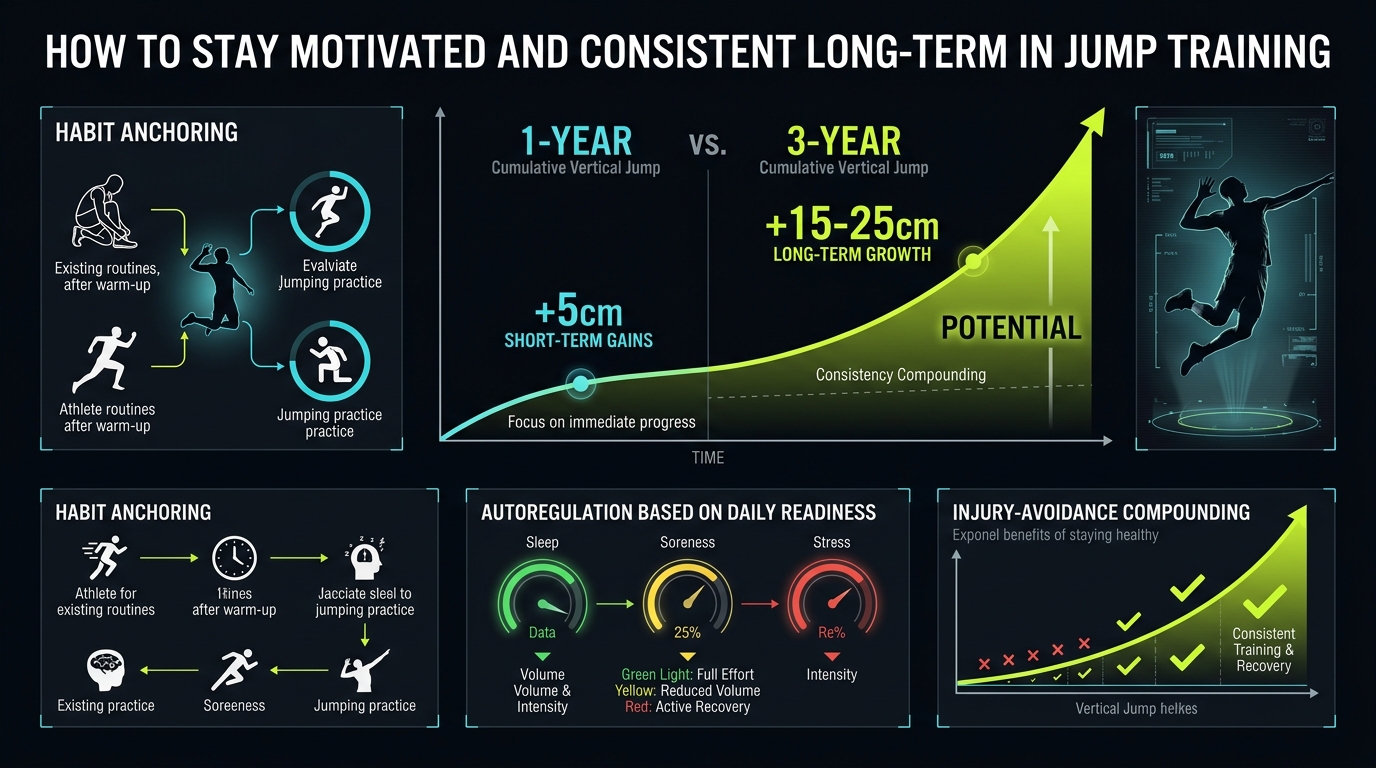
Motivation is a wave, not a switch. Athletes who stay consistent for years do not rely on feeling motivated — they build systems that work on the days they do not feel like training.
Consistency is a design problem, not a personality trait: identity, process tracking and tiny commitments make training survive bad weeks.
Identity over outcome
'I am a trainer' is more sustainable than 'I want to jump higher than X'. The first is identity and survives bad days; the second is a goal that can fail.
Track the process, not just results
Log completion ('completed 85% of the plan this month') alongside jump data. Process is controllable; results fluctuate. Add a training partner or community — accountability is a powerful driver.
The minimum commitment
'I'll just do 10 minutes' is the most effective trick in long-term training — once started, you usually finish. Rotate variables every 4–6 weeks to prevent boredom, reward milestones, and accept that not every cycle is a PR cycle. Sometimes maintaining is winning.
The psychology of identity-based habits
Self-determination theory points to three needs that sustain behavior: autonomy, competence and relatedness. Identity-based framing ('I am a trainer') connects each session to who you are, which survives the days when outcome goals feel out of reach.
Building the system
Consistency comes from structure, not willpower:
- Fixed weekly training windows.
- A process-completion log ('85% of plan completed').
- The 10-minute minimum rule for low-motivation days.
- Rotate variables every 4–6 weeks.
- A training partner or community for accountability.
- Reward milestones, not just outcomes.
Handling the bad weeks
Accept fluctuation: not every cycle is a PR cycle, and maintenance weeks count. When a week goes wrong, return through the minimum commitment instead of doubling up — compensation sessions are how overtraining and injuries start.
Key takeaways
- Build identity around training, not outcomes.
- Track completion rates and rotate variables to stay engaged.
- Ten-minute minimums beat skipped sessions every time.
- Design for the worst week, not the best one.
- A maintenance week still counts — consistency is the metric.
Related calculators
References
- Deci & Ryan (2000) Psychol Inq
- Weinberg & Gould (2019) Foundations of Sport and Exercise Psychology
- PubMed: Self-determination theory and exercise adherence
Keep reading
PSYCHOLOGY
Nervous on Test Day? How to Perform Under Pressure
Test anxiety is physiological over-activation — and it responds to simulation, routines, breath control and reframing.
PSYCHOLOGY
Overcoming the Fear of Jumping After Injury
Kinesiophobia fades through graded exposure, cognitive reframing and success experiences — not through waiting.
TRAINING PROGRESS
How Long Until You See Results From Jump Training?
A realistic vertical jump improvement timeline: what changes at 2, 4, 8 and 12 weeks, and why starting level, training quality and recovery decide the pace.