Nervous on Test Day? How to Perform Under Pressure
Test anxiety is physiological over-activation — and it responds to simulation, routines, breath control and reframing.
Test-day nerves over-activate the sympathetic nervous system: heart rate climbs, muscles tense and coordination drops. The fix is not 'try to relax' — it is training the performance environment and your interpretation of the feeling.
Performance anxiety is arousal, not weakness: the same activation that ruins a tense jump can fuel a prepared one. The skill is channeling it.
Simulate the environment
Schedule regular test days in training so the body and brain get used to pressure. The first few tests are the hardest precisely because they are unfamiliar.
Build a pre-performance routine
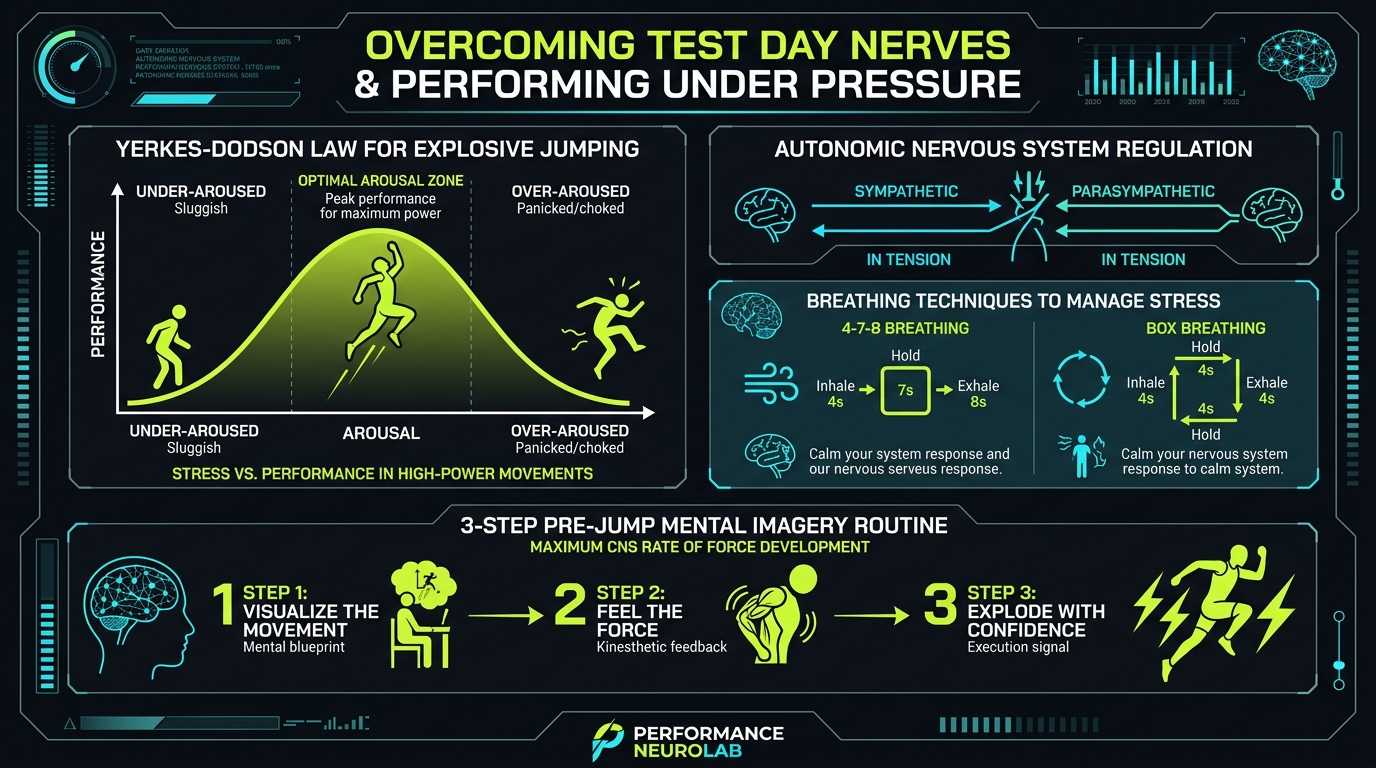
A fixed sequence — three deep breaths, two arm swings, two light jumps, then test — lowers uncertainty and anxiety. Add 4-7-8 breathing (inhale 4s, hold 7s, exhale 8s) to activate the parasympathetic system quickly.
Reframe and set process goals
Reinterpret 'I'm nervous' as 'I'm ready' — the physiology is nearly identical and only the interpretation differs. Then focus on technique cues instead of height, and stack recorded test successes so confidence has evidence.
The Yerkes-Dodson curve in jumping
Performance follows an inverted U with arousal: too little leaves you flat, too much degrades fine coordination, and the middle is the zone where the jump happens. Test-day work is about landing in that zone, not eliminating the feeling.
A 10-minute test-day protocol
A fixed sequence that settles arousal before the first attempt:
- 5 minutes before: 4-7-8 breathing, three rounds.
- Rehearse the technique cue you will focus on.
- Two light jumps to feel the surface.
- Fixed countdown, then start.
- First attempt at 90% effort, then go full.
Building pressure tolerance between tests
Simulate test days monthly so the environment becomes familiar. Record every successful session, review what worked, and treat the data — not the feeling — as the measure of readiness.
Key takeaways
- Test regularly in training to make test day familiar.
- Use a fixed routine and 4-7-8 breathing before attempts.
- Nervous is ready — then focus on cues, not numbers.
- Arousal is fuel — the skill is keeping it in the optimal zone.
- First attempt at 90% protects the set and settles the nerves.
Related calculators
References
- Weinberg & Gould (2019) Foundations of Sport and Exercise Psychology (7th ed.)
- Yerkes-Dodson Law
- PubMed: Pre-performance routines and sport performance
Keep reading
PSYCHOLOGY
Overcoming the Fear of Jumping After Injury
Kinesiophobia fades through graded exposure, cognitive reframing and success experiences — not through waiting.
PSYCHOLOGY
How to Stay Motivated and Consistent Long-Term
Motivation fluctuates even for elite athletes. Identity, process tracking and minimum commitments are what survive the bad weeks.
TRAINING PROGRESS
How Long Until You See Results From Jump Training?
A realistic vertical jump improvement timeline: what changes at 2, 4, 8 and 12 weeks, and why starting level, training quality and recovery decide the pace.