How to Do a Deload Week (Without Losing Progress)
The three ways to deload, how often, and why performance often peaks the week after a deload — not during the hardest training.
Deloading looks like doing less, but it is a training tool: it lets the nervous system, tendons and joints catch up so the next block can be harder.
The deload is the least-loved but most reliable training tool: it converts accumulated fatigue into a performance jump.
Why deload
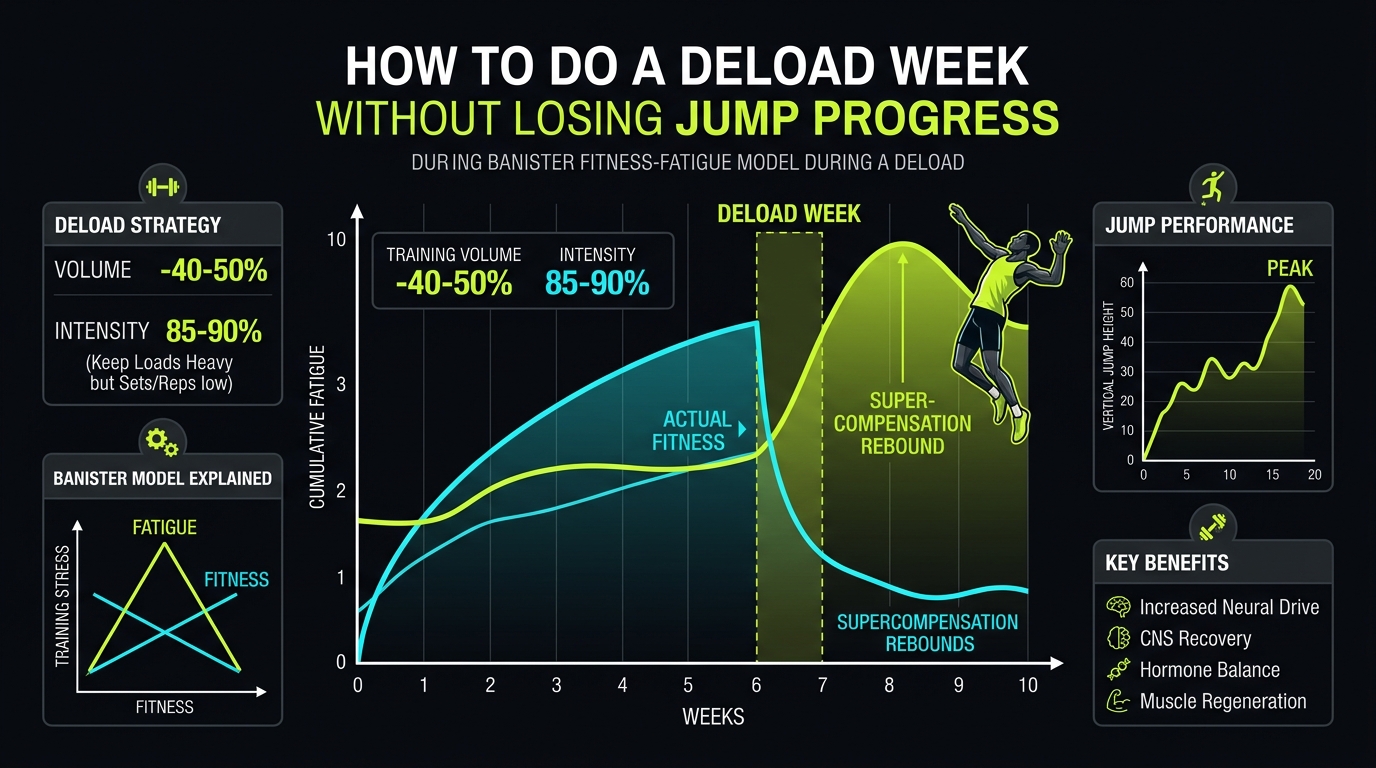
Deloading drives neuromuscular recovery, gives tendons and ligaments time to adapt (they adapt much slower than muscle), prevents overtraining and creates supercompensation — performance after a deload often surpasses the previous peak.
The three methods
Pick the one that fits your situation:
- Half volume, same intensity (most recommended): e.g. 3×5 at 85% becomes 2×5 at 85%.
- Lower intensity, same volume: work at 60–70% 1RM for normal sets.
- Full rest: light aerobic and stretching only.
When to deload
Plan one deload week every 4–6 weeks, and take an unplanned one if RPE keeps climbing, sleep worsens or joints ache. Many jump PRs happen not in the hardest week, but on the test week after a deload.
What supercompensation looks like
After a deliberate reduction in load, performance rebounds above the pre-deload baseline — that is supercompensation. It is why the test week after a deload, not the hardest training week, is where PRs appear.
How to choose a method
Half volume with the same intensity is the safest default: it preserves the strength stimulus while cutting fatigue. Lower intensity with the same volume suits technique-heavy periods, and full rest fits travel, illness or joint pain. Do not spend the deload week testing new exercises.
What to do in a deload week
A practical deload checklist:
- Keep the same movement patterns.
- Cut volume by 40–50%.
- Keep intensity at or near normal.
- Drop plyometric volume to low-contact technical work.
- Prioritize sleep and nutrition.
- Test on day 7–8, then start the next block.
Key takeaways
- Deload every 4–6 weeks, planned or forced.
- Half volume with same intensity is the safest method.
- Test after the deload — that is when the gains show.
- Deloading is not doing nothing — it is deliberately lowering the dose.
- PRs usually appear the week after a deload, not during one.
Related calculators
References
- Verkhoshansky & Siff (2009) Supertraining, Ch. 4
- Mujika & Padilla (2003) Med Sci Sports Exerc
- Bompa & Buzzichelli (2019) Periodization (6th ed.)
- PubMed: Taper and supercompensation in athletic performance
Keep reading
PERIODIZATION
How to Design a Full Jump-Training Macrocycle
The 12–16 week structure: base adaptation, max strength, power conversion, then peak and test. With RPE and volume targets for each phase.
PERIODIZATION
How to Maintain Your Jump During the Season
In-season training is about the minimum effective dose: keep intensity, cut volume, monitor weekly and never chase PRs.
PERIODIZATION
How to Know Whether to Add Weight or Volume
Progressive overload is the engine — but one variable at a time. Here is the double progression rule for strength and the contact rule for plyometrics.