How to Maintain Your Jump During the Season
In-season training is about the minimum effective dose: keep intensity, cut volume, monitor weekly and never chase PRs.
In-season goals are the opposite of off-season goals: maintain, don't build. The minimum effective dose keeps you explosive without draining the legs before games.
In-season training is a trade: every session competes with game legs. The minimum effective dose preserves the jump while spending as little recovery as possible.
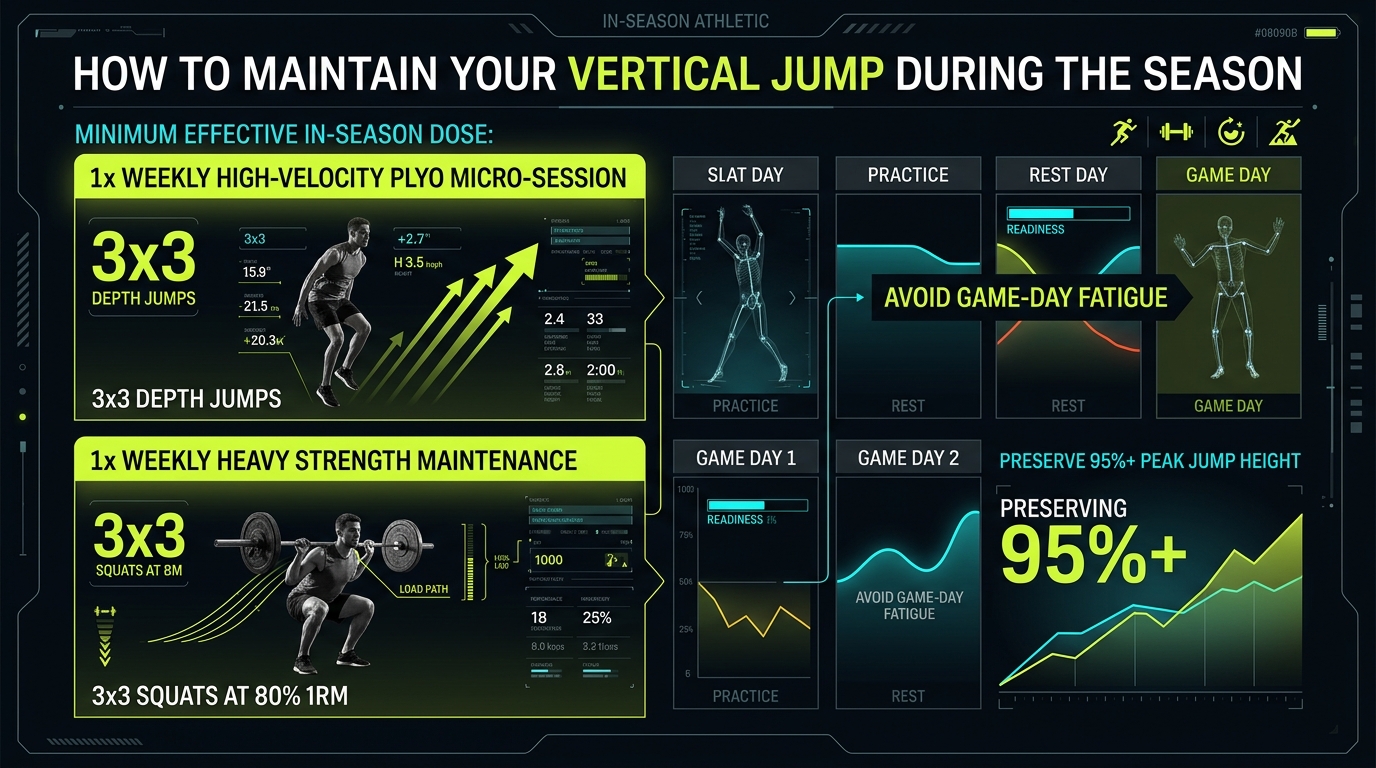
The minimum effective dose
Strength: 1–2 sessions per week of compound movements. Keep intensity above 80% 1RM, cut volume to 2–3 sets of 3–5 reps — maintain, don't chase PRs.
Plyometrics and monitoring
One plyometric session per week, low volume (30–50 contacts), moderate-high intensity, on a non-game day and more than 48 hours before competition. Test CMJ weekly — a drop over 5% means reduce volume and add recovery.
What never to do in-season
No squat PR attempts and no high-intensity plyometric spikes — the injury risk is not worth it. In-season equals maintenance; off-season equals building. Keep the goals separate.
Why intensity stays high but volume drops
Strength is maintained by high-intensity, low-volume work: compounds above 80% 1RM in 2–3 sets of 3–5 reps. Plyometrics maintain reactivity at 30–50 contacts per week. Volume is what costs recovery, so it is cut first; intensity is what preserves the quality.
Scheduling around games
Schedule hard sessions at least 48 hours before competition, avoid heavy lower-body work the day before a game, and treat the day after as recovery. Weekly CMJ monitoring tells you when the schedule is wrong before performance does.
The in-season decision rules
Four rules keep the season intact:
- CMJ drops more than 5% → cut volume and add recovery.
- Tendon or joint pain appears → skip plyometrics that week.
- Sleep is poor → reduce session intensity rather than skipping.
- Never chase PRs — the season is maintenance by design.
Key takeaways
- 1–2 strength sessions plus 1 plyo session per week is usually enough.
- Weekly CMJ is the canary: drops over 5% mean back off.
- Maintain in-season; build off-season.
- Keep intensity, cut volume — maintenance is a dose, not a workout.
- CMJ is the in-season canary: a 5% drop means back off.
Related calculators
References
- Bompa & Buzzichelli (2019) Periodization, Ch. 12
- NSCA Essentials of Strength Training and Conditioning (4th ed.), Ch. 21
- PubMed: In-season strength maintenance in team sports
Keep reading
PERIODIZATION
How to Design a Full Jump-Training Macrocycle
The 12–16 week structure: base adaptation, max strength, power conversion, then peak and test. With RPE and volume targets for each phase.
PERIODIZATION
How to Do a Deload Week (Without Losing Progress)
The three ways to deload, how often, and why performance often peaks the week after a deload — not during the hardest training.
PERIODIZATION
How to Know Whether to Add Weight or Volume
Progressive overload is the engine — but one variable at a time. Here is the double progression rule for strength and the contact rule for plyometrics.
Related exercises
Box Jump
The first-choice entry to plyometrics — the box jump teaches fast force production and coordinated landing, a cornerstone of jump training
Trap Bar Deadlift
A high-quality strength movement for jump training — research shows trap-bar deadlifts may transfer to CMJ better than conventional deadlifts, are friendlier to the lower back, and train the front and posterior chains evenly