Can You Do Plyometrics Every Day? (No — Here's Why)
The nervous system needs 48–72 hours to recover from high-intensity stretch-shortening work. Here is how to schedule it correctly.
Absolutely not. High-intensity plyometrics are some of the most demanding training you can do for the nervous system and tendons, and both need multiple days to recover.
The 48–72 hour rule is not about soreness — it is about the time the nervous system and tendons need to rebuild the capacity the session just used.
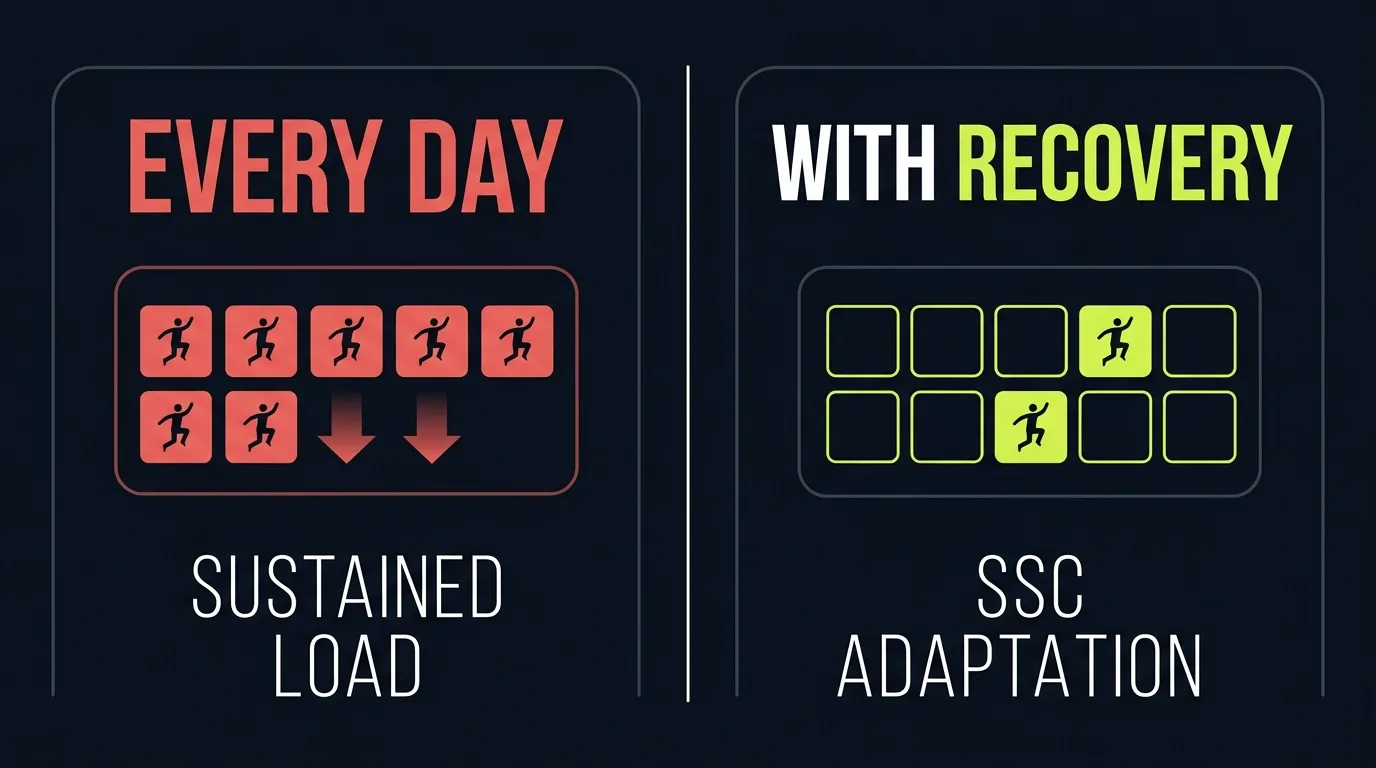
Three reasons daily plyometrics fail
The limits are physiological, not motivational:
- Nervous-system recovery: high-intensity SSC work needs 48–72 hours for CNS recovery.
- Tendon recovery: collagen synthesis in the Achilles and patellar tendons takes 36–72 hours after intense work.
- Consecutive-session risk: fatigue accumulates, landing mechanics degrade and injury risk rises exponentially.
A typical week
Keep at least 48 hours between high-intensity plyometric sessions. A workable split: Monday and Thursday high-intensity plyometrics, Tuesday and Friday strength, Wednesday and Saturday low-intensity or recovery work, Sunday full rest.
What recovery actually requires
High-intensity stretch-shortening work taxes the central nervous system and the tendons simultaneously. Collagen synthesis in the Achilles and patellar tendons peaks 36–72 hours after intense loading, and jump performance typically rebounds by day three — which is why consecutive hard days produce progressively worse output.
What daily sessions are for
Daily work is fine when it is low-intensity and technical: landing patterns, pogo jumps at low volume, ankle and foot drills. The distinction is between training plyometrics — maximal, high-load SSC work — and practicing landings, which is skill work that recovers quickly.
Signs you violated recovery
If any of these appear, the schedule — not the athlete — is the problem:
- Jump tests drop more than 5% from baseline.
- Ground contact times lengthen across sessions.
- Landings get loud or sloppy.
- Morning tendon or joint stiffness appears.
- RPE stays high even on easy days.
Key takeaways
- High-intensity plyometrics need 48–72 hours between sessions.
- Fatigued landings are where injuries happen.
- Mix intensity: two hard plyo days plus recovery days beats daily jumping.
- Daily is for low-intensity landing practice, not high-intensity plyometrics.
- If output drops across consecutive sessions, the schedule is the problem.
Related calculators
References
- Verkhoshansky & Siff (2009) Supertraining, Ch. 4
- NSCA Essentials of Strength Training and Conditioning (4th ed.), Ch. 18
- PubMed: Plyometric training frequency and vertical jump
Keep reading
PLYOMETRICS
Depth Jump Technique: The Complete Guide
Box height, step-off vs jump-off, contact time, rebound direction and the common errors that turn depth jumps from a power tool into a injury risk.
PLYOMETRICS
What Is Plyometrics? A Safe Starting Guide
The stretch-shortening cycle explained, fast vs slow SSC, the NSCA entry criteria and low-intensity progressions for beginners.
PLYOMETRICS
How to Count and Control Plyometric Contacts
Foot contacts are the real volume unit for plyometrics. Learn weekly volume by level, session math and the monitoring rules that keep jumps fast.
Related exercises
Depth Jump
The gold-standard jump exercise — the depth jump maximizes SSC (stretch-shortening cycle) use, directly raising reactive strength and jump height
Box Jump
The first-choice entry to plyometrics — the box jump teaches fast force production and coordinated landing, a cornerstone of jump training
Pogo Jump
The two-foot entry of the ankle-elasticity family — pogo jumps train Achilles stiffness and elastic-energy utilization