How Deep Should You Squat to Jump Higher?
Full, half and quarter squats each have a role in jump training. Here is how to periodize squat depth instead of choosing one forever.
The question is not whether deep or shallow squats are better for jumping — it is when to use each. Jump training rewards a periodized approach: build the base with full squats, then specialize toward the takeoff angle as competition approaches.
Here is how each squat depth fits into that plan.
The evidence supports specificity without abandoning range: deep work builds capacity, shallow work builds transfer, and the balance between them is periodized rather than permanent.
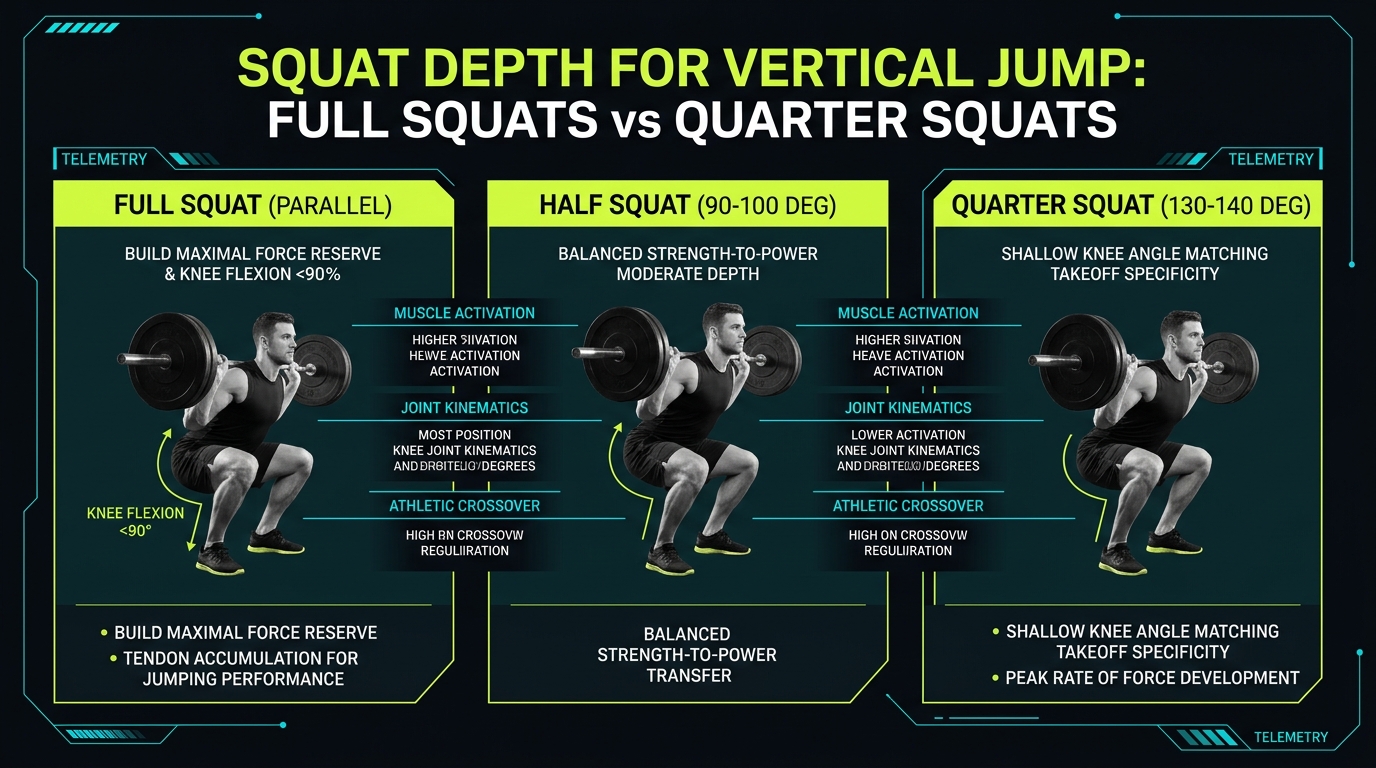
Full squat: the accumulation staple
Squatting parallel or below builds full range-of-motion strength, cross-sectional area and the max strength reserve that higher jumps depend on. This is the staple of accumulation phases and should be the majority of your squat work for the first 4–6 weeks of a block.
Quarter squat: specificity
Quarter squats (around 130–150° of knee flexion) match the takeoff angle — the knee is roughly 130–140° at takeoff — and transfer more directly to jumping. They also allow heavier loads with lower range, which is why they appear in conversion phases. They are a complement, not a replacement for full ROM work.
Half squat: the compromise
The half squat (90–100°) balances leverage and transfer. It is a useful middle zone for athletes who need heavier loading than full squats allow but want more range than quarter squats.
A practical protocol
A simple way to apply this across a 12-week block:
- Weeks 1–6: full squats as the main strength lift.
- Weeks 7–10: add quarter squats and loaded jumps for specificity.
- Weeks 11–12: peak with quarter squats and plyometrics.
- Re-test CMJ before changing the emphasis.
The evidence behind depth and transfer
Transfer to jumping is about matching the joint angles that matter at takeoff. The knee is roughly 130–140° at takeoff, which is why quarter squats are used in conversion phases: they load the exact range where the jump happens, and they allow heavier loads with less range.
Full squats earn their place differently: they build the max strength reserve and full range-of-motion control that make shallow work safe and productive. Neither depth is 'correct' alone — they serve different phases.
Loading and safety considerations
Strength blocks typically work at 70–90% of 1RM; the exact percentage matters less than control. Knees must track over the toes, the spine stays neutral, and depth is never forced at the expense of position.
If you cannot hold a controlled bottom position, the load is too heavy for that depth — reduce it or shorten the range until technique is clean.
Combining depths in one session
A practical template: full squats as the main lift (3–5 reps), quarter squats as a heavier accessory (4–6 reps at a load you could not control at full depth), then plyometrics later in the session or on a separate day.
This preserves the accumulation effect of full ROM while adding the takeoff-specific stimulus of shallow work.
Key takeaways
- Full squats build the base; quarter squats build takeoff specificity.
- Periodize depth across a block instead of picking one forever.
- Never sacrifice joint control to chase a deeper or heavier rep.
- Use full squats in accumulation phases and quarter squats in conversion phases.
- Load only what you can control at the bottom of the lift.
Related calculators
References
- Verkhoshansky & Siff (2009) Supertraining, Ch. 3
- Hartmann et al. (2012) Sports Med
- NSCA Essentials of Strength Training and Conditioning (4th ed.), Ch. 18
Keep reading
TRAINING METHODS
How Many Jump Training Sessions Per Week Do You Actually Need?
Training frequency by experience level, safe plyometric contact volume, and the warning signs that tell you to cut back.
TRAINING METHODS
How to Split Strength and Plyometric Training
Combined strength and plyometric training beats either alone. Here are the phase ratios, same-day ordering rules and common mistakes.
TRAINING METHODS
Can Bodyweight Training Improve Your Jump?
Yes for absolute beginners — then it hits a ceiling. Here is where bodyweight work fits and when you must add load.
Related exercises
Barbell Back Squat
The king of strength training and an irreplaceable foundation movement for jump training
Barbell Front Squat
With the bar on the clavicles and front delts and elbows high, squat with a more upright torso
Goblet Squat
The best first squat for jumping — the goblet squat teaches the correct pattern (upright torso, braced core) as a foundation for barbell squats and jumping