Can Bodyweight Training Improve Your Jump?
Yes for absolute beginners — then it hits a ceiling. Here is where bodyweight work fits and when you must add load.
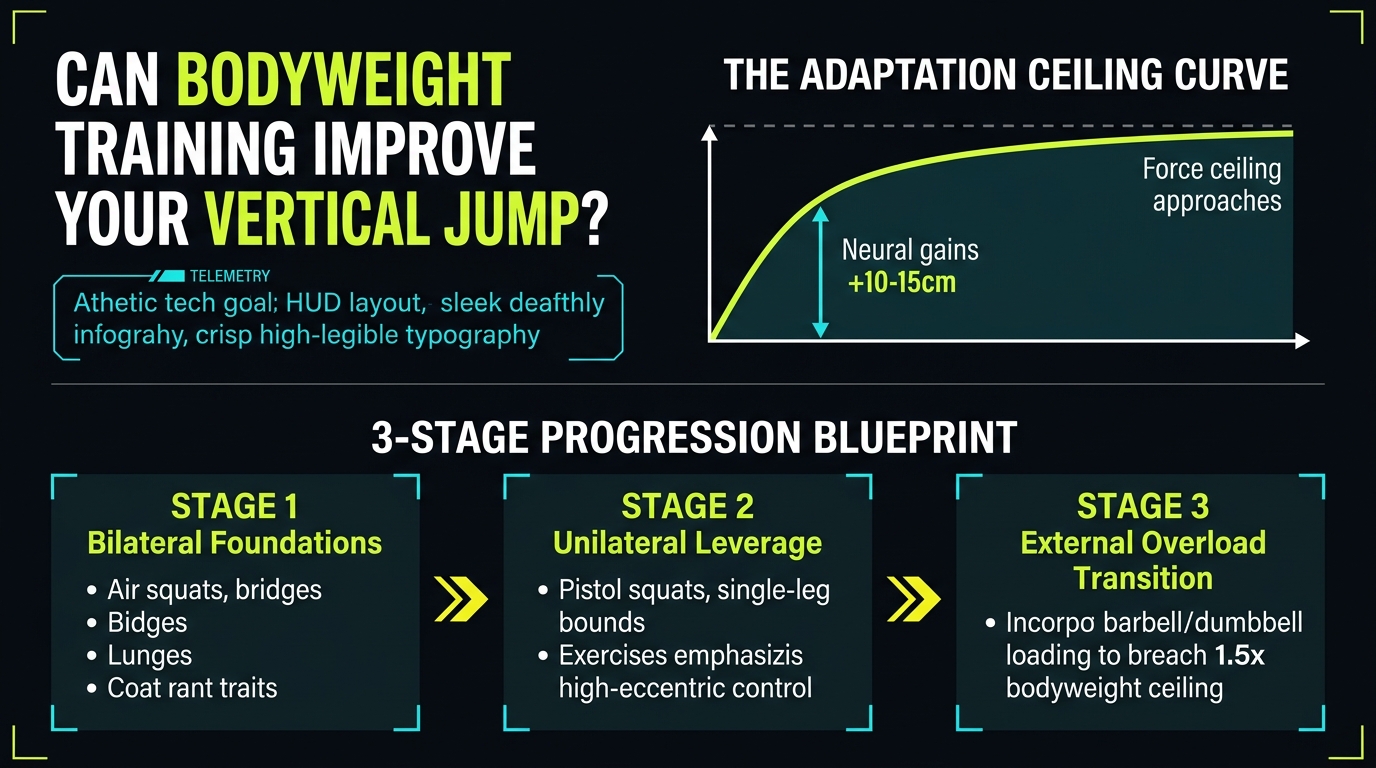
Bodyweight training can add 10–15 cm to a complete beginner's jump — mostly through neural adaptation. But it has a clear ceiling, and knowing where that ceiling is saves you months.
The distinction is progression: bodyweight is a ceiling only when it stops being a stimulus. For an untrained athlete it is a stimulus; for a trained athlete it is maintenance.
The beginner window
In the first months, bodyweight work improves motor-unit recruitment and basic strength, which is exactly what an untrained jumper needs. That is where the 10–15 cm comes from.
The ceiling
Beyond beginner level, jumping needs force levels far beyond bodyweight stimuli. Intermediate and advanced athletes hit a bottleneck and must add external load — barbell or dumbbell work — to keep strength rising.
Where bodyweight still belongs
Bodyweight movements remain excellent as supplements: warm-up activation, single-leg variations like pistol squats and single-leg bridges, and rehab work. They raise intensity without equipment, but they cap out as a primary strength stimulus.
Why beginners respond
Untrained individuals gain strength from low-load work because early gains are neural: better recruitment and coordination, not new muscle. Bodyweight squat programs measurably improve knee strength in sedentary populations within weeks — the same mechanism that produces 10–15 cm of early jump gain.
The overload math
Jumping requires force levels far beyond bodyweight stimuli — plyometric gains are limited below roughly a 1.5x bodyweight squat. External load is what allows progressive overload past the bodyweight ceiling: adding load keeps relative strength climbing, and relative strength is what predicts jump height.
A bodyweight-first program
If equipment is unavailable, structure the bodyweight phase deliberately:
- Weeks 1–4: movement patterns and bodyweight strength — squats, lunges, single-leg bridges, calf raises.
- Weeks 5–8: progress single-leg variations — pistol squats, split squats, single-leg jumps.
- Weeks 9–12: add external load where available, or accept that further gains require equipment.
- Re-test CMJ at each phase boundary.
Key takeaways
- Beginners can gain 10–15 cm from bodyweight work alone.
- Intermediates need external load to keep progressing.
- Use bodyweight as a supplement, not a replacement for loaded strength work.
- Bodyweight is a phase, not a destination.
- Progress single-leg variations before expecting more jump height.
Related calculators
References
- NSCA Essentials of Strength Training and Conditioning (4th ed.), Ch. 18
- Verkhoshansky & Siff (2009) Supertraining, Ch. 7
- Scientific Reports: Bodyweight squat training in sedentary women (2023)
Keep reading
TRAINING METHODS
How Many Jump Training Sessions Per Week Do You Actually Need?
Training frequency by experience level, safe plyometric contact volume, and the warning signs that tell you to cut back.
TRAINING METHODS
How Deep Should You Squat to Jump Higher?
Full, half and quarter squats each have a role in jump training. Here is how to periodize squat depth instead of choosing one forever.
TRAINING METHODS
How to Split Strength and Plyometric Training
Combined strength and plyometric training beats either alone. Here are the phase ratios, same-day ordering rules and common mistakes.
Related exercises
Goblet Squat
The best first squat for jumping — the goblet squat teaches the correct pattern (upright torso, braced core) as a foundation for barbell squats and jumping
Walking Lunge
Highly specific to the single-leg drive of jumping — lunges build single-leg strength and dynamic stability, directly improving single-leg takeoff
Bulgarian Split Squat
Rear foot elevated on a bench, front foot forward, weight on the front leg, lower until the front thigh is parallel