How to Split Strength and Plyometric Training
Combined strength and plyometric training beats either alone. Here are the phase ratios, same-day ordering rules and common mistakes.
The meta-analytic evidence is clear: combined strength and plyometric training produces better vertical jump results than either modality alone. The real question is how to split them across the week and the training block.
This article turns that evidence into a weekly structure: which days carry strength, which carry plyometrics, and how the ratio shifts across a 12-week block.
Why combined training wins
Strength training raises the ceiling — the force your muscles can produce. Plyometrics improves the floor-to-ceiling conversion — how fast and how much of that force reaches the ground. Training only one side leaves the other as your limiting factor.
Phase ratios
A proven way to shift emphasis as a block progresses:
- Base adaptation (weeks 1–4): strength 75% / plyo 25%, low-intensity entry.
- Max strength (weeks 5–8): strength 65% / plyo 35%.
- Power conversion (weeks 9–12): strength 40% / plyo 60%.
- Peak / in-season (week 13+): strength 30% / plyo 70%.
Same-day ordering
When strength and plyometrics share a day, put strength in the morning and plyometrics in the afternoon with at least 6 hours apart, or use separate days. Never run plyometrics immediately after heavy strength — fatigue destroys movement quality and raises injury risk.
Common mistakes
The split fails most often for three reasons:
- Plyometrics performed fatigued, turning power work into sloppy conditioning.
- Strength volume so high that recovery is gone before the plyometric session.
- No phase structure — the same ratio all year leaves no periodization.
What the meta-analyses show
Sánchez-Sixto and colleagues (2021) confirmed that combined strength and plyometric training beats either modality alone for vertical jump. More recent network meta-analyses extend the finding: combined resistance and plyometric programs also outperform isolated training for sprint performance.
The practical implication is not just 'do both' — it is that the two qualities reinforce each other, so the split should be deliberate rather than whatever fits the schedule.
A weekly split template
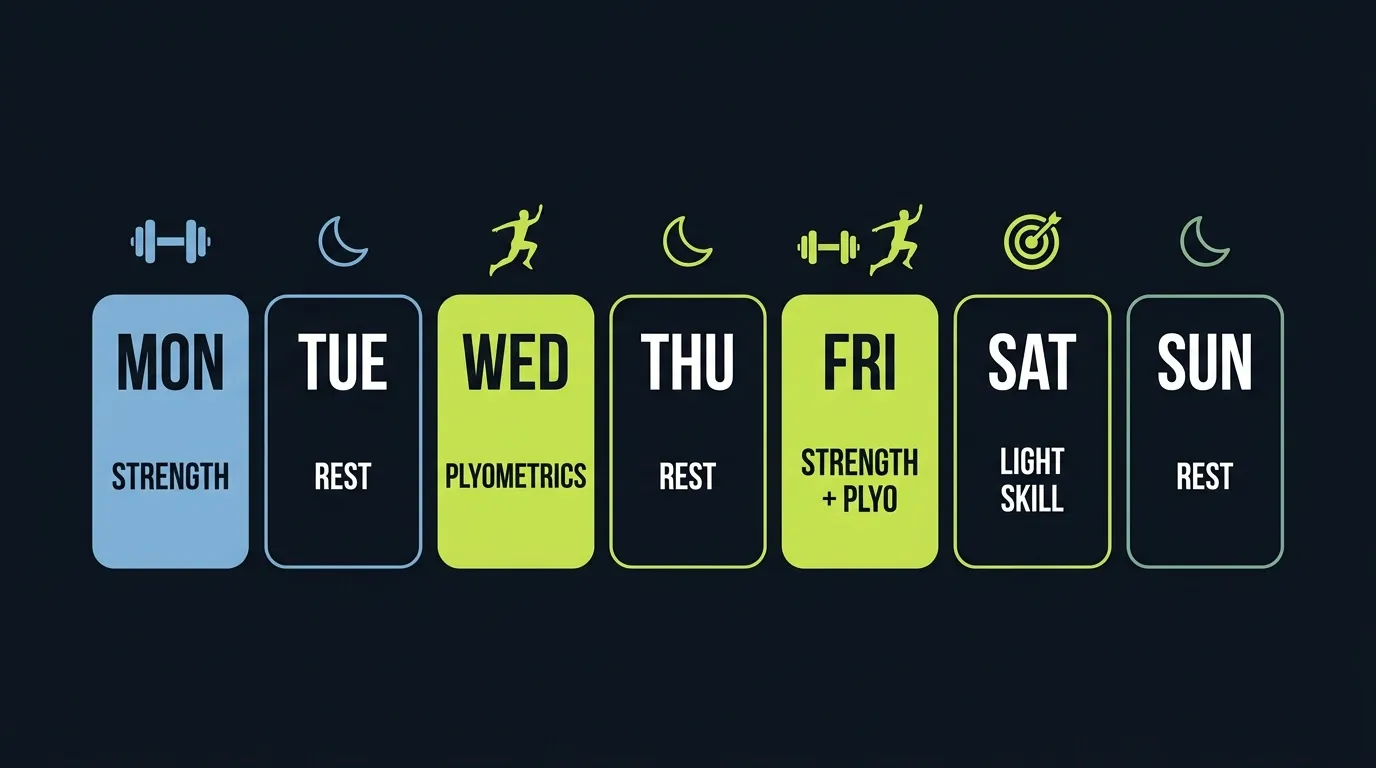
A workable five-day structure with 48 hours between hard plyometric sessions:
- Monday: lower-body strength (full squats, deadlift variations).
- Tuesday: moderate plyometrics (box jumps, hurdle hops).
- Wednesday: recovery or low-intensity conditioning.
- Thursday: lower-body strength (emphasis can shift to quarter squats later in the block).
- Friday: high-intensity plyometrics (depth jumps, loaded jumps) after at least 6 hours from any heavy strength.
Adjusting the ratio to your weakness
If an F-V profile shows a force deficit, keep the strength emphasis longer — the 65/35 ratio can extend through week 10. If it shows a velocity deficit, shift toward plyometrics earlier.
Re-test at the end of the block and let the next block's ratio follow the diagnosis rather than a fixed template.
Key takeaways
- Combine strength and plyometrics; neither alone maximizes jump height.
- Shift the ratio from strength-dominant to plyo-dominant across a 12-week block.
- Keep plyometrics fresh: separate them from heavy strength by 6+ hours or put them on different days.
- Combined training outperforms either modality alone in the meta-analytic evidence.
- Re-test and let the ratio follow your diagnosed deficit.
Related calculators
References
- Sánchez-Sixto et al. (2021) Sports Med
- NSCA Essentials of Strength Training and Conditioning (4th ed.), Ch. 18
- Verkhoshansky & Siff (2009) Supertraining, Ch. 7
- Network meta-analysis: combined resistance and plyometric training (2026)
Keep reading
TRAINING METHODS
How Many Jump Training Sessions Per Week Do You Actually Need?
Training frequency by experience level, safe plyometric contact volume, and the warning signs that tell you to cut back.
TRAINING METHODS
How Deep Should You Squat to Jump Higher?
Full, half and quarter squats each have a role in jump training. Here is how to periodize squat depth instead of choosing one forever.
TRAINING METHODS
Can Bodyweight Training Improve Your Jump?
Yes for absolute beginners — then it hits a ceiling. Here is where bodyweight work fits and when you must add load.
Related exercises
Jump Squat
The most direct vertical-power entry — explode from a shallow squat, then reorganize your posture after landing
Barbell Jump Squat
Loaded speed-strength training — with a light barbell, convert the squat pattern into maximal takeoff speed
Box Jump
The first-choice entry to plyometrics — the box jump teaches fast force production and coordinated landing, a cornerstone of jump training