How Much Do Height, Weight and Skeleton Matter for Jumping?
Training level explains 60–80% of jump performance. Height matters far less than relative strength and body composition.
Taller, lighter, longer-limbed athletes have advantages — but the research weights training far above body structure. Here is the honest factor ranking.
The ranking is not about denying physical advantages — it is about where to spend your training hours. Structure is the smallest lever, and training is the largest.
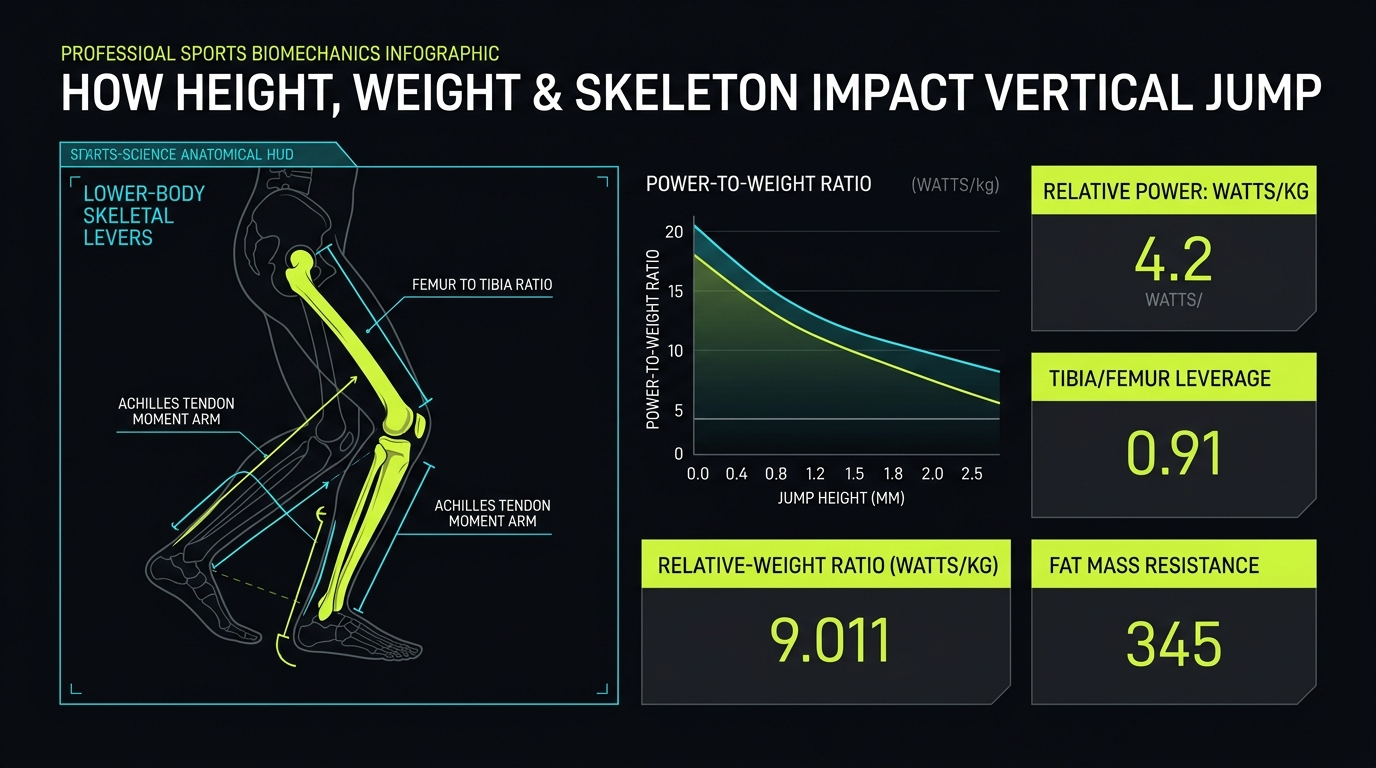
The factor ranking
In rough order of importance:
- Training level (60–80%): the largest controllable variable.
- Relative strength (strength ÷ bodyweight): predicts jump better than absolute strength.
- Body composition: as a rough guide, meaningful fat loss while strength is preserved is often associated with several cm of CMJ improvement — but the exact amount per kg varies widely by athlete.
- Limb ratios: longer legs theoretically allow longer force application but add rotational inertia.
- Absolute height: real but not decisive.
The height counterexample
Nate Robinson — 1.7 m with a ~110 cm vertical — is the standard proof that height is not the bottleneck. What separates jumpers is training and relative strength, not centimeters of stature.
Relative strength as the mediator
Maximal squat strength correlates strongly with vertical jump performance in elite athletes, and relative strength (strength per kilogram of bodyweight) predicts jump height better than absolute strength.
That is the controllable path: improve relative strength and the body-structure factors matter less at every level below the genetic ceiling.
Body composition and the fat-loss rule
Fat loss only helps jumping while strength is preserved. The effect is not a fixed number: some athletes gain several cm as they get leaner, others change little, and excessive cutting can cost more jump height than it adds. So body-composition work must protect lifting performance.
What limb length actually does
Relatively longer legs theoretically allow a longer force application, but they also add rotational inertia. In practice, technique and strength dominate the equation, and individual differences in proportions do not justify not training.
Key takeaways
- Training is the biggest lever by a wide margin.
- Relative strength beats absolute strength as a predictor.
- Optimize training and recovery before blaming your skeleton.
- Improving relative strength is the highest-leverage change available.
- Fat loss only helps while strength is preserved.
Related calculators
References
- NSCA Essentials of Strength Training and Conditioning (4th ed.), Ch. 2
- Verkhoshansky & Siff (2009) Supertraining, Ch. 3
- PubMed: Maximal squat strength and vertical jump in elite soccer players
- Markovic & Jaric (2007) J Strength Cond Res
Keep reading
BODY FACTORS
Does Age Affect Jump Training?
The training priorities change across decades — neural plasticity for youth, recovery management for masters — but it is never too late to start.
BODY FACTORS
Do Flat Feet Hurt Your Jump? Shoe Choices Explained
A flattened arch weakens the spring effect — but it is not decisive. Foot training, shoe choice and calf flexibility all matter more.
BODY FACTORS
What Bodyweight Is Best for Jumping? (And Should You Cut?)
The answer is relative strength, not a scale number. Here is the math that decides whether you should lose fat or build strength first.