Does Age Affect Jump Training?
The training priorities change across decades — neural plasticity for youth, recovery management for masters — but it is never too late to start.
Age changes what you should emphasize, how hard you can push and how much recovery you need — but it does not close the door on jumping.
The age bands below are starting points, not limits: the principles — progressive loading, technique first, managed recovery — apply at every age.
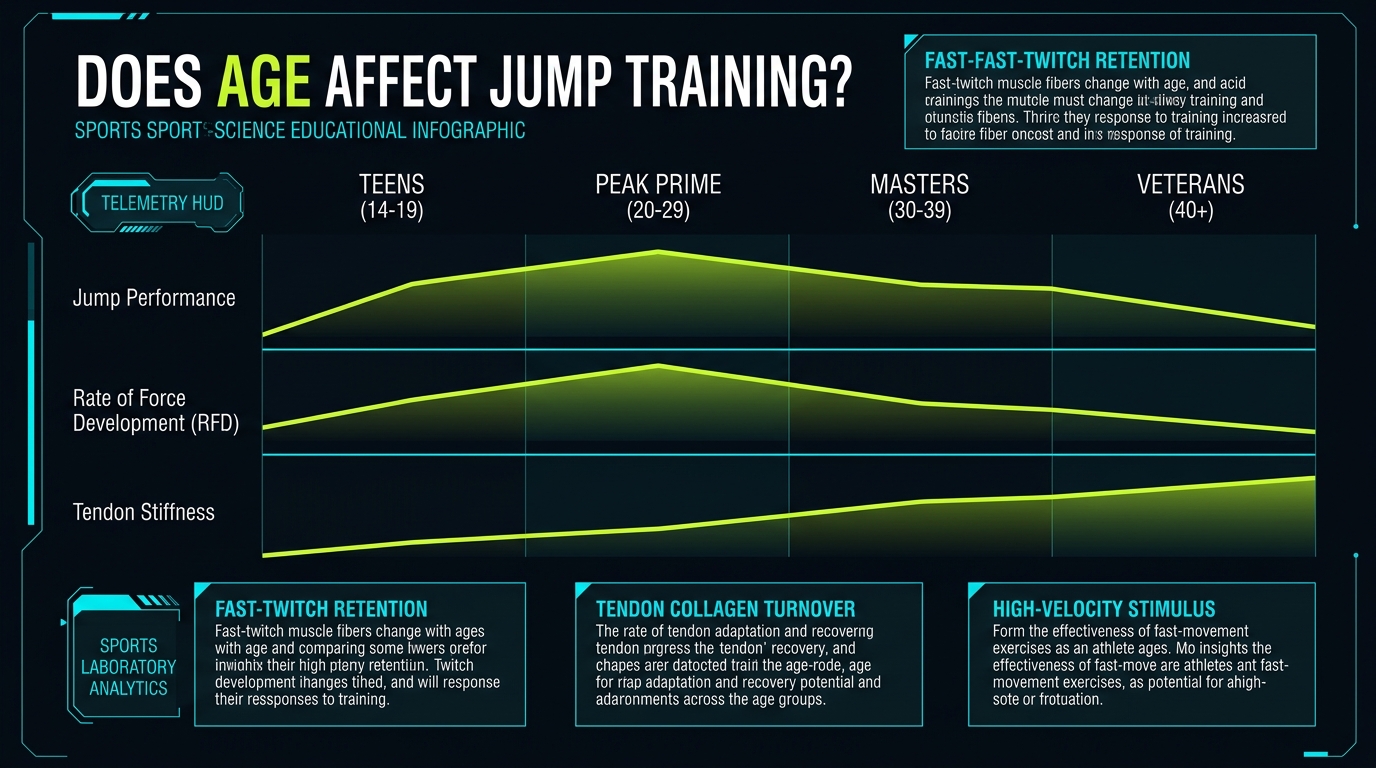
Priorities by age band
A practical map:
- Youth (13–18): the best window for neural plasticity — prioritize movement patterns, coordination and technique. Strength training is safe; avoid maximal loads above 85% 1RM and keep plyometrics low-intensity.
- Prime (18–30): high testosterone and recovery capacity — can handle high-intensity strength and plyometrics.
- Mature (30–40): recovery slows — schedule more recovery days and make strength training matter more.
- Senior (40+): focus on maintenance over breakthroughs — strength preserves muscle and bone density; plyometrics stay low-intensity.
The never-too-late part
Every decade responds to training. The goals and intensities change, but the principle does not: progressive, well-recovered training improves jumping at any age.
Why youth respond so well
The teenage years are a window of neural plasticity, which is why technique and coordination gains come fast. Youth resistance training is safe and beneficial under supervision — the NSCA position statement and the 2014 International Consensus both support it — with the caveat of avoiding maximal loads and keeping plyometrics low-intensity.
The 30+ recovery equation
From the thirties onward, recovery capacity declines before strength does: schedule extra recovery days, and let strength training become relatively more important because it maintains the force output the jump depends on. Sleep also becomes a bigger lever as recovery windows shrink.
Training principles that never age
Regardless of the decade, these rules hold:
- Progress loads gradually.
- Technique before load, always.
- Manage fatigue with recovery days.
- Re-test regularly to keep the program honest.
- At 40+, prioritize strength maintenance to preserve muscle and bone.
Key takeaways
- Youth: technique and coordination first, no max loads.
- 30+: recovery becomes the limiting factor — plan for it.
- 40+: strength maintenance is the priority.
- Youth gains come fast through neural plasticity; adult gains come through patience and recovery.
- Strength maintenance at 40+ protects the jump you already have.
Related calculators
References
- Faigenbaum et al. (2009) J Strength Cond Res
- NSCA Long-Term Athletic Development Position Statement
- Position statement on youth resistance training: 2014 International Consensus
Keep reading
BODY FACTORS
How Much Do Height, Weight and Skeleton Matter for Jumping?
Training level explains 60–80% of jump performance. Height matters far less than relative strength and body composition.
BODY FACTORS
Do Flat Feet Hurt Your Jump? Shoe Choices Explained
A flattened arch weakens the spring effect — but it is not decisive. Foot training, shoe choice and calf flexibility all matter more.
BODY FACTORS
What Bodyweight Is Best for Jumping? (And Should You Cut?)
The answer is relative strength, not a scale number. Here is the math that decides whether you should lose fat or build strength first.
Related exercises
Goblet Squat
The best first squat for jumping — the goblet squat teaches the correct pattern (upright torso, braced core) as a foundation for barbell squats and jumping
Single Leg Box Jump
Highly specific single-leg jump training — trains single-leg takeoff, stable box landings and left/right power differences; suits basketball layups, volleyball approach jumps and more