Do Flat Feet Hurt Your Jump? Shoe Choices Explained
A flattened arch weakens the spring effect — but it is not decisive. Foot training, shoe choice and calf flexibility all matter more.
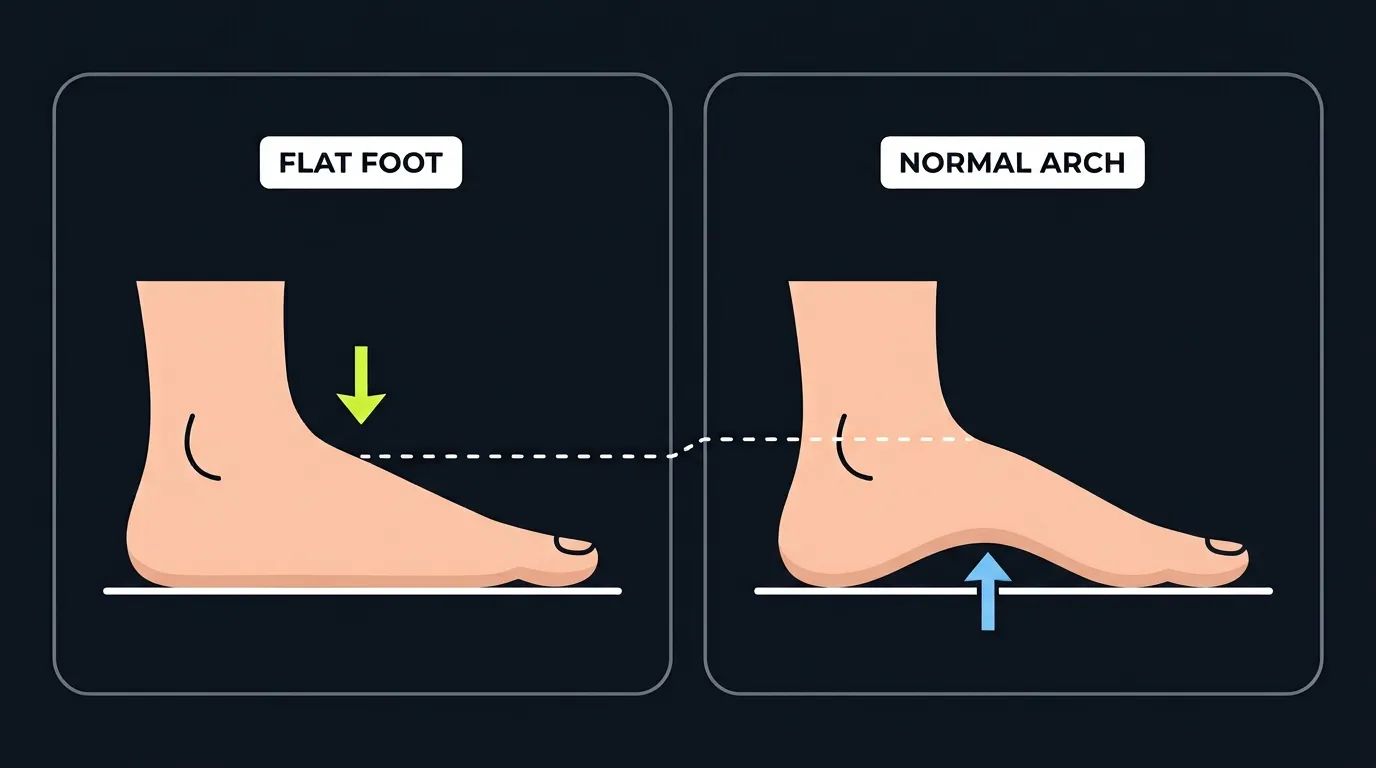
A normal arch acts like a spring during jumping: it collapses on landing to store energy and rebounds on push-off. A flattened arch weakens that effect by roughly 5–10% — real, but far from decisive.
The arch is one component of a spring system that includes the Achilles, ankle and foot intrinsics. Weakness anywhere in the chain can mimic flat-foot limitation — which is good news, because the chain is trainable.
Improvement strategies
What actually helps flat-footed jumpers:
- Foot intrinsic training: short-foot exercise, towel curls, barefoot walking on sand.
- Shoe choice: flat, firm soles (e.g. Nike Metcon, Reebok Nano); avoid soft running shoes.
- Orthotics: only if function is clearly limited.
- Calf flexibility: flat feet often accompany a tight soleus.
The perspective check
Many elite athletes have flat feet. The arch is one input in a system that includes strength, technique and reactivity — train the system and the arch stops being the excuse.
The arch spring in numbers
During landing the arch flattens to store elastic energy, then rebounds on push-off. A flattened arch reduces that energy return by roughly 5–10% — meaningful in a sport decided by centimeters, but smaller than the training effect you can add elsewhere.
Systematic reviews of short-foot training show improvements in intrinsic foot muscle strength and arch posture, though effect sizes are modest — which is why foot work is one lever, not the whole plan.
A foot-strengthening protocol
A practical weekly addition for flat-footed jumpers:
- Short-foot exercise: 3×10–15 reps daily.
- Towel curls: 3×20 reps.
- Barefoot walking on varied surfaces (grass, sand).
- Single-leg balance work to train the whole chain.
- Soleus/calf stretching to address accompanying tightness.
Choosing shoes and orthotics
For jumping and lifting, choose flat, firm soles such as weightlifting or cross-training shoes — soft running shoes compress under landing loads and delay force transfer. Running shoes with cushioning belong on runs, not in jump sessions.
Orthotics help only when function is clearly limited; test them by whether landing control improves, not by how they feel in the store.
Key takeaways
- Flat feet cost some elastic return but are not decisive.
- Train the foot intrinsics and keep the soleus flexible.
- Train in flat, firm-soled shoes, not soft running shoes.
- Improve the whole chain: intrinsics, calf flexibility, single-leg control.
- Shoes for jumping: flat and firm. Shoes for running: cushioned.
Related calculators
References
- McKeon et al. (2015) Br J Sports Med
- Headlee et al. (2009) J Orthop Sports Phys Ther
- PubMed: Short foot training and flatfeet meta-analysis (2024)
Keep reading
BODY FACTORS
How Much Do Height, Weight and Skeleton Matter for Jumping?
Training level explains 60–80% of jump performance. Height matters far less than relative strength and body composition.
BODY FACTORS
Does Age Affect Jump Training?
The training priorities change across decades — neural plasticity for youth, recovery management for masters — but it is never too late to start.
BODY FACTORS
What Bodyweight Is Best for Jumping? (And Should You Cut?)
The answer is relative strength, not a scale number. Here is the math that decides whether you should lose fat or build strength first.
Related exercises
Single Leg Balance
The foundation for preventing the #1 jump injury (ankle sprain) — single-leg balance rebuilds proprioception and ankle stability, the safety prerequisite for all single-leg jumps
Star Excursion Balance
Dynamic balance closer to real landings than single-leg standing
Ankle Alphabet Drill
The pre-training ankle activator — alphabet drills cover every ankle movement direction, warming up for the complex ankle actions of jumping